Thursday, August 9, 2018

Winemaker's CUT: a moment in time


Photo: Michal Mosny

The Winemaker’s CUT label wines, formerly released along with the wines of Lunessence Winery & Vineyard in Summerland, now stand on their own.

The label is owned by Michal and Martina Mosny. He is also the winemaker for Lunessence.

The two wines under the Winemaker’s CUT label are small-lot, single vineyard wines. “Like a director’s cut, an edited version of a film that represents the director’s unique point of view, Winemaker’s CUT is the winemaker’s unique styling/blending of an Okanagan wine,” Michal explains in the brochure accompanying the current releases.

The wines – a Sauvignon Blanc and a Syrah – are from the Deadman Lake Vineyard, midway between Oliver and Osoyoos. “The terrain is rich in minerals, sulphur and natural elements, in heavy concentration, that is exclusive to the Okanagan valley and evident in our wines,” Michal adds.

Michal, who was born in Slovakia in 1982, lives and breathes classical music. “In Slovakia, I had a small garage winery next to a village where Beethoven used to go,” Michal says. “He wrote Für Elise there.”

In 2011, Michal and his wife, Martina, emigrated to the Okanagan. He set up a vineyard management company; that led to him being recruited in 2014 to manage Lunessence and its six-and-a-half-acre vineyard. Here, speakers among the vines play classical music. It also plays in the cellar. Michal would have you believe it benefits the wines. It certainly does them no harm.

“There are a lot of studies about how music impacts the plants,” Michal says. “I did a lot of research about it. I think there is something. I can see something in the wines, that they have a different integrity. I think they are happier. With classical music, every single instrument produces some emotions.”

He continues: “When we ferment white wines, usually it is opera we are listening to, to bring some stories into the wines. White wines are usually fermented to Giuseppe Verdi. When the reds come into the cellar, we switch to Puccini. It is fun when you are listening to Puccini and there is some tragedy and you are doing punch downs …”

The Winemaker’s CUT wines are described as “a moment in time captured, cut from the vineyard vine.”

Here are notes on the releases.

Winemaker’s CUT Sauvignon Blanc 2017 ($25 for 180 cases). This wine is fermented both in barrel and in stainless steel, with 20% aged in barrel. It begins with aromas of herbs and grapefruit. On the palate, there are luscious tropical flavours of grapefruit and grapefruit rind with a twist of lime and a backbone of minerals. 91.

Winemaker’s CUT Syrah 2016 ($32 for 260 cases). This wine has acquired a smoky/toasted oak note after aging for 10 months in a variety of barrels. It also has aromas of plum, fig and pepper that are also reflected in the flavours. Long, ripe tannins give the wine a fullness on the palate while appropriate acidity adds freshness to the fruit. 92.


Monday, August 6, 2018

Free agency and ownership changes in the BC wine industry


Photo: Retiring Foxtrot owners Torsten and Kicki Allander

It would not be a summer without major changes in winemakers and in ownership in the British Columbia wine industry.

The shifting around of winemaking talent this year resembles free agency in the NHL, with wineries adding or replacing bench strength.

The biggest ownership change was the recent announcement that Torsten and Kicki Allander, the founders of Foxtrot Vineyards, are retiring. The new owners of this Naramata Bench Pinot Noir specialist are Douglas Barzelay, an authority on the wines of Burgundy and co-author of a forthcoming book, Burgundy Vintages – A History from 1844, and Nathan Todd, an entrepreneur focused on wine with longstanding ties to the Okanagan Valley.

A Manhattan lawyer, Barzelay is a long time expert Burgundy collector. A decade ago, he was one of the Burgundy collectors who blew the whistle on Rudy Kurniawan’s massive counterfeiting of rare old Burgundies. Todd is a former Calgarian. Interested in producing wine in the Okanagan, he and his family had already purchased an orchard adjacent to the seven-acre Foxtrot vineyard. It is being added to the property, with about 3.5 acres scheduled to be planted to vines next year.

The statement from Foxtrot added: “Gustav Allander (right), the long time winemaker at Foxtrot, will continue to be in charge of viticulture and winemaking and the new owners expect there to be no significant changes at the winery.”

Foxtrot Winery, which opened in 2007, was launched after Torsten and Kicki bought an established Pinot Noir vineyard on the Naramata Bench in 2002. Torsten arranged to have another winery make the debut Foxtrot vintages in 2004 to determine whether a world-class Pinot Noir could be produced.

After three vintages told him the answer was yes, he built a winery and enlisted Gustav, his son, as the winemaker. His daughter-in-law, Nadine, after studying winemaking in New Zealand, also had a hand in Foxtrot’s early vintages. (She is now a winemaker at Time Estate Winery in Penticton.)

The Foxtrot portfolio, which also includes Chardonnay, has one of the most stellar international reputations in the BC wine industry. The winery produces about 2,000 cases a year.


There have been at last half a dozen winemaker changes or promotions so far this year, with more to come.

In June, Andrew Peller Ltd. promoted Sandy Leier (right) to lead winemaker at Sandhill Wines, succeeding Howard Soon who retired last year. Born in Kelowna in 1978, she joined the Calona Vineyards winemaking team in 2006 after earning a chemistry degree at UBC Okanagan. Since then, she has been the lead winemaker for both the Calona and Wayne Gretzky Okanagan labels.

Peller has owned Calona and Sandhill since 2005. The Calona name now has been phased out, replaced by Conviction Wines.

In June, Nikki Callaway (left) moved from Quails’ Gate Estate winery to Laughing Stock Vineyards.

Born in Calgary in 1982, Nikki is the daughter of a physician who worked for many years in Saudi Arabia and Dubai. Nikki lived in Saudi Arabia for 10 years until she was 14 and had completed elementary school. At that point, her family moved to Dubai so she could complete high school.

She came back to Canada f0r a bachelor’s degree in microbiology at the University of Victoria. She had not mapped out a career path although she was interested in wine. “Dad talked me out of medicine,” she recalls. “He thought I would have more fun drinking wine.”

So she went to Beaujolais in 2004 and picked grapes for two months while checking out French wine schools. She chose the University of Bordeaux and graduated in 2007 with a Diplôme National d’Oœnologue (in spite of a chauvinist professor who kept trying to make her cry).

The winemaking program included hands-on cellar work in French wineries. Upon graduating, she worked about five months in a French winemaking co-operative. Then she went to South Africa to do a crush there before returning to France for another crush at a Loire winery.

She might have stayed in France but she could not get a work visa. So she returned to Canada in 2009 where Mission Hill offered her a four-month job. “It turned out to be four years,” she said later. In 2010, she moved to Quails’ Gate, where she had a major impact by enlarging the portfolio with an array of super-premium wines.

Quails’ Gate has just announced that Ross Baker (left), who had been Nikki’s assistant since 2013, has been promoted to winemaker.

“A native of Kelowna, Ross completed his Bachelor of Science in Wine at the University of British Columbia Okanagan,” the winery said. “Ross previously worked at Villa Maria Estates in Marlborough, New Zealand and also held positions locally at both Red Rooster Winery and Kettle Valley Winery.”

Quails’ Gate also announced the appointment of Kailee Frasch in the role of Oenologist. Kailee started at the winery in 2016. She holds a Bachelor of Science in Microbiology from the University of British Columbia Okanagan, and a Certificate in Grape and Wine Technology from Brock University.

As well, Quails’ Gate is finalizing the appointment of a director of winemaking operations. That individual will oversee both Quails’ Gate and the Stewart family wineries in Sonoma.

On the Naramata Bench, Jacqueline Kemp (left) moves from Moraine Vineyards to take over in September as the winemaker at Therapy Vineyards. Now 42, Jacq  was born in New Zealand. Because her father was a New Zealand diplomat, she grew up in Europe, primarily in Belgium, and was exposed to European wine regions.

At university in New Zealand, she did an honours degree in animal and human nutrition before recognizing that wine was her passion. In 2000 she got a winemaking degree at Lincoln University. Her career in New Zealand started with highly-regarded Sacred Hill Winery in Hawkes Bay and continued with the equally highly regarded Akarua Winery, a notable Pinot Noir specialist in the Central Otago region on New Zealand’s south island.

She came to Canada in 2008 when Chris Carson, now her former husband, was recruited by Meyer Family Vineyards at Okanagan Falls. Initially busy raising her family, she also consulted with several wineries before joining Moraine in 2012.

Moraine’s owners, Oleg and Svetlana Aristarkhov, have just announced that Dwight Sick (right), formerly of Stag’s Hollow Winery, is the new Moraine winemaker. He takes over just as Moraine completes its new 15,000-square-foot production facility.

Born in Edson, Alberta, Dwight developed an interest in wine during 19 years as a flight attendant. After accepting an Air Canada retirement package, he came into the Okanagan wine industry in 2004 as a cellar hand at Township 7 Vineyards & Winery, quickly developing into one of the valley’s most accomplished winemakers. He joined Stag’s Hollow in 2008.

His
successor at Stag’s Hollow is Keira LeFranc (left). The winery offers this biographical note on her. “Keira LeFranc grew up in the Okanagan and got her start in the wine industry in our tasting room as her summer job in 2012. Showing an interest in the cellar side of things, after completing a science degree in 2013, she jumped at the opportunity to join our vintage team on the crush pad in 2013.

“Now more passionate about wine and winemaking, Keira spent 2 years training and working as a Sommelier in Australia however she discovered she missed getting her hands dirty in the cellar. So again, she joined our vintage crew in 2015, and then left to complete a Postgraduate Diploma of Wine Science in New Zealand. We are happy to have her back permanently, working hard in the cellar to help create our wines.”

In July, Graham Pierce (right), the winemaker at Black Hills Estate Winery since 2008, moved to Harry McWatters’s Time Estate Winery in Penticton. There, he teams with Nadine Allander, who was also promoted to winemaker from assistant winemaker.

Born in Vancouver in 1971, Graham came into wine through an early career in food service. He came to the Okanagan to work at the Summerhill winery restaurant. When an interest in wine took precedence, he became a cellar hand at Mt. Boucherie Estate Winery. There, he was mentored by Dr. Alan Marks, then the winemaker, before immersing himself in winemaking courses at Okanagan University College. Graham came winemaker at Mt. Boucherie in 2003, moving to Black Hills five years later where he succeeded Senka Tennant.

Nota Bene was already a cult wine when Graham took over there. Even so, several of his major winemaking decisions raised the bar further with Nota Bene. One was increasing the barrel-aging of the blend from one year to 18 months.

Black Hills, which was acquired last year by Andrew Peller Ltd., expects to announce its new winemaker within a few weeks, capping a busy summer for winemaker appointments in British Columbia.


Friday, August 3, 2018

Kitsch gains its cult


Photo: Kitsch winemaker Grant Biggs


Kitsch Wines in Kelowna, now in its third year, seems to have acquired a cult following.

Consumers have taken to travelling with Kitsch wines and posting photographs from exotic locales where the bottles have been enjoyed. These range from a safari in Africa to the Eiffel Tower in Paris; to a surfing beach in Australia and to numerous vacation spots across the United States.

“And people are doing it on their own, which is really special,” says Kitsch winemaker Grant Biggs.
You bet it is. With a burgeoning number of wineries in the Okanagan, it is not easy to stand out, never mind inspire your fans to traipse the bottles around the world.

Perhaps some consumers just think the label is quaint– not realizing that Kitsch is the family name of the owners, Trent and Ria Kitsch. More probably, the quality of the wine itself is the reason why devoted fans want to take a bottle or two half way around the world. Most of this winery’s peers would die for this kind of following.

The winery is on a plateau in northeastern Kelowna, surrounded by 12.7 acres of vines that were planted in 2013 and 2014. Trent and Ria launched the winery with the proceeds from the development and then sale of the SAXX brand of men’s briefs.

The wines initially were cellared in the three-car garage attached to the home of Trent’s parents, Bruce and Esther Kitsch. The tasting facilities were informal, while the owners monitored whether their venture would succeed. And succeed it did: a debut Kitsch Riesling even won a Lieutenant Governor’s Award of Excellence.

With Kitsch Wines here to stay, the three-car garage has been converted into a dedicated tasting room. Preparations are under way to build a processing facility on the property. A new press and relating winemaking equipment should arrive any day from Italy. The winemaker expects to produce at least 3,000 cases of wine this year.

The winery is just one of the businesses that Trent and Ria run. Serial entrepreneurs, they also operate a publicly-traded cannabis company. Ria suggests there is some overlap between the two businesses in that both wine and cannabis are heavily regulated.

(Two other Okanagan vintners also have invested in the cannabis business: Poplar Grove’s Tony Holler and Tantalus’s Eric Savics. In all instances, the cannabis business is entirely separate from the wine business.)

The winemaker at Kitsch, Grant Biggs, is a clean-cut youth who was born in Port Alberni in 1983. He honed an early appreciation of wine while working in Victoria restaurants, where he took a professional sommelier course.

“My grandfather, I think, is the reason why I pursued a career in wine,” Grant says, referring to Italian-born Elio Navé. “He used to order grapes from California – Zinfandel and Muscat – and we would make wine in the basement together when I was growing up. I associated the fondest memories with the foods that grandma was cooking and the wine that my grandpa was drinking.”

Elio died last year but his memory remains with Grant. “He was there with me when I was making those wines last year,” Grant says.

Grant came to Kitsch in 2015 to make the debut wines. He spent the previous two years as an assistant winemaker at Tantalus Vineyards. Before that, he had been an assistant winemaker at Mt. Boucherie Vineyards, had done a crush with a large New Zealand winery and had enrolled in the distance learning program from the University of California at Davis. He has honed a detail-oriented winemaking style, some of which is still evolving.

Case in point is Pinot Gris. His first two vintages at Kitsch had a significant amount of skin contact. In 2017, he switched to pressing whole clusters and fermenting in stainless steel to craft a more fruit-expressive wine. He calls it “Okanagan in a glass” because the aromas and flavours are redolent with Okanagan tree fruits. “I think I will keep this style of Pinot Gris going forward,” he says.

Kitsch grows five acres of Riesling in two different blocks. “Riesling is a big part of what we do here,” Grant says. The single Riesling made in 2015 incorporated fruit from both blocks. In 2016, a dry Riesling was made from the block with more sun exposure and an off-dry wine was made from the block with more acidity.

Two Rieslings were made again in 2017; but now the blocks have been named, honouring the women involved in the winery.  The dry Riesling is called Esther’s Block for Esther Kitsch and the off-dry Riesling is called Maria’s Block (Ria is a contraction of Maria).

“The drier Rieslings cleanse the palate naturally,” Ria maintains. “They are so intense. When people are tasting for a long time, dry Riesling will always stand out because it reawakens the entire palate.”
The other Kitsch white is Chardonnay. By his second vintage, Grant seems to have dialled in his style for a barrel-fermented Chardonnay.

“In 2015 I would have inoculated everything,” he says. “In 2016, I had 11 barrels. I did five with natural ferment. With the other barrels, I used a different yeast strain for each barrel, just to see what the difference would be between our indigenous yeast and different strains of cultured yeast.”

The wine aged eight months in barrel and, to preserve a freshness, was not allowed to go through malolactic fermentation.

“I love the outcome. On the nose, it is assertive on the oak but on the palate, it has this eruption of pineapple fruit and there is great acid balance,” Grant says.

He also took pains 2017 Kitsch Pinot Noir Rosé, crushing the fruit by foot. The advantage of this traditional method is its gentleness. There are no bitter flavours in the wine because the seeds are not broken nor are the skins treated harshly. “In 2017, I was looking to take the skin contact back with the rosé and let the expression of fruit shine through,” Grant says.

Lest anyone is squeamish about wines crushed by foot, it is worth noting that Grant had a thorough pedicure before he stepped into the bins of grapes. “It was such a cool experience,” Grant says. “It’s the middle of harvest. You have been working so hard. It is so hot outside. A mid-harvest pedicure is going to be an annual tradition now.”

Grant has also begun to define a subtle and pretty Pinot Noir style with the 2016, combining gentle handling of the grapes and fermenting them entirely with indigenous yeast.

“I am from Port Alberni,” he says. “It is the salmon capital of the world. I want to make Pinot for pink fish, and not have it be big and overly extracted.”
Here are notes on the wines.

Kitsch Pinot Gris 2017 ($22 for 490 cases). The wine has expressive aromas of apples and pears. On the palate, the flavours display a basket of orchard and tropical fruits. The finish is crisp. 91.

Kitsch Riesling 2017 Esther’s Block ($25 for 336 cases). This bright, vibrant wine begins with aromas of citrus that lead to flavours of lemon and lime. The acidity is bright but well-balanced. 92.

Kitsch Riesling 2017 Maria’s Block ($25 for 476 cases). The 22.6 grams of residual sugar are nicely balanced with 8.3 grams of acid. The sugar lifts the aromas – lime and lemon with a hint of petrol – and adds weight to the palate, with its medley of citrus and peach flavours. 93.

Kitsch Chardonnay 2016 ($29 for 254 cases). This wine begins with appealing aromas of pineapple, citrus and cloves. On the palate, the subtle and well-integrated oak frames flavours of pineapple and tangerine. With bright acidity, the wine is crisp and refreshing. 93.

Kitsch Pinot Noir Rosé 2017 ($25 for 240 cases). The wine presents with a beautiful and delicate rose petal hue. It begins with aromas of rhubarb and strawberry the are echoed on the palate. Bright acidity keeps the wine fresh. 92.

Kitsch Pinot Noir 2016 ($35 for 347 cases). The wine begins with dramatic aromas of wild strawberries, cherries and spice, which is echoed in the generous medley of berry flavours and a hint of forest floor. The texture is silky. 94.


Wednesday, August 1, 2018

Hester Creek celebrates its Old Vines


Photo: Hester Creek proprietor Curt Garland

This year, Hester Creek celebrates the 50th anniversary of the planting of its Golden Mile vineyard by releasing wines that show off the old vines.

The story of the vineyard is well known. Joe Busnardo, who emigrated to the Okanagan from Northern Italy, began planting vinifera grapes in 1968 on a superb finger of land left eons ago by a retreating glacier. The mineral-laden soils are complex. The vineyard is exposed to the sun from morning until late afternoon. And it is high enough above the valley floor that the danger of frost is minimal.

In 1968, no one else was planting vinifera in the Okanagan. Conventional wisdom had it that vinifera would not thrive because the Okanagan was too cold. Other growers planted winter-hardy hybrids.

Wineries refused to pay Joe a premium for his grapes. For several years, he let the birds eat his grapes. Then, one famously hard winter killed a lot of hybrid vines in the valley, probably because they had been overcropped. Joe’s vines came through the winter just fine. A few years later, in 1983, he started his own winery on the site.

The vineyard and the winery have changed ownership several times. Hester Creek was acquired in 2004 by Curt Garland, a Prince George businessman. He has unlocked the potential of the site by building a state of the art winery and by employing professionally-trained viticulturists and winemakers. It has become, without doubt, one of the Okanagan’s best wineries.

As part of the 50th anniversary celebration, the winery has released a super-premium Bordeaux red blend named, fittingly, Garland.

That took me a bit by surprise. I have met Curt and I found him to be a self-effacing individual. He is justifiably proud of what has been accomplished at Hester Creek but I doubt he spends much time, if any, behind the bar at the tasting room. He lets his team do the work and have the glory.

I am guessing it took them months to talk their boss into putting his name on the bottle.

He should be pleased with the result. It is a great bottle of wine. The rest are not bad either.

Here are my notes.

Hester Creek 2017 Character White ($17.95 for 3,000 cases). This is a blend of Pinot Gris and Gewürztraminer.  This refreshing, fruity white begins with aromas of citrus and pear, leading to flavours of peach and apple. 90.

Hester Creek 2017 Old Vines Trebbiano Block ($23.95 for 1,000 cases). This legendary white – the only Trebbiano in the Okanagan – is made with grapes from vines believed to be 50 years old. The dry white wine begins with aromas of melon and quince, followed by flavours of apple, apricot and papaya with a lingering hint of grapefruit on the finish. The rich texture allows the wine to coat the palate. The finish just will not quit. 92.

Hester Creek 2017 Terra Unica Sémillon ($22.95 for 155 cases). This special white, made with grapes from 20-year-old vines, is available only to Hester Creek’s wine club. It begins with aromas of citrus and herbs, leading to flavours of peach, apple and grapefruit, with honeydew melon on the finish. 90.

Hester Creek 2017 Cabernet Franc Rosé ($19.95 for 2,000 cases). This wine begins its appeal visually with a vibrant pink hue (48 hours of skin contact). Aromas of strawberry, raspberry and rhubarb jump from the glass and are echoed in the flavours. A slight touch of residual sugar adds to the fleshy, juicy texture of this intense rosé. 91.

Hester Creek 2015 Block 3 Reserve Cabernet Franc ($28.95 for 650 cases). The 50-year-old Cabernet Franc vines in this vineyard enable Hester Creek to showcase the power and richness of well-grown Cabernet Franc. The wine begins with aromas of blackberry, plum and vanilla. On the full-bodied palate, the wine has flavours of blackberry and spiced dark berries with notes of vanilla and chocolate on the finish. 93.

Hester Creek 2015 Garland ($60 for 330 cases). This exceptional wine is a blend of 54% Cabernet Franc, 32% Merlot, 8% Cabernet Sauvignon, 4% Petit Verdot and 2% Malbec. It begins with aromas of black cherry, plum and vanilla. It delivers layer upon layer of flavour – plum, fig, cherry, with toasty and earthy notes on the finish. It is a bold wine, with the voluptuous tannins and texture that are Hester Creek hallmarks. 94.

I also believe that proprietary wine names using an individual’s surname are an excellent idea. I have recommended the idea to two other wineries (neither of which took my advice) as alternatives to using Meritage. Names like this telegraph authority; and their individuality avoids trademark issues.


Monday, July 30, 2018

Ruby Blues has defined a house style


Photo: Ruby Blues Winery

In the decade since it opened, Ruby Blues Winery has established a clearly-defined house style with wines that are easy to like.

That seems to reflect the personalities of the winery’s owners, Prudence and Beat Mahrer. In an era when tasting room fees are routine, Ruby Tuesday only asks that its guests smile. If they are not smiling when they arrive, they are certain to be smiling by the time they leave.

The style also reflects how winemaker Blair Gillingham makes the wines.  “It is a Ruby Blues style: you open the bottle and you can just keep drinking it,” he says. “You don’t have to have food, you don’t have to do anything. You can just open it and enjoy it with your friends and family.”

He continues: “I am making Okanagan wines here. People drive in, they buy a bottle, drive out and drink it. So let’s make it for that for now; and eventually we can evolve with our customers. Sure, we have reserve style wines which will take a few years but for the most part, why not make a wine and sell it.”

That is not to suggest that the wines at Ruby Blues are simple. Anything but. Blair is a detail-oriented winemaker. His wines have won major awards, including four Lieutenant Governor’s Awards in five years.


Blair (below) was born in Kamloops in 1981 and grew up in Victoria. “I took a year off between high school and university,” he says. “My plan was to go to Japan and teach English. That did not work out, so I went to Australia. I got to do a lot of surfing; I had a job at a ski hill. I was in Sidney during the Olympics, working there.”

He made friends with a family that had a winery in the Hunter Valley. He visited them during harvest and his wine interest was born. When he returned to Canada, a sister who was working in a wine shop suggested he should move to the Okanagan, work in a winery and take winemaking courses.

He began by working the harvest at Sumac Ridge in 2001 and went on through a variety of roles – but none that seemed to be leading to winemaking. He enrolled in some winemaking courses in the Okanagan as well but was not satisfied he was learning enough. “I had opportunities to travel again and work overseas, so I went to New Zealand and worked the harvest there at Kim Crawford in 2006.” 

Blair returned to the Okanagan to a job at Jackson-Triggs Winery. He stayed there until 2010 before he decided to go overseas again. “By late 2009, I had decided I needed to expand my wings and gain more knowledge of the wine industry as a whole,” he says. “So I thought, let’s go to Germany, let’s learn how to make some Riesling.”

He had a contact in Germany, Johannes Hasselbach from Gunderloch Winery. They had met when the German was working the 2006 harvest at Jackson-Triggs. Johannes referred him in 2010 to one of the leading wineries in Austria, Weingut Jurtschitsch.

“Since I had just come off working two harvests in Australia, they said, great, you can make our red wine,” Blair says. “Over a period of time, I became a junior kellermeister. I worked with the cellar master and we oversaw all the operations in the cellar.”

He spent two years in Austria before he decided to return to the Okanagan in 2012. Bill Eggert at Fairview Cellars gave him a job. “I worked at Fairview for a year and a half. That was a solid year and a half,” Blair says. “I definitely learned a lot working with Bill. I really respected what he was doing. The red wines are amazing. I even had an opportunity to plant some Grüner Veltliner on his Crooked Post property at Gallagher Lake.”

Leaving Fairview Cellars early in 2014, Blair went back to New Zealand to work the harvest and pile on more experience. “During that time, I had been interviewing with Ruby Blues,” he says. “I came back from New Zealand, came here and got the job.”

His experience on three continents has equipped him with what amounts to a graduate degree in hands-on winemaking. It shows in the consistent quality and predictable style of the wines at Ruby Blues.

Here are notes on the current releases.


Ruby Blues Forever Young Chardonnay 2017 ($23). Forever Young comes from the lyrics of a song – but this is also a wine with a refreshing youthfulness. The wine was fermented in stainless steel, with 7% of it fermented in barrel for additional complexity. The aromas and flavours of peach and apple just dance on the palate. The fruity flavours persist on the finish. This is the first Chardonnay table wine at Ruby Blues. 91.

Ruby Blues Pinot Gris Commune 2017 ($20). The term “Commune” means that grapes are from several vineyards. This expressive wine captures the vibrancy of Naramata Pinot Gris, with aromas of citrus and pear and flavours of pear and peach. The finish is crisp. 91.

Ruby Blues Viognier Commune 2017 ($25). The winery is a master of Viognier, having won four Lieutenant Governor’s Awards with this variety. This is a rich and tropical wine, beginning with aromas of peach and apricot that are echoed on the palate. Bright acidity gives the wine appealing freshness on the finish. 92.

Ruby Blues Gewürztraminer Commune 2017 ($20). The grapes for this wine are from 38-year-old vines and that accounts for the intensity of the aromas and flavours. The wine begins with floral and spicy aromas that lead to flavours of grapefruit and lychee. 91.

Ruby Blues White Stiletto 2017 ($20). This is a blend of Pinot Gris, Pinot Blanc, Gewürztraminer, Riesling and Muscat. The wine is crisp and fresh, starting with aromas of citrus and spice. On the palate, there is a fruit bowl of flavours – melon, peach, green apple – with a touch of spice on the finish. 91.

Ruby Blues Peace & Love & Bubbles NV ($25).  This wine was judged the top Canadian sparkling wine in competition at this summer's All Canadian Wine Championships. This drinkable sparkling wine just cries out for a picnic in summer. The wine gets its pink hue from the Merlot in the blend. The other varieties in the blend are Pinot Blanc and Gewürztraminer. The wine is fresh and juicy, with aromas and flavours of raspberry and rhubarb. 90.

Ruby Blues Pinot Noir Reserve 2016 ($50). This is the winery’s first Pinot Noir, made when two barrels in the cellar stood out for their richness and depth. The wine spent two months in new oak barrels and 14 months in older barrels. It has aromas of cherry mingled with toasty oak. It is silken in texture, with flavours of cherry and strawberry. 92.

Ruby Blues Red Stiletto NV ($25). This is the winery’s signature red, made in an easy-drinking style and a blend of two vintages, with the younger vintage contributing fresh fruit flavours. It is a blend anchored with 35% Syrah, fleshed out with Merlot, Cabernet Sauvignon, Pinot Noir and Dunkelfelder. The wine begins with lovely aromas of cherry, vanilla and cloves, leading to spicy flavours of red berries. 90.

Ruby Blues Black Stiletto 2016 ($35). This wine was first made in 2013 in response to customer demand for a more age-worthy wine than Red Stiletto. The blend here is 38% Syrah, 20% Merlot, 15% Cabernet Sauvignon, 12% Pinot Noir and 15% Dunkelfelder. The wine was aged 16 months in barrel and has a firm (but not hard) structure.  It begins with aromas of black currant and cherry which are echoed on the palate. The finish is filled out with dark chocolate flavours. 92.

Ruby Blues Late Harvest Chardonnay 2014 ($35 for 375 ml). This is a rare dessert wine from Ruby Blues. The grapes were picked under Icewine conditions but were allowed to warm a touch before the juice was pressed. The wine is plump with honeyed flavours of ripe mango and peach. Good acidity gives the wine a clean and fresh finish. 90.

Wednesday, July 25, 2018

Cherie Spriggs - the Canadian superstar of English bubbly


Victoria-born Cherie Spriggs is one of the best winemakers to have grown up in British Columbia – but she got away from us.

She has just been named “Sparkling Winemaker of the Year” at the recent International Wine Challenge in London.

“It must be one of the – if not the – most amazing award a winemaker could get,” she writes. “What is so astonishing is that this is the first time that anyone outside of Champagne has won, and the first time ever a woman has won.”

The bad news is that you need an aeroplane ticket to taste her wines. She is the chief winemaker Nyetimber Vineyard, the pioneering West Sussex producer of sparkling wine in England, where she has worked for 11 years. She won four gold medals for sparkling wine at the IWC competition – along with an impressive list of awards over the years.

In a statement after receiving the award, Cherie said: “The award is not only a great achievement for Nyetimber, but also gives an indication on the direction this industry is headed. What is being achieved today here in England, by English wine producers, and particularly by Nyetimber, is significant as it has never been done before outside of Champagne.”

The 16-hectare vineyard at Nyetimber was planted between 1988 and 1991 with Chardonnay, Pinot Meunier and Pinot Noir, the classic varietals for making Champagne. The winery was launched by Sandra and Stuart Moss, two Americans who believed that southern England had the soils and climate in which to grow wines rivalling Champagne.

Their first release was a 1992 Première Cuvée, a blanc de blanc from Chardonnay. It won a gold medal at the 1997 International Wine & Spirits Competition. Once the Mosses had the winery on its feet, they sold it to the current owner and chief executive, Eric Heerema. He is the owner who hired Cherie Spriggs and her winemaker husband, Brad Greatrix.

Cherie grew up in Langford on Vancouver Island. She was torn between science and classical music as a career, having studied piano. But an honours Bachelor of Science (in biochemistry) from Queen’s University in 2000 set the direction for her future.

“When I met my now husband during my biochemistry degree at Queens, his parents introduced us to the pleasure of sharing wine,” Cherie recounts in an interview. “They had a lovely habit of opening a nice bottle of wine on a Friday evening and spending time together. Later we had the chance to vacation in Burgundy and absolutely fell in love with the artistry of wine.”

The University of British Columbia had just started its Wine Research Centre and was recruiting master’s students. Cherie and Brad both signed up in 2001.

“This was an amazing experience,” Cherie remembers, “but ultimately we decided that we wanted to make wine, not study it.”

In 2004, they enrolled at the University of Adelaide for graduate diplomas in enology – degrees they completed in one year because of the strong science background both already had.

In 2006, having made wine at wineries in Australia, New Zealand and Oregon, Cherie was looking for winemaking opportunities in British Columbia and elsewhere. Andy Johnston, the proprietor of Averill Creel at Duncan, hired her for the 2006 harvest. He remembers her as “a marvellous winemaker.”

“She made my 2006 Pinot Noir,” Andy says. “She showed up in my vineyard and we were talking. Her job in Burgundy had not materialized. I said, ‘What are you doing for the harvest? Would you like to work here?’ And she did.”

At the time, Averill Creek did not have the budget for a full-time winemaker, let along a winemaking duo. So in February, 2007, Cherie and Brad applied at Nyetimber and were both hired (Brad, now the associate winemaker at Nyetimber, had worked the 2006 harvest at Chateau Margaux in Bordeaux).

“My father was born in Cambridge and therefore I have always held dual citizenship,” Cherie continues. “During our studies at UBC Mom and Dad, who still live in Canada, were taking a vacation to England. I asked Dad to bring me back a bottle of Nyetimber, having heard of it in Jancis Robinson’s wine atlas. Brad and I tasted the wine, and while it wasn’t perfect, we could see incredible potential in it that we hadn’t seen in sparkling wine anywhere else in the world outside of Champagne.”

When she was at the University of Adelaide, Cherie found that she was particularly attracted to the sparkling wine process. “It is just that much more challenging of a wine to make, plus I really enjoy drinking sparkling wine.”

She and Brad had begun looking for winemaking opportunities in the Okanagan in 2007 when her husband suggested that they should apply for “dream jobs” even if they thought it unlikely they would get them.

“The first thing that entered my head was the memory I had of the potential to make sparkling wine in the UK. So I wrote Nyetimber to ask if there was enough of a wine industry in the UK to warrant moving there and looking for work,” Cherie says. “The lady in the cellar explained that the CEO [Eric Heerema] had been looking for six months for a winemaker. In fact they needed two people.”

Cherie and Brad both sent their resumés to Nyetimber and, after two telephone interviews, were offered jobs. They have been at Nyetimber since early 2007.

 Cherie has been nominated twice before for the winemaker of the year award, finally breaking through this year.


Monday, July 23, 2018

Volcanic Hills: wines you can afford


Photo: Bobby Gidda of Volcanic Hills

With almost 70 acres of vineyard and with contract growers, Volcanic Hills Estate Winery crafts an extensive portfolio of reasonably-priced wines.

Now going into its 10th year, the winery is operated by Sarwan Gidda and his son, Bobby. Sarwan, born in India in 1953, was one of three brothers who launched Mt. Boucherie Estate Winery in 2000.

Sarwan left that partnership in 2008 and built the 1,400 square-meter (15,000 square-foot) Volcanic Hills winery. A subsequent falling out between the remaining brothers led Mt. Boucherie into receivership and to new ownership several years ago.

But it remains business as usual with Volcanic Hills. The winery is managed by Bobby. Born in 1985, he graduated in business administration at Okanagan College and worked in the finance department there while taking the college’s winery assistant and winery sales courses. As part of the course work, Bobby, who previously worked in the Mt. Boucherie cellar, designed Volcanic Hills, a $2.3 million winery with geothermal heating and cooling. The expansive wine shop is above the processing cellars, with a view of Okanagan Lake. Volcanic Hills, which opened in 2009, also has a popular restaurant next to the wine shop.

The winemaker here is Daniel Bontorin, a veteran Okanagan winemaker. Born in Surrey in 1976, Daniel pursued various jobs in the Okanagan, including importing motorcycle parts, until 2000 when he recognized that the real future was in wine. After courses at Okanagan University College, he worked in the cellars at several wineries including Fairview Cellars, Domaine Combret, Hillside and Hester Creek. Then, after a vintage in northern Italy, he joined Le Vieux Pin in 2005 and became a consultant in 2010.

The Volcanic Hills vineyards afford the opportunity to make a number of quite complex blends.
The winery takes its name from its proximity to Mt. Boucherie, believed to be an extinct volcano. The terminology around volcanoes has inspired several of the winery’s labels.  

 Here are notes on the current releases.

Volcanic Hills Bubbly Gewürztraminer 2016 ($19.79 for 243 cases). It is rare to see a sparkling wine made with this grape, if only because the variety loses acidity as it ripens. The grapes for this wine must have been picked early because there is enough acidity to give the wine a crisp, dry finish. It begins with a fruity aroma that leads to flavours of green apple, kiwi and spice.  91.

Volcanic Hills Lava White Blend 2016 ($19.79 for 514 cases). This is a blend of 40% Pinot Gris, 20% Viognier, 18% Gewürztraminer, 10% Chardonnay, 7% Ehrenfelser and 5% Riesling Icewine. The wine has honeyed aromas and flavours of pear, mango and apple. The Icewine in the blend gives it 22 grams of residual sugar. The intensity of the Icewine makes the finish seem overly sweet. 88.

Volcanic Hills Viognier 2016 ($21.69 for 515 cases). The winery says this wine is “very pretty and very tasty.” I could not be more in agreement. It starts with a dramatic aroma of ripe apricot, leading to rich, luscious flavours of apricot and guava. 93.

Volcanic Hills Magma White 2016 ($15.90 for 515 cases). This wine is a blend of 48% Pinot Gris, 23% Viognier, 21% Gewürztraminer and 8% Ehrenfelser. The wine begins with herbal and spicy aromas that lead to flavours of pear, ripe apple and guava. There is a touch of residual sweetness but it is well balanced so that the finish seems dry. 90.

Volcanic Hills  Gamay Noir 2016 ($16.90 for 578 cases). This wine, made from mature estate vines, was aged five months in oak. It is a full-bodied wine with aromas and flavours of cherry that linger on the finish. 90.

Volcanic Hills Pinot Noir 2015 ($19.99 for 375 cases). The wine was aged 13 months in French oak (30% new). This wine has the hallmarks of a hot vintage: the aromas and the flavours are ripe cherry mingled with oak while the finish is a bit rustic. 87.

Volcanic Hills Lava Red 2015 ($19.79 for 1,207 cases). This is a blend of 58% Zweigelt, 21.5% Merlot, 11.5% Maréchal Foch, 3% Gamay, 3% Cabernet Sauvignon and 1.5% each of Cabernet Franc and Pinot Noir. Each varietal was fermented separately and barrel-aged 15 months in American and French oak. Just before bottling, a modest quantity of Zweigelt Icewine was added. It has aromas and flavours of cherries, blackberries and plum. The Icewine gives it an off-dry finish. It is not a style I care for but, given the volume produced, the winery has a strong following for off-dry red wine.  88.

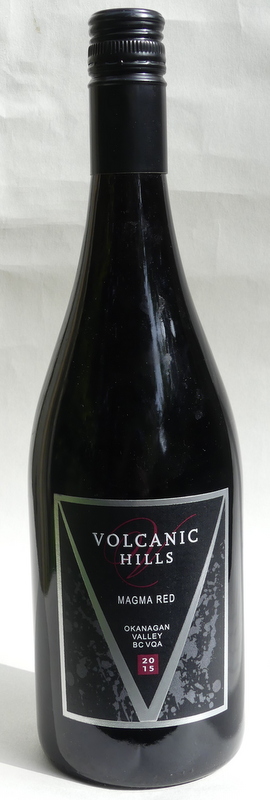
Volcanic Hills Magma Red 2015 ($17.39 for 1,100 cases). The blend is 53.7% Zweigelt, 27.3% Merlot, 10.7% Maréchal Foch, 2.8% Cabernet Sauvignon, 2.8% Gamay Noir, 1.4% Cabernet Franc and 1.4% Pinot Noir. The wine was barrel-aged 13 months in French and American oak (25% new). The wine is bold and juicy, with aromas and flavours of spicy dark cherry and plum. 91.

Volcanic Hills Syrah 2014 ($26 for 798 cases). The grapes for this wine are from Osoyoos. There is 5% Cabernet Sauvignon in the blend. The wine was aged 14 months in French and American oak. It is a bold and dark wine with classic aromas and flavours of deli meat, spiced plum, fig and black pepper. 92.

Volcanic Hills Cabernet Franc 2014 ($21.99 for 378 cases). Grapes for this wine were sourced in Oliver. The blend is 87% Cabernet Franc and 13% Merlot. The wine was barrel-aged 15 months in French oak (40% new). The wine shows the typical brambly aromas and flavours of a variety whose profile is on the rise. Decanting is recommended. 90.

Volcanic Hills Cabernet Sauvignon 2014 ($27.49 for 645 cases). Grapes for this wine were sourced from growers in the Similkameen Valley and from Oliver. The wine was aged 18 months in French and American oak. The wine begins with aromas of black currant and black cherry. Those are echoed on the concentrated palate, along with flavours of tobacco and dark chocolate. 91.


Volcanic Hills Eruption 2014 ($27.49 for 434 cases). This is a blend of 75% Merlot, 15% Cabernet Sauvignon and 10% Cabernet Franc. The grapes are sourced in both the Similkameen and the south Okanagan. The wine was aged 15 to 18 months in French oak. The wine begins with aromas of black currant. The palate is quite concentrated (decanting is recommended), with flavours of black currant, black cherry, dark chocolate and dark coffee. 90-92.