Writer and wine columnist John Schreiner is Canada's most prolific author of books on wine.
Monday, September 12, 2022
Moon Curser's original wines
Photo: Vintner Chris Tolley
Moon Curser Vineyards produces no Pinot Gris, no Chardonnay and no Gewürztraminer even though these are three of the most widely grown varietals in the Okanagan.
With a few exceptions, Chris and Beata Tolley, owners of this Osoyoos winery, did not plant many of the popular grape varieties. For the most part, their wines are made with varietals that few other wineries, if any, are growing.
That may have struck some as commercially risky. However, the Moon Curser portfolio is exciting, never boring and usually delivers surprises.
Chris and Beata did not think outside the box initially. They launched in 2006 as Twisted Tree Vineyards & Winery. After a few years, they concluded that the name could be confused with several other wineries and, in any event, did not project the excitement inherent in the varieties they were growing.
With the help of a brand consultant, they rebadged the winery as Moon Curser and had memorably garish labels created.
There is local history to support the name. There was gold mining in the South Okanagan in the late 1800s. The ore was shipped to a smelter in Spokane, attracting duties as it crossed the border. Some miners evaded the duties by smuggling the ore across the border at night – and cursed the moon on those nights when it was too bright for smuggling.
Today, Chris grows some Italian varieties as a homage to his family’s origin in northern Italy. He grows Rhône varieties because they do so well in the South Okanagan. He has the only planting of Touriga Nacional, which is used for Port in Portugal, and he was the first to plant Tannat, the robust red variety of Uruguay.
There is an original mind at work here, making some of the most original wines in the Okanagan.
Here are notes on the current releases.
Moon Curser Moonlit 2021 ($26.99 for 457 cases). This is the winery’s first sparkling wine, made with Viognier grapes, a variety rarely used for a bubbly. The wine begins with aromas of citrus and apples which are echoed on the palate. The bubbles give the wine a creamy entry to the palate but the finish is crisp and dry. 90.
Moon Curser Arneis 2021 ($26.99 for 534 cases). This varietal is native to Piedmont in northern Italy. Moon Curser is believed to be the only Okanagan winery growing Arneis. The wine begins with floral notes of lilac and apple. The palate delivers a bowl of fruit flavours including lime, kiwi, apple and honeydew melon. Bright acidity gives the wine a refreshing finish. 92.
Moon Curser Viognier 2021 ($23.99 for 605 cases). The wine begins with aromas of apricot, orange and lemon. The richly textured palate delivers flavours of citrus, quince and stone fruits with hints of honey on the long finish. 92.
Moon Curser Roussanne Marsanne 2021 ($27.99 for 635 cases). This is 82% Roussanne, 18% Marsanne. A portion of the wine was fermented cool in stainless steel and a portion was fermented at a warmer temperature in barrel. A portion was aged four months in French oak (20% new). The wine begins with aromas of vanilla and toasty oak mingled with orange. The palate is rich, beginning with an appealing note of cloves that leads to flavours recalling marmalade. This is a delicious and complex wine with a finish that refuses to quit. 93.
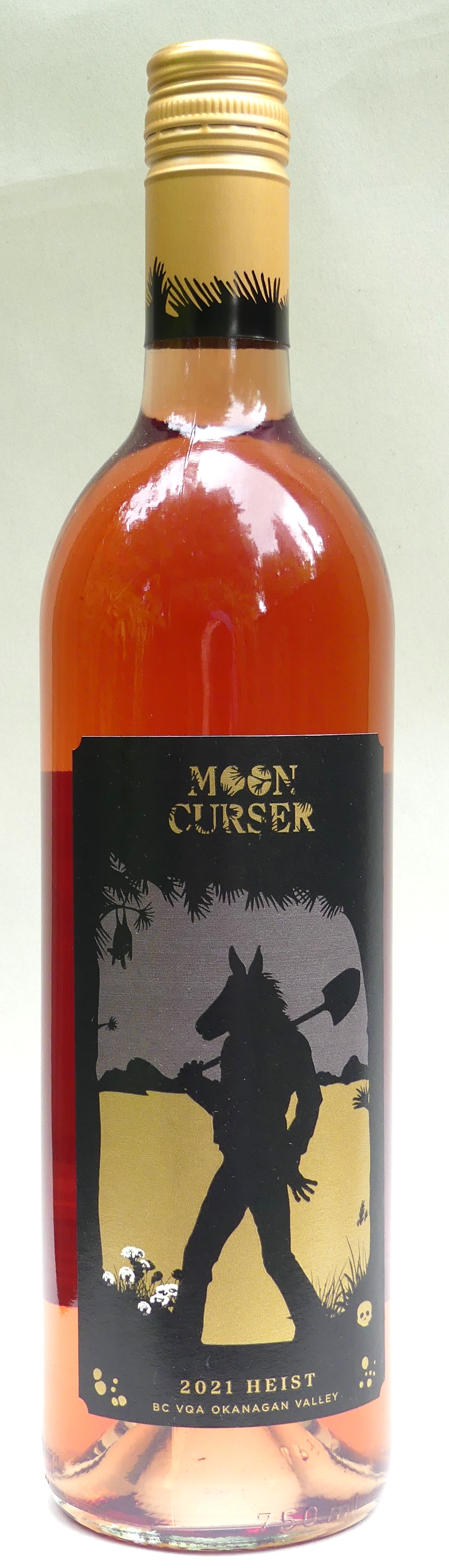
Moon Curser Heist Rosé 2021 ($26.99 for 223 cases). This is 90% Syrah and 5% each of Malbec and Nebbiolo. Two hours of skin contact gave this wine a salmon pink hue that I consider ideal for a rosé. The aromas are fruity, with notes of strawberry and apple. The fruit flavours are intense – a medley of plum, cranberry mingled with the apple and strawberry. Bright acidity leaves the wine refreshing, as a good rosé should be. 92.
Moon Curser Tempranillo 2020 ($34.99 for 295 cases). This wine was aged about 15 months in French and American oak barrels (20% new). Dark ruby in colour, the wine springs from the glass with aromas of plum and blueberry. On the palate, there are savoury flavours of plum, cherries, blackberries mingled with leather, cigar box and chocolate. Long, ripe tannins give the wine a lingering finish. 92.
Moon Curser Touriga Nacional 2020 ($43.99 for 145 cases). This wine was aged about 15 months in French oak (33% new). Dark in colour, the wine begins with aromas that draw one in: dark cherry, plum and cinnamon. The spice carries through to a rich palate, mingling with plum and dark chocolate. This is full-bodied wine with an exceptionally long finish. Consider pairing this with game. 95.
Moon Curser Malbec 2020 ($34.99 for 513 cases). This wine was aged about 15 months in French oak (25% new). It begins with aromas of blueberry jam. The palate delivers flavours of spice, black currants, black olives and truffles, with a long finish. 92.
Moon Curser Petit Verdot 2020 ($35.99 for 264 cases). This wine was aged about 15 months in French oak (27% new). This varietal is always as dark as a moonless night. Don’t think of serving this with a white table cloth because the stains will be hard to remove. The wine is as dense as it looks, with aromas and flavours of figs, black currant, dark coffee, dark chocolate and even graphite. The tannins have grip. As good as the wine is now, it wants to be cellars for another five years. 93.
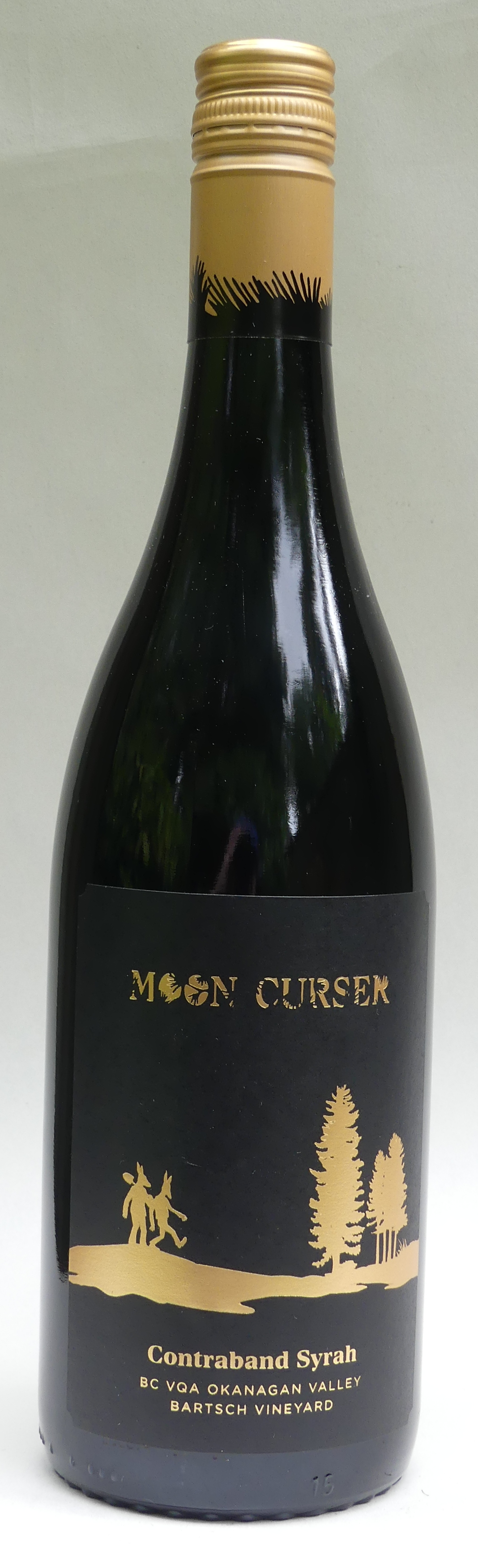
Moon Curser Contraband Syrah 2020 ($37.99 for 165 cases; but sold out). This is a powerful and full-bodied wine. It begins with dense, jammy aromas of dark fruit. On the palate, there are flavours of black cherries and figs with a touch of licorice and spice. 93.
Moon Curser Syrah 2020 ($29.99 for 1,168 cases). This is also a big, ripe Syrah. It begins with classic meaty and dark fruit aromas mingled with pepper. On the palate, there are flavours of blueberry, dark cherry and plum. There is two percent Tannat blended in, presumably for backbone. 92.
Moon Curser Dead of Night 2020 ($43.99 for 483 cases). This wine has emerged as Moon Curser’s flagship red blend. This is a blend of 51% Tannat and 49% Syrah, most of it co-fermented. The wine was aged about 15 months in French oak (29% new). It is a full-bodied wine with aromas of dark fruit, spice and dark chocolate. Firm in texture, the wine delivers layer upon layer of flavour: plum, blackberry, dark chocolate, tobacco. The wine has the bones to age sublimely for a decade. 95.
Thursday, September 8, 2022
Foxtrot releases vineyard-designated Pinot Noirs
Photo: Douglas Barzelay, co-owner of Foxtrot Vineyards
New York lawyer Douglas Barzeley, who bought Foxtrot Vineyards in 2018 with Alberta-born partner Nathan Todd, is an authority on the wines of Burgundy. In the same year that he took over Foxtrot, he also published (with a co-author) Burgundy Vintages: A History from 1845.
The fingerprints of Burgundian winegrowing philosophy are now all over Foxtrot, the Naramata Bench Pinot Noir producer launched in 2004 by Torsten Allander. A former pulp and paper engineer from Sweden, he had retired with his family to a property on the Naramata Bench. There was already a 3 ½ acre vineyard there, all clone 115 Pinot Noir. Torsten had three vintages made in a nearby winery. Once the wines showed his vineyard had the potential of produce world-class Pinot Noir, Foxtrot built its own winery.

The glorious Pinot Noir was hard to get. Not only was production limited; the winery had no wine shop and not even a sign on Naramata Road. People who found the winery were dealt with cordially – and were directed to the Naramata General Store if they wanted to buy a bottle.
The new owners have made a number of consumer-friendly changes. The winery has now opened a wine shop and tasting room; it has launched a second label called foxly; Foxtrot has created a wine club; and now it has expanded its premium range with vineyard-designated Pinot Noirs.
The vineyard-designated wines reflect Douglas Barzelay’s admiration of how Burgundy vintners make wines that express the terroir of their vineyards. The distinctive terroir of the Naramata Bench, he has discovered, yields wines that are distinctive.
“One of the things we were thrilled to see early on was the diversity of the terroir within a close distance,” Douglas said at a recent Vancouver tasting. “All of the vineyards that we are going to taste here – the single vineyards – are at most a couple of kilometres from each other. Several of them are right next to each other and yet they are very distinct.”
He believes this is “a potential the Okanagan has that is not yet fully developed. We’re doing our part. We hope to see more of that in the valley. The potential is there. There are many places in the New World that don’t have that potential to let the land speak.”
Andrea Barker (in photograph), the winemaker who joined Foxtrot in 2019, calls on consulting services from Veronique Drouhin, a member of one of the great wine families in Burgundy. “She has been a great guide, helping us to find gentler ways to approach the wine,” Andrea says.
For all the Burgundian influences, Foxtrot is still making Okanagan wine. “There is a distinction to be made,” Douglas says. “People sometimes use the term, Burgundian, to mean a certain flavour profile. I would not want to suggest to anyone that Okanagan Pinot Noirs taste like Burgundy, but stylistically, in terms of what we are trying to achieve, it is very much in the Burgundian style. We are looking for balance, for delicacy, for elegance. We are not trying to produce big, powerful, fruity wines.”
Andrea says she was attracted to Foxtrot by the opportunity to make wines expressing terroir. Born in Toronto, she has a soil science degree from the University of Maryland. “I had the great idea to get into the wine industry straight after that. I did a bit of a travelling winemaker scene. I worked in Virginia, South Africa, New Zealand, Santa Barbara and Germany, before I went back to Ontario to do a master’s degree at Brock University.” Her thesis dealt with clones of Pinot Noir, Chardonnay and Riesling. She joined Foxtrot early in 2019, after getting her master’s degree.
The premium Foxtrot wines still will be hard to get. The single vineyard wines are made in limited volume. They will be offered to the wine club and sold at the winery but there will not be enough at this time for further distribution.
However, the winery’s foxly wines are more widely available. The second label enables the winery to offer a greater selection of varietals and additional volume, all priced more approachably that the Foxtrot portfolio.
“These wines are not necessarily wines of place,” Nathan Todd says (above). “They are wines of pleasure.”
Here are notes on the wines.
Foxtrot Chardonnay 2020 ($44 for 196 cases). The fruit for this wine was sourced from growers in Peachland, Osoyo0s and the Similkameen Valley. (Foxtrot has planted an acre of Chardonnay in a new vineyard on the Naramata Bench for an state-grown Chardonnay in future). The wine was fermented in French oak barrels. It was aged on the lees for 10 months in French oak (12% new) and a further six months in stainless steel before being bottled. This is an elegant wine with aromas of lemon and pineapple that are echoed on the palate, along with a hint of butter. The finish is lingering and refreshing. 93.
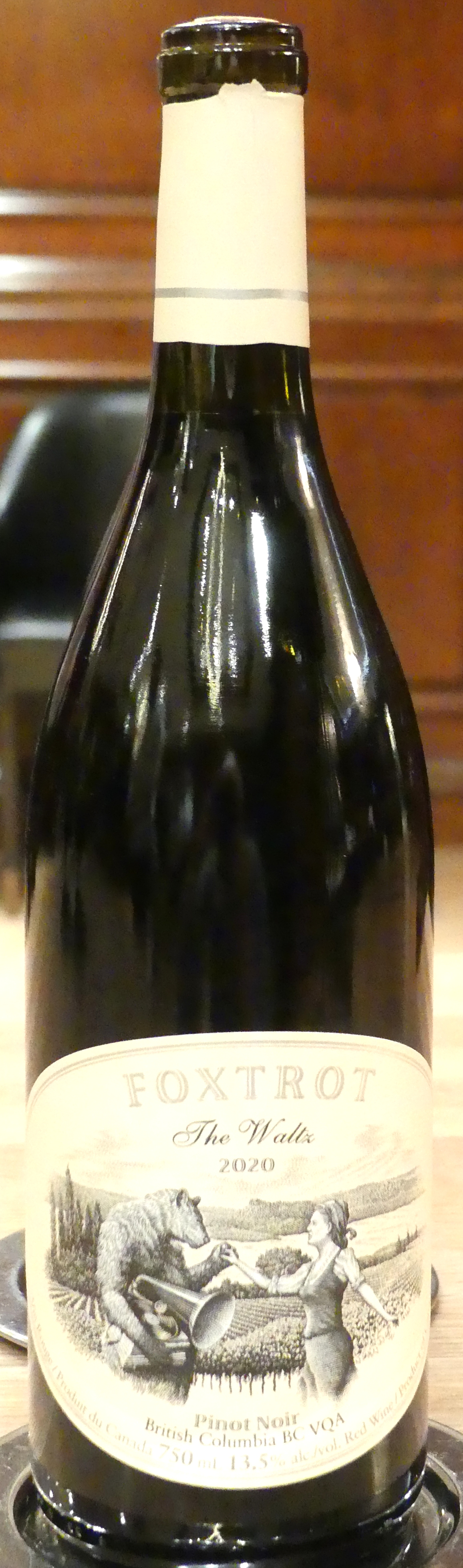
Foxtrot The Waltz Pinot Noir 2020 ($47 for 270 cases). This wine, Foxtrot’s answer to Bourgogne Rouge, is a blend of fruit from vineyards in the Okanagan and the Similkameen Valleys. Each parcel was fermented separately before being blended. The wine was aged 14 months in French oak barrels (eight per cent new). The wine begins with aromas of cherry, spice and what the trade calls forest floor. On the palate, the flavours are intense: cherry, strawberry and blackberry. There is a peppery spice on the finish. 91.
Foxtrot Henriccson Vineyard Pinot Noir 2020 ($69.99 wholesale for 97 cases). Foxtrot has had an off and on relationship with Peter Henriccson whose vineyard is a kilometre or so north of Foxtrot and on the uphill side of Naramata Road. The relationship has been back on in recent vintages, with Foxtrot getting grapes from every second row. The fruit (25% whole cluster) is fermented in stainless steel, spending 17 days on the skins. The wine was aged 14 months in French oak (12% new). The wine begins with aromas of blueberry, blackberry and spice. The palate delivers rich dark fruit flavours, with an earthy forest floor note on the finish. 93.
Foxtrot Wily Fox Vineyard Pinot Noir 2020 ($69 wholesale for 96 cases). This vineyard was planted in 2013/2014 with own-rooted cuttings from the original clone 115 vines on the estate vineyard. The wine was fermented in stainless steel and, after 21 days of maceration, was transferred into French oak barrels (25% new) for 14 months. This is a concentrated wine with aromas of cherry and red currant. There is a great depth of flavour here with notes reminiscent of cassis. 94.
Foxtrot Paddock Vineyard Pinot Noir 2020 ($N/A for 23 cases). This tiny vineyard was planted in 2014, again with cuttings from the original Foxtrot vineyard. Only one barrel of wine was produced in 2020. The grapes were fermented in stainless steel, with 25% whole clusters. After 16 days maceration, the wine was aged 14 months in neutral French oak. It is a powerful wine, with aromas and flavours of spice and cherries. A hint of anise mingles with minerality on the long finish. 92.
Foxtrot Raisin d’Etre Vineyard Pinot Noir 2020 (N/A for 48 cases). This vineyard, which is just downhill from the estate vineyard, was planted in 2009 with clone 828. The wine was fermented in stainless steel (25 % whole clusters) and, after 15 days maceration, was aged in French oak (50% new) for 14 months. The wine has aromas and flavours of blueberry and cherry mingled with notes of lavender. The finish is long and silky. 93.
Foxtrot Estate Vineyard Pinot Noir 2020 ($95 for 178 cases). The own-rooted vines, all clone 115, are about 25 years old. The grapes were fermented in several lots in stainless steel. After 17 to 20 days of maceration, the wine went into French oak (25% new) for 14 months. The wine begins with what the winery calls an “assertive” nose: there are aromas of cherry, blueberry and spice. The flavours are expansive, with notes of cherry and cassis, and a classic hint of forest floor in the finish. The ripe tannins are firm enough to assure the wine will age very well. 96.
foxly pinot gris 2021 ($24 for 170 cases). This wine was made with fruit from vineyards near Summerland and Lake Country. The wine is crisp and fresh, with aromas and flavours of citrus and apple. 90.
foxly chardonnay 2020 ($28.99 for 122 cases). This wine was fermented in and aged ten months in neutral French oak. There are aromas and flavours of pear and apple with a touch of spice and oak on the finish. 90.
foxly rosé 2021 ($24 for 150 cases). Made with Pinot Noir, the wine has a salmon pink hue from three hours of skin contact. There is an explosion of strawberry and mandarin orange flavours. Bright acidity gives the wine a crisp, dry finish. 90.
foxly pinot noir 2020 ($24 for 500 cases). This is a lively and fresh wine that was aged 16 months in oak. There are aromas and flavours of cherry and red berries. 90.
Tuesday, September 6, 2022
Osoyoos Larose: Bordeaux excellence in the Okanagan
Photo: Chief operating officer and winemaker Michael Kullmann
Consumers who want Bordeaux red wine in their cellars but cannot afford them should consider the wines from Osoyoos Larose Winery.
Osoyoos Larose is a Bordeaux winery in the Okanagan. Groupe Taillan, a major producer of wines in Bordeaux, was a 50% joint venture partner with Vincor when the winery was launched in 1999. Groupe Taillan purchased the other 50% in 2013. That led to Osoyoos Larose moving its production facilities from the rear of the Jackson Triggs winery north of Oliver.
After a prolonged search, the winery purchased a former fruit packing house at the east end of Osoyoos. That has been renovated to enable the winery to make the 2022 vintage there. Plans to open a tasting room on the highway north of Osoyoos have run into regulatory barriers. However, the winery, several years ago, converted an orchard to a vineyard. The varieties planted there are Sauvignon Blanc and Sémillon, the primary whites grown in Bordeaux.
Groupe Taillan ensured that there will be a French stamp on the winery from that start, both by having a French consultant involved in developing the vineyard and by sending a succession of French-trained winemakers to the Okanagan.
The current chief winemaker is Michael Kullmann. While he was born in London, he has a master of science degree from a Bordeaux university and experience at two Bordeaux wineries. He became the vineyard manager at Osoyoos Larose in April, 2019, and took over managing the winery and making wine in January 2022 when, Catherine Schaller, his predecessor, moved to another Okanagan winery.
The two current releases from Osoyoos Larose reflect Catherine’s talents. Here are notes on Le Grand Vin and Pétales which, in the style of Bordeaux, is the chateau’s very good second wine.
Osoyoos Larose Pétales D’Osoyoos 2019 ($33.99). This is a blend of 64% Merlot and 36% Cabernet Sauvignon. The wine was aged 12 months in medium toast French oak barrels from multiple coopers. The wine begins with aromas of cassis and cherries. On the palate, there are flavours of dark cherries, blueberries and black currants. Bright fruit and long, ripe tannins give this wine appeal for current consumption, but with moderate ageability. 92.
Osoyoos Larose Le Grand Vin 2018 ($53.99). The blend is 64.9% Merlot, 14.2% Cabernet Franc, 12.7% Cabernet Franc, 5.2% Petit Verdot and 3% Malbec. The grapes, after crushing, were fermented in stainless steel tanks, with about 25 days of skin contact. The wine was then aged 12 months in French oak (60% new, 40% one year old). This wine is built for aging for 10 to 15 years, with grippy tannins at this stage. Decant the wine for early consumption. The wine begins with aromas of dark cherries, black currant and plum. On the brooding palate, there are flavours of dark fruits, leather, dark chocolate and cigar box spice. 94.
Friday, September 2, 2022
Terravista adds Mencía to its varietal mix
Photo: Dallas and Eric Thor
When Terravista Vineyards was established in 2009 on the Naramata Bench, founders Bob and Senka Tennant planted Albariño and Verdejo, white Spanish varietals never before planted in the Okanagan.
Dallas and Eric Thor purchased Terravista in 2019. They not only continued producing the Spanish whites. In 2022, they also planted a block of a Spanish red varietal called Mencía, the first in British Columbia and perhaps in Canada.
“We wanted to do something Spanish, since we have Spanish whites here,” Eric says. “It would not do to compliment the white varieties with something French. There is a legacy in the Terravista name. A red Spanish variety seemed key.”
Jancis Robinson and her colleagues, writing in 2012 in Wine Grapes, described Mencía as an “increasingly appreciated aromatic variety found in both Spain and Portugal.”
Writing about its viticultural properties, the authors say: “Small bunches of medium-sized berries in Spain; medium to large berries in Portugal. Early budding, mid ripening. It is said to have good production potential in Portugal but to be not very productive in Spain. It is prone to wind damage and susceptible to powdery and downy mildews and botrytis bunch rot.”
Will the variety thrive in the Okanagan’s Naramata Bench? Only time will tell.
“We don’t know a tremendous amount about the grape just yet,” Eric told me in June. “We have done a cursory review of where it grows and how it grows. It is very Pinot Noir-esque. We are rolling the dice a little bit, but given that Pinot Noir is successful on the bench here, it seems reasonable to expect Mencía to do well. It is a bit of a gamble but it is also fun. It will turn all our brains on for years to come. I just don’t want to be copying another Pinot Noir, or try to chase something everybody else is after.”
Three and one-half acres of Mencía occupy half of a seven-acre site not far from Okanagan Lake, which Terravista calls the Naramata Outlook Vineyard. “We have Mencía planted in a few different orientations,” Eric says. “A rolling slope to the west; some on a true north to south orientation. And some high-density plantings.”
I first interviewed Eric and Dallas soon after they took over Terravista. Here is an excerpt from my 2020 book, Okanagan Wine Tour Guide (with Luke Whittall as co-author).
When Dallas and Eric Thor acquired Terravista Vineyards in 2019, it was the culmination of the wine journey Eric began as a bar manager in a Vancouver restaurant in 2000. He was showing off his wine knowledge to a guest. Then he discovered he was talking to Harry McWatters, the founder of Sumac Ridge, who promptly hired him to work that fall’s vintage. He even got to put the Christmas lights on Harry’s house before work ran out at Sumac Ridge.

Eric, who was born in 1978 and grew up in Penticton, went back to school to learn accounting. In 2003 he joined Point Grey Research, a technical start-up (digital cameras) launched by five University of British Columbia graduates. Eric had become the company’s chief financial officer by 2016 when Point Grey was taken over for $250 million. Eric’s share was more than enough to get him and Dallas, his wife, back into the wine business.
A teacher with a master’s degree in science, she shares his passion for wine. In 2016, when they were buying an ocean-going catamaran in the south of France, they lived for seven weeks at the village of Canet en Roussillon, working the harvest at a small winery. They returned to Penticton to buy some land in 2017 on the Naramata Bench for a vineyard. And they asked Senka Tennant to be their consultant.
Senka and her husband, Bob, are legendary in the Okanagan. They were co-founders of Black Hills Winery, where the flagship red, Nota Bene, acquired a cult following. Two years after Black Hills was sold in 2007, they established Terravista Vineyards, based on a 1.6-hectare (four-acre) vineyard with the Okanagan’s first planting of Albariño and Verdejo, two Spanish white varieties. Once again, the wines attracted a cult following.
Senka thought it was premature for Eric and Dallas to seek her advice before they had planted a vineyard. (A small block of Pinot Noir was planted in 2019 while Syrah was planted in 2020 on most of their two-hectare vineyard.) The Thors continued to consult with Senka; and they joined Terravista’s wine club. The relationship blossomed. “They did not bother letting us know they were selling for a couple of meetings,” Eric recalls. “When they decided we would be suitable candidates to take over their baby, they let us know they were selling.”
As Senka reduced her consulting relationship, the Thors have retained Nadine Kinvig as their winemaker. An Okanagan native, she went to New Zealand to train as a winemaker. Back in the Okanagan, she worked previously at Time Winery and Poplar Grove Winery. “She eats and breathes wine,” Eric says.
Here are notes on current releases from Terravista.
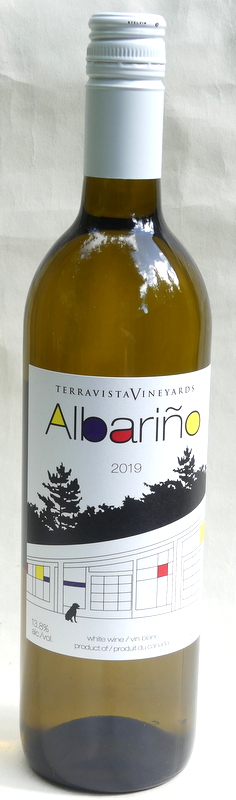
Terravista Albarino 2021 ($27 for 204 cases; sold out). This is a crisp, refreshing white, with aromas and flavours of citrus and green apples with an herbal note on the finish. 92.
Terravista Fandango 2021 ($29 for 471 cases). This is 51% Albariño, 49% Verdejo. The wine has nice weight on the palate, with aromas and flavours of peaches, pears and apples. 92.
Terravista Figaro 2020 ($33; sold out). This is a blend of 48% Roussanne, 35% Marsanne and 17% Viognier. The first two varieties were barrel-fermented and, for the most part, co-fermented. The wine is fleshy, almost full-bodied, with aromas and flavours of citrus and stone fruits. 91.
Terravista Viognier 2021 ($24 for 266 cases). This wine was made with fruit both from the Naramata Bench and the Similkameen Valley. It has aromas and luscious flavours of apricot and pineapple. 92.
Terravista Syrah 2020 ($35; not yet released). This was tasted a few hours after it was bottled, so there is no score. But the flavours of plum, figs and other dark fruits promise it will be delicious when released in October.
Subscribe to:
Posts (Atom)