Writer and wine columnist John Schreiner is Canada's most prolific author of books on wine.
Wednesday, March 10, 2021
Steven Spurrier has died
Photo: Steven Spurrier at work tasting BC wines
Steven Spurrier, perhaps the most influential advocate for British Columbia wine among British wine writers, has died at 79, the victim of aggressive liver cancer.
He lent his prestige, beginning in 2015, to presiding over a series of Judgment in B.C. tastings that were organized over five years by the British Columbia Wine Institute.
As a tribute by Jancis Robinson says, this was entirely typical of his extensive interest in wines other than the French classics. “At any sparsely attended tasting of the most obscurely nascent wine region, Steven would be there,” she wrote.
“Obscurely nascent” is not a term we in British Columbia would attach to our wine industry but the truth is there are probably more consumers in Britain who have tasted Georgian wine than there are those who have tasted Canadian wine. In recent years, however, Steven helped our producers spread the word there, especially after becoming familiar with our wines through the Judgment of BC tastings. Those were blind tastings with BC wines pitted against comparable imported wines. BC wines more than held their own against the competition. The tastings are no longer held because the point has been made.
The Judgment of BC tasting was modelled on Steven’s famous 1976 tasting, The Judgment of Paris, which put California wines in the map internationally. In 1976 Spurrier was a wine merchant in Paris with some California wines in his shop. He organized a tasting and, to draw attention, decided that it would be a blind tasting. California was then a nascently obscure wine region, at least to the French. So he pitted top California wines against leading French wines.
He sold primarily French wines and he expected French wines to win the tasting. When the result was announced, one of the outraged French judges demanded her ballot back. (All but two of the 11 judges were French and the scores of the others – Steven and an American – were not counted.) You can understand why the French were outraged when an upstart like Stag’s Leap Cabernet Sauvignon beats a First Growth Bordeaux like Chateau Mouton.
The results of The Judgment of BC did not have the same shock value, if only because blind comparative tastings have become routine. But the fact that British Columbia’s wines scored well, and often won, was reassuring both to the consumers here and to the producers.
At the first such tasting, the top Syrah was a Syrah from C.C. Jentsch Cellars, an Okanagan winery that has been open just two years and was not widely known at the time.
Steven presided over these tastings – at which there were at least two dozen wine professionals as judges – with his characteristically modest mien. His wore his celebrity lightly. Jancis Robinson recounts that he told a host of a South American wine visit that it was not necessary for Steven to fly business class.
His interest in British Columbia wines was genuine, which could not always be said of all of his contemporary wine writers in Britain.
Monday, March 8, 2021
Blue Mountain's Cru quality Gamay Noir
Photo: Blue Mountain's Matt Mavety
Over the years, the price of Blue Mountain Gamay Noir has crept up. The 2011 vintage, for example, was released at $21 and the 2014 at $23 a bottle. The current release is $30.
I believe the quality of the wine has also risen. The 2019 may also be the best Gamay Noir to date from this Okanagan Falls winery. And the price is just right, considering that the competitive wines – the Beaujolais Cru wines from France - are listed around $30 as well.
Beaujolais is made in Burgundy with the Gamay Noir grape. The wines are released at several levels of quality: Beaujolais, Beaujolais Village and, at the top, about a dozen named Crus, such as Morgon, Chénas or Brouilly. The recently listed 2016 Pascal Aufranc Chénas Vignes de 1939 is priced $28.99.
I have previously expressed my view that Blue Mountain’s Gamay Noir is of Cru quality. I can’t tell you which of the Cru because I don’t get to taste them often. From memory, I might compare it to Morgon or Juliénas or Moulin-à-Vent.
The varietal tends to be treated as the poor man’s Burgundy, a wine to buy when you cannot afford Pinot Noir. I once told Matt Mavety, Blue Mountain’s winemaker, that nobody collects Gamay Noir in his or her cellar. “Well,” Matt retorted, “they don’t know what they are missing.”
If you do not know what you are missing, Blue Mountain’s 2019 Gamay Noir is a place to start. Here is a note on the wine.
Blue Mountain Gamay Noir 2019 ($30). The vines range in age from 12 years to 30 years. Blue Mountain also has three clones of this grape. The wine is fermented with natural yeast and the maceration period is 18 days. After ferment, the wine is aged a year in four-year-old French oak barrels. The result is a silky, full-bodied wine with aromas and flavours of cherry, blackberry and spice and with a hint of mocha on the finish. 92.
Monday, March 1, 2021
Stag's Hollow releases top Syrahs
Photo: Winemaker Keira LeFranc
This year, Stag’s Hollow Winery, which is located just south of Okanagan
Falls, celebrates its 25th anniversary. What better way to start the year than
with the release of two outstanding Syrahs.
The wines are a tribute to the Amalia Vineyard near Osoyoos, which has supplied fruit for Stag’s Hollow for
some years. They also celebrate the skills of Keira LeFranc, who began taking over the winemaking here in 2016 and who made every wine in the 2018 vintage. The designation Renaissance at Stag’s Hollow is reserved for the premium winesin the best vintages.
Erin Korpisto, the winery’s sales and marketing manager, described how a portion of the 2018 Syrah was selected as a Renaissance Syrah. “In 2018 we were able to do a bit of Viognier co-fermentation with our Syrah,” she recounted in a note accompanying the release of these wines. “We distributed a small amount of Viognier, in varying amounts (ranging from 5%to 20%), amongst six of our eight one-ton Syrah ferments (keeping two ferments as 100% Syrah). These small lot ferments were pressed off individually into a combination of French oak barriques, hogsheads and puncheons (22% new) where they aged for 18
months.”
Erin continues the story: “As we followed their élevage, it became increasingly evident that the quality of the vintage was such that we’d have the opportunity to create our third ever Renaissance Syrah.” Both this wine and the white label Syrah are from the same vineyard, but each wine is distinct. “With the exception of the Viognier inclusion, the winemaking for both wines was identical – the difference being purely the consequence of careful barrel selection,” Erin writes.
I would also suggest that the white label Syrah is more perfumed and very slightly lighter because there is significantly more Viognier in the blend. But both are excellent Syrahs and reasonably priced for the
quality.
Here are notes on the wines.
Stag’s Hollow Renaissance Syrah 2018 ($38 for 95 cases.) The winery also bottled 24 1.5-litre magnums of this excellent, age-worthy wine. This wine, made from fruit grown in the Amalia Vineyard on the
Osoyoos West Bench, is a fist in a velvet glove. Deep in colour, the wine begins with aromas of black cherry, plum, leather and black pepper, all of which is echoed on the full-bodied, even fleshy, palate. It is immensely satisfying to drink now and will age gracefully for 10 years – longer for the magnum. 94.
Stag’s Hollow Syrah 2018 ($27 for 383 cases). This wine has 9.2% Viognier co-fermented with the Syrah (the Renaissance had just 1.2% Viognier). The fruit is also from the Amalia Vineyard. The Viognier in the blend gives an appealing floral lift to the cherry and blackberry aromas. On the palate, there are
flavours of plums, cherries, pepper and spice with complexing notes of licorice and earth on the finish. 92.
Thursday, February 25, 2021
Monte Creek Ranch invests $10 million
Photo: New winery under construction
Monte Creek Ranch Winery is investing an eye-popping $10 million to add a gravity-flow winery to its facilities east of Kamloops.This is one of the largest investments in a winery this year in British Columbia and it is being made in the Thompson River Valley, home to just four wineries in total. Monte Creek general manager Erik Fisher hopes that his winery’s spending will attract other winery investment to the valley.
“We want others to come and develop the region so there are more than just the four wineries,” he says. “Hopefully, an investment of this scale is a good indication for others that there is good long-term potential here. We would love to see a few other wineries over the next few years.”
Photo: Erik Fisher
Monte Creek Ranch is spending $8 million on the new winery, including equipment, and $1.25 million on a new grape propagation greenhouse. Other infrastructure improvements bring the total spend to $10 million.
The current winery, located beneath the Monte Creek wineshop and restaurant, will be retained, largely for white wine production. The new facility is designed primarily for the production of reds, notably Pinot Noir and Gamay, the winery’s signature varietals and the reason for adopting the gravity-flow design.
“We have bought into that whole philosophy of gravity flow,” Erik says. “More gentle handling of red fruits has the potential to produce a higher quality product.”
The expanded winery will have the capacity of producing 50,000 cases of wine. Monte Creek plans to grow to that when all its vineyards are in full production. The winery currently has 75 acres in two vineyard blocks – one on either side of the Thompson River and the TransCanada Highway. These vineyards have been developed since 2010 and will be expanded further.
Monte Creek also gets fruit from its property in the Similkameen Valley, just east of Keremeos. The land was acquired in 2018. The plan is to plant 90 acres of vines over several years. The major varietals are Pinot Noir and Gamay, along with smaller blocks of Chardonnay and Riesling. The latter produced a small quantity of fruit last fall.
The winery came about almost by chance. Gurjit Sidhu, the winery owner, is a major blueberry grower and nursery operator in the Fraser Valley. He bought a large tract of ranch land east of Kamloops in 2007 with the intention of growing blueberries there as well. Then he discovered that blueberries do not thrive in the hot and dry climate of the Thompson River Valley.
When grape growing was suggested, Gurjit commissioned a study from John Vielvoye, the retired grape specialist with the provincial government. John recommended planting Minnesota hybrids, varieties with a track record for producing good wines in Minnesota and Quebec vineyards while tolerating winters colder than those of the Thompson River Valley. European wine grapes seldom survive -25ºC but these varieties can survive as hard a freeze as -35ºC. Taking the advice, Gurjit initially planted hardy varieties in the vineyards. Monte Creek grows five Minnesota hybrids: Frontenac and Marquette, a rosé called Frontenac Gris, and white varietals called Frontenac Blanc and La Crescent. The vineyards also have Maréchal Foch, a hardy French hybrid.
The history of the Minnesota hybrids begins with Elmer Swenson, an American plant breeder who died in 2004. He began breeding winter-hardy wine grapes in 1943 at his farm in Osceola, Wisconsin (one of his varieties grown in a Monte Creek test plot is called Osceola). Later he moved to the University of Minnesota which took over his work. The varieties are grown in those northern states but also in Quebec, which accounts for the French names of some varieties.
Monte Creek also planted several somewhat more tender vinifera varietals in both of its original vineyards, including Riesling, Chardonnay, Pinot Noir and Gamay. The winery has had to take measures to protect them against cold temperatures after a cold snap two winters ago caused about 50% loss of production from those vines (the Minnesota hybrids were unscathed). .
“This year, we hilled up our vinifera,” Erik says. “We dropped all of our trellising down to about knee level, so that we could hill up essentially the whole vine. We think that will be a determining factor for the viability of some of the vinifera varieties.”
After a mild winter, there were four days in mid-February this year with temperatures low enough to kill vinifera buds. “We had an effective inversion layer,” Erik says. “We used our wind machines effectively. Our vineyard manager thinks we might be relatively unscathed. It was just a couple of hours that it hit -22◦C and we were able to bring warm air down during that period. We are hopeful the damage will be minimal this year, with the burying of the vines and the effective use of the wind machines.”
The other large winery nearby in the Thompson River Valley is Harper’s Trail Estate Winery, which opened in 2012, two years earlier than Monte Creek. The vineyard here - more than 25 acres is under vine and there is ample room for more – has succeeded with vinifera varietals and wind machines to move cold air to the valley bottom.
The record of these producers, along with Monte Creek’s current investment, should anchor this young wine region. Other than a diminished sales volume to restaurants during the pandemic, wineries have continued to do good business during the pandemic.
“Our tasting room has been surprisingly consistent,” Erik notes. “We are on the TransCanada Highway and we are near a major centre, in Kamloops. Retail sales numbers are up a bit and direct-to-consumer is up a bit. All in all, we have been relatively unscathed.”
Friday, February 19, 2021
Kathy Malone "hates" Icewine
Photo: Winemaker Kathy Malone
Hillside Winery’s veteran winemaker, Kathy Malone, writes what seems to be a monthly commentary that is sent to everyone registered on Hillside’s email list.
I highly recommend registering. And you may also want to order some Hillside wine while you are at it. The quality is very high.
Kathy’s latest commentary is titled, provocatively, “Why I hate Icewine.” Then she writes: “Of course I don’t hate Icewine. It is truly nectar of the gods, with its rich aromas, concentrated flavours and unctuous texture.”
She goes on to allude to the challenges and frustrations of making wine from grapes that, by regulation, must be picked no warmer than -8◦C. “The lay person would be amazed by how often in a season we approach but don’t meet that temperature, and more amazed how often that happens on Christmas Eve, Christmas Day, New Year’s Eve, vineyard manager’s birthday etc.!”
In the Okanagan and Similkameen Valleys, the necessary Icewine freeze has happened occasionally in mid-November, more often in December and occasionally as late as mid-February. That seems to have happened this year when the winter had been unusually mild until recently. Only seven wineries picked for Icewine of the 14 that had registered in advance with the British Columbia Wine Authority. Only 61 tons of grapes wee picked.
An Icewine harvest in mid-February is not ideal. Most of the grapes left for Icewine will long since have been eaten by birds; or knocked to the ground by wine; or become too desiccated to yield much juice for wine. There is not much juice to begin: frozen grapes yield about 20% of the juice compared to the yield for table wine. That is why Icewine is always going to be expensive (and probably not very profitable for the wineries either).
Twenty years ago, I wrote a book called Icewine: The Complete Story. It was, and remains, the only thorough book that I am aware of dealing with the history of Icewine and profiling most of the producers in the world. Thanks to the ineptitude of the publisher, it has been out of print for a long time. Amazon still has some used copies available.
Many of the producers I interviewed had horror stories about trying to make Icewine. The late Karl Kaiser, the Austrian-born winemaker who put Canadian wine on the map with Inniskillin Icewine, first left grapes hanging to freeze in 1983 without netting the wines. He lost the entire harvest one afternoon to a voracious flock of starlings. I picked up the story in my book:
“I didn’t know where to buy nets here,” Kaiser admitted later. “And I didn’t know how ravenous the birds were either.” Meanwhile, Walter Strehn, another Austrian and the winemaker at the new Pelee Island winery near Windsor, had the foresight to import netting from Europe that year for the vines he set aside for icewine on Pelee Island, a 4,000-hectare island positioned in Lake Erie on two major migratory flyways for birds. He draped the white nets across at least eight rows of vines, protecting a quantity of grapes that, if made into Icewine, would have created a considerable sensation. The netting worked too well, trapping birds as well as protecting the grapes. Strehn’s nets were dismantled by conservation officers from the province’s Ministry of Natural Resources, who charged Strehn with trapping birds out of season. While the charges were dropped later, birds ate about $25,000 worth of Strehn’s unprotected grapes, primarily Riesling. Even so, he salvaged enough Vidal to make a commercial quantity of Icewine in 1983, shipping about one hundred cases to the Liquor Control Board of Ontario where the wine retailed for $12.50 a half bottle. After little was sold, the LCBO returned it to the winery for refund. Subsequently, Pelee Island found more remunerative markets in the United States and when the Icewine began selling there for more than $100 a bottle, the LCBO begged to have it back.
Another harrowing experience was recounted by Austrian producer Sepp Moser, the owner of Weingut Sepp Moser:
Moser’s Eiswein is made primarily from grapes in a Chardonnay vineyard only six-tenths of a hectare in size, just across the street from the mansion, beside a busy road that usually deters birds and other predators. “I remember a situation in 1982,” Sepp Moser recalls. “We had eleven and a half hectares of Grüner Veltliner hanging for Eiswein until January 6 of 1983. It was a quite a quantity of grapes but 1982 was a very big harvest, so we left them because our cellars [at Lenz Moser] were completely filled. On a Friday it was snowing and getting cold. I looked forward to harvesting on Monday.” The snowfall was so heavy on Sunday afternoon that it completely covered the ground where the birds had foraged, driving them onto the vines. “Almost the complete Eiswein harvest was finished by the birds. On Monday morning, there was nothing left, just a few kilos. It could have been a very high quality Eiswein.”
That is not to deny the romantic appeal of Icewine (Eiswein in German) to some producers. Typical was the attitude of Günther Thies, who was the general manager of the prestigious German producer, Schloss Schönbrun, when I interviewed him.
“Picking Eiswein is something special,” Thies says. “It is fun. We start at four o’clock in the morning and we finish at seven. We have breakfast later on together and we have some of our Schnapps to get warm. We have a lot of customers who ask to come out with us. There is a special atmosphere and there is a story that they can tell later, that they have been part of the Eiswein picking at Schloss Schönborn or wherever. You can see in the newspapers that a lot of politicians go out, doing Eiswein picking for publicity.”
While researching that book, I tasted close to 500 Icewines from producers all over the world. I agree with Kathy Malone that it is the nectar of the gods. I have never understood why producers – at least those in Canada, where most of the world’s Icewine is made – have never positioned the wine properly.
Because it is a dessert wine does not mean it need always be served with dessert, which can be an overload of sweetness. Austria makes some of the world’s greatest desserts – but I do not remember an Austrian winemaker ever offering a Sacher Torte with an Eiswein. Invariably, a cheese plate was offered. My favourite pairing with Icewine is a soft blue cheese like Cambozola. I also prefer Icewine as an aperitif; it can be too rich for dessert.
Wednesday, February 10, 2021
Remembering George Hanson – The Legend
Photo: George Hanson, courtesy of Seven Stones Winery
Seven Stones Winery founder George Hanson died suddenly at home on February 5, 2021. Cause of death is undisclosed at this time.
It is a major loss in the Similkameen Valley where he was a pioneer of fine winemaking, including his flagship Bordeaux red called The Legend. It is one of British Columbia’s iconic and collectible red wines.
Almost all of the Seven Stones production, about 4,500 cases a year, is red wine. George did not aspire to produce a greater volume. “If I can’t make a living selling 4,000 cases, I am doing something very wrong,” he told me in 2013. “Plus, I still intend to be the winemaker and keep control of that.”
Born in Alberta in 1957, George spent 25 years with the telephone company in the Yukon as a human resources manager. His interest in wine, he said, began when a brother married into an Italian family that included a father who was a good winemaker. George also took up winemaking and, by his own account, became the best amateur winemaker in the Yukon.
When the phone company offered golden handshakes, George, who had already been thinking of taking early retirement to start winery, took his severance and began looking for vineyard property in the South Okanagan.
One day in 1999, he was driving past a property near Cawston in the Similkameen just as the “for sale” sign was going up. Then a 25-acre parcel growing hay, it had the soil and aspect of an excellent vineyard. George promptly bought it. The next year, he began planting Merlot, Cabernet Sauvignon and Cabernet Franc with the intent of producing Meritage wine. Subsequently, he added Malbec, Petit Verdot, Syrah, Pinot Noir and one block of Chardonnay.
“The idea is that I would try to make old world wines with a little bit of flair, so they would be new world wines,” George told me. “This is an exceptional place to grow grapes. We have been selling to four or five other wineries and they are all making premium wines.”
Initially, he called the vineyard Harmony-One because, in his mind, there was a parallel between a conductor directing an orchestra and a grower managing his vines. That was also the tentative name for the winery when he had consultant Lawrence Herder make an initial volume of red Meritage in the debut 2003 vintage.
About this time, he married Vivianne, his first wife, a former natural foods store operator. Because they were building a new home at the vineyard, Seven Stones made no wine in 2004 to concentrate on the construction. The winery resumed winemaking in 2005, and opened in 2007. The Seven Stones name for the winery had been suggested by Vivianne. It is inspired by the massive boulders around the valley and by their indigenous heritage.
“I like the ring of the Seven Stones,” Vivianne, who died in 2012, once told me. “It has a bit of a magic to it. I read a lot of books and there are legends about the different rocks. It has lots of marketing potential because each rock has a story. We wanted to make it our own story, too.”
Aside from the wines, one of the features of the Seven Stones winery is the 3,500-square-foot underground barrel cellar built in 2014, connected by a short tunnel to the house. When George initially proposed building a cellar, Vivianne argued that the winery did not generate enough cash flow to pay for it. Then the couple went on a wine tour in Sonoma and George arranged visits to a number of wineries with cellars.
“Strangely enough,” George told me in 2013, “after the fourth winery, she said, “You know, honey, we should build some caves.” I said it was a good idea.”
The signature of Seven Stones wines, aside from good viticulture, has been developed by George’s meticulous blending. He discussed his methods with me when I was preparing an entry on The Legend for my 2017 book, Icon: Flagship Wines from British Columbia’s Best Wineries. The first vintage of that wine was made in 2008.
“When the grapes first come in, we treat them all the same,” George told me. “I separate the wines by barrel in the cellar. I taste every barrel every month. I start developing my favourites. The next thing I know it is blending time and I have picked out those that go into The Legend.” The wine is always aged in new French oak for a total of 18 months.
He equated blending with building a person. “You make the body, which is the Merlot and Cabernet Sauvignon together,” he explains. “Then you put the personality in and the final dress. That would be Petit Verdot and Cabernet Franc.”
The blending of The Legend by a careful blending of Meritage and, more recently, several other proprietary reds. George also made some impressive single varietals, notably Merlot, Cabernet Sauvignon, Syrah and Pinot Noir.
George’s death leaves the future of Seven Stones somewhat in question. He had listed the winery for sale in the fall of 2019, aggressively priced at $8.8 million.
“If you're not in the market to buy a beautiful, multi-million dollar home, we're willing to bet you still love looking at them,” the realtor gushed. “Especially when they are so extra you can't even believe they're real. We've come across an absolutely dreamy B.C winery for sale and you just need to see it.
“This positively giant property sits on 25.34 acres of land, so it’s worth every cent of the nearly $9 million price tag. The home itself has four bedrooms and four bathrooms and a beautiful country-chic interior. The home is bright, welcoming, and classically comfortable.
“It’s also outfitted with solar panels to reduce utility costs and be nice to Mother Earth. Next to the home is a modern winery with a huge tasting room. Sprawling on all sides of the home is a stunning vineyard with mountain ranges jutting up around it. It's a pretty serious treat for the eyes, and for the tastebuds if you're a wine lover.”
The past year has not been a great one for selling winery properties, even one with a reputation as fine as Seven Stones.
Friday, February 5, 2021
Class of 2020: Horseshoe Found Winery
Photo: Winery owners Pavel and Michaela Horak
Horseshoe Found Winery, which Pavel and Michaela Horak opened last fall near Cawston in the Similkameen Valley, may be British Columbia’s smallest winery. In the 2020 vintage, the winery made 4,500 litres of wine, the minimum allowed under a winery license. So far, just two wines have been released from earlier vintages. Don’t look for the winery to get much bigger. “No, we will not do that because we would like to stay small, and maintain production between 4,500 litres and 6,000 litres, so we can focus on the quality of what we would like to do,” Pavel says.
The winery fulfills a dream inspired by his father’s fruit wines and by Pavel’s blackberry wine when, as an immigrant from Czechoslovakia (as the Czech Republic was known then), Pavel established a home in New Westminster. Trained as a mechanical engineer, Pavel, then 24, slipped out of Czechoslovakia in 1980. He spent six months in Austria, securing his visa to come to Canada – and straight to Vancouver. “I was always attracted to Canada's west coast,” he explains. “This was in my opinion the best choice because of the scenery, weather, nature, and opportunities.”
In Vancouver, Pavel had a 20-year career with Creo Inc., a Burnaby producer of digitized plates for the printing industry. The company was taken over in 2005 by Kodak which then moved the production to Mexico four years later. Creo’s former owners established a new company, Kardium Inc., which makes medical products to deal with atrial fibrillation. Pavel joined that company in 2007, working there fulltime until 2016 and parttime now that he and his wife have dedicated themselves to the winery.
Home winemaking in New Westminster, where they had built a house, nourished Pavel’s ambitions. Once they realized that the Lower Mainland is less than ideal for viticulture, they began search for property in the interior. “We decided to get out of the city and go to the Okanagan, or somewhere where we can actually grow grapes and make wine,” Pavel recalls. “We travelled all the way to the Kootenays. The Okanagan seemed to be very expensive. Then one day, we drove through Cawston and saw one property there, the one we have now. It was more expensive than we thought but we fell in love with it, put an offer on it and got it. We bought it in 2006.”
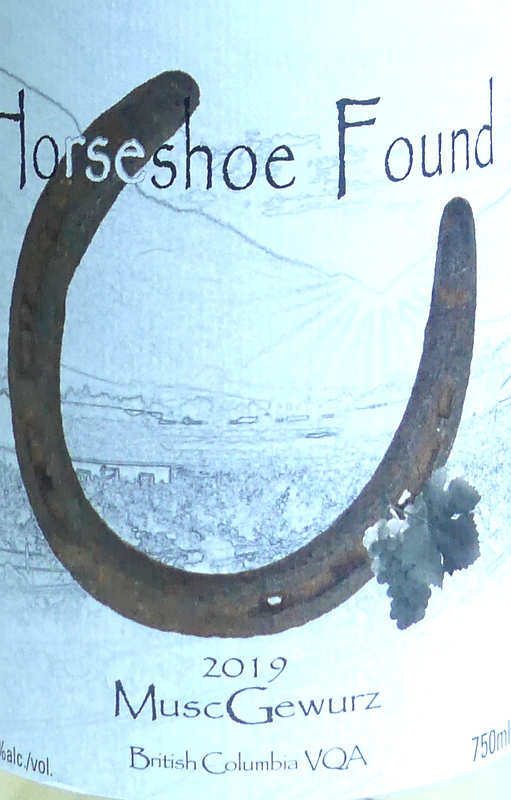
The property has then a hay field. Many years earlier, Pavel learned, it had been a rodeo ground. That explained why, when he was digging holes for vineyard posts, Pavel turned up a number of rusty horseshoes. That is also why he and Michaela have named the winery Horseshoe Found. The labels were designed with input from Pavel’s artistic father-in-law in Prague, Jarda Vsetecka. Pavel drew on his experience in the graphic arts industry to finish the design. There was one helpful suggestion from a neighbour who pointed out that the horseshoe was upside down on the original design. In equestrian circles, that is considered to be bad luck. Pavel turned the horseshoe the right way up – to keep the luck from falling out.
“It was a gradual project because I was still working in Vancouver fulltime in the high tech industry and travelling to Cawston every weekend,” Pavel says. “We developed it little by little. There was an old barn and an old house, all of which had to be renovated. We started with the barn; and then the house. And we developed plans for the winery underneath the house. In between we prepared the field for planting.”
They have planted about three acres (there is not much room for more vines), settling on the varieties they like to drink. There is a block of Gewürztraminer, a small block of Muscat, 300 Cabernet Sauvignon vines, and an acre of Pinot Noir. “Pinot Noir is the holy grail of winemaking, in my opinion,” Pavel says. “It is a problematic grape to grow, but when it grows well, you can make some fantastic wine.”
To ensure that the wine is that good, the Horaks have engaged a consulting winemaker, Anthony Buchanan. He is currently the winemaker at Desert Hills Estate Winery and he has his own label as well. In the past, he has also consulted with Eau Vivre Winery. By coincidence, Eau Vivre is just across Highway 3 from the Horseshoe Found Winery. “I must say that he taught me a great deal of skills,” Pavel says. “This is important as we are focusing on quality throughout the process starting from vineyard and ending in a bottle.”
The vineyard is managed by Michaela. Formerly a stage actress in Prague, she now runs her own home-based accounting service in Cawston. “All our activities around vineyards including planting, cultivation, weed control and nutrients are based on biodynamic and organic practices,” Pavel says. “We are not certified organic, but we certainly follow all practices as we believe in nature, good bugs, and harmony between all living organisms. Weed control is all manual, and we do not use chemicals.”
He believes that “excellent wine starts in the vineyard and to keep vines happy it takes time and effort and if done right all these activities will be positively reflected in wine terroir. This is also why we are not planning to expand as we want to enjoy all work when we do it ourselves. This way, for example, we can properly balance each vine in terms of production and future growth. Michaela as vineyard manager can carefully plan all vineyard activities like pruning, applying organic sprays, and nutrients. Each year is different, and that is the beauty of it.”
Here are notes on the wines.
Horseshoe Found MuscGewurz 2019 ($27). This is a blend of Gewürztraminer and Muscat. It begins with a clean, spicy aroma. On the palate, the spice mingles with stone fruit flavours. The finish is dry. 90.
Horseshoe Found Pinot Noir 2018 ($37). The wine. which was aged 16 to 20 months in neutral oak, is appealing fruit-driven Pinot Noir. Silken in texture, it has aromas and flavours of cherry and raspberry. 90.
Subscribe to:
Posts (Atom)