Friday, March 20, 2015

Steller's Jay Brut: a wine for all seasons


A few years ago, Constellation Brands decided to elevate Steller’s Jay Brut, the former Sumac Ridge flagship, into a standalone brand.

The rationale is that top sparkling wines come from sparkling wine houses. Now, if only Constellation would build a luxury Champagne cellar in the Okanagan!

Having indulged in some improbable daydreaming, I will agree that Steller’s Jay is one of the iconic wines of the valley.

Steller’s Jay Brut emerged from sparkling wine trials begun in 1985 by Sumac Ridge founder Harry McWatters and his winemaking team. That vintage was not released. It was said that Harry drank it all. He is a great lover of sparkling wine, and has quipped that is what he drinks while deciding what wine to have for dinner.

The first commercial Steller’s Jay Brut was a blend of 1987 (85%) and 1985 (15%) wines. The cuvée was 70% Pinot Blanc, 15% Chardonnay and 15% Pinot Noir. The wine, which was named in honour of British Columbia’s official bird, was released in July, 1989 after just two years on the lees. Most subsequent vintages have benefited from three years en tirage.

The cuvée has always included Pinot Blanc, Chardonnay and Pinot Noir. Pinot Blanc, while not a traditional sparkling wine varietal, contributes subtle fruitiness to the wine. The proportion was reduced to about 40% of the cuvée as more Chardonnay and Pinot Noir became available. The wine is balanced to have a crisp and fairly dry finish. A typical blend has 10-12 grams of residual sugar and seven to nine grams of acidity per litre.

Consumers think that Champagne-style wines, perhaps because they are perceived to be expensive, are limited to celebratory consumption. In fact, a wine like Steller’s Jay is for all seasons and for a wide variety of foods.

I chose to assess the 2009 with lightly-spiced Thai food. The combination was effective. Why not have it more often than New Year’s, Valentine’s Day and your birthday? It costs no more than other good tables.


Steller’s Jay Brut 2009 ($25). The wine begins with toasty and lightly citrus aromas, leading to fruity flavours with hints of nuts. The wine is creamy on the palate, with a lively mousse, but it finishes crisply. 91.

Tuesday, March 17, 2015

Eau Vivre Winery highlights Similkameen fruit


Photo: Eau Vivre Winery

Eau Vivre Winery has put the spotlight on Similkameen Valley grapes with its current releases.

Of course, Eau Vivre, which opened in 2009, is based on a vineyard near Cawston. The one-hectare estate vineyard, planted primarily to Gewürztraminer,  only supports a portion of the winery’s production, which reached 3,000 cases in 2014.

However, there has been a significant expansion of vineyards in the Similkameen, enabling Eau Vivre to purchase grapes from its neighbours.

The 2014 B.C. Wine Grape Acreage Report, compiled by Lynn Bremmer at Mount Kobau Wine Services, reported 657.6 acres (266.1 hectares) of vineyard in the Similkameen. That has tripled from her 2006 census, when just 335.4 acres were under vine in the valley.

With just 15 wineries in the Similkameen, most of those vineyards sell fruit to Okanagan wineries. There is, in fact, a long history of that, and for good reason. The quality of Similkameen fruit is very good.

Just ask J-M Bouchard, the winemaker at Road 13 Vineyards near Oliver. In recent vintages he has begun buying grapes from Blind Creek Vineyard, a large and relatively new Similkameen vineyard. J-M just raves about the quality of the grapes.

“If there is a vineyard which is going to stand out in five, 10 years in B.C., that will be it,” he told me during a tasting last fall.

There are 45 vineyards in the Similkameen and Blind Creek is not the only powerhouse. The recently released reds from Vanessa Vineyards – soon getting its own winery license – included a knockout Syrah and an impressive Meritage.

Dale Wright and Jeri Estin, the proprietors at Eau Vivre, have benefited from the increasing number of suppliers in the valley. There is, however, competition for the grapes. While Dale was able to get all the Pinot Noir he needed in 2013 from the Similkameen, he has had to return to Okanagan sources for that variety. He began buying Okanagan Pinot Noir in 2008.

“All the other grapes are strictly from the Similkameen Valley,” he adds quickly.

Here are notes on the current releases.

Eau Vivre Sauvignon Blanc 2013 ($17 for 311 cases). Grapes from two Keremeos vineyards went into this wine. Whole clusters were pressed to ensure the purest of juice. The juice was fermented at a cool temperature two more than two weeks and then spent two months on light lees, stirred every two months. The result is an elegant Sancerre style white with aromas of lemon, lime and herbs. On the palette, there are herbal flavours along with notes of guava and green apple. The finish is crisp and, with a moderate alcohol of 12.2%, the wine is refreshing. 89.

Eau Vivre Gewürztraminer 2013 ($17 for 210 cases). The wine begins with aromas of spice and grapefruit, leading to flavours of herbs, orange zest and lychee. There is good weight on the palate, with an excellent balance between the acidity and the residual sugar, creating a finish that seems dry. 88.

Eau Vivre Riesling 2013 ($19 for 303 cases, $450 for 23 19.5 litre kegs). But for the specifications provided by the winery, one might not have guessed that there is 15.6 grams of residual sugar here. The bright acidity – 10.1 grams – provides such an exquisite balance that the finish of the wine seems crisply dry. The wine, with just 11.3% alcohol, begins with honeyed aromas of petrol and citrus, leading to flavours of lime, lemon and green apple. 90.

Eau Vivre Pinot Noir 2013 ($21.90 for 600 cases). The winery, having won a Lieutenant Governor’s Award with an earlier vintage, has made Pinot Noir one of its flagship reds. This vintage is bold and juicy, with concentrated aromas and flavours resulting from cold-soaking the grapes four days before fermentation and then punching down the cap in the open-top fermenters during 16 days of maceration. The wine has aromas of vanilla and black cherry and this is echoed on the palate. The wine was aged 10 months in French oak; 21% of the barrels were new and contributed aromas of toast and bacon fat. The texture is silky. The wine is simply delicious. 90.

Eau Vivre Cabernet Franc 2012 ($22 for 205 cases). This wine begins with aromas of raspberry and blackberry. On the palate, there are flavours of blackberry, black cherry and mocha. The tannins are ripe but the texture still is firm enough to support cellaring this up to five years. There is a hint of cedar on the finish. 89.


Eau Vivre Buddhafull 2010 ($26). Don’t be put off by the pun that serves as this blend’s name. The wine is serious. It is a blend of 52% Cabernet Franc, 27% Cabernet Sauvignon, 15% Malbec and 6% Syrah. The wine has had sixteen months aging in barrels (mostly French). It begins with aromas of black cherries, red berries and vanilla, leading to flavours cherry, black currant, plum and mocha, with a hint of spice and cedar on the finish. The tannins are ripe, but firm enough to allow the wine to develop further in bottle over the next two or three years. 91. 

Friday, March 13, 2015

Upper Bench impresses BC Wine Appreciation Society


 Photo: Upper Bench's Gavin and Shana Miller

Upper Bench Winery & Creamery has become a must-visit Penticton area winery since Shana and Gavin Miller took it over late in 2011.

Initially, the prime attraction was probably Shana’s cheese. She had learned the craft of making cheese at the superb Poplar Grove Cheese Company. The Upper Bench cheeses are equally superb.

If the wine took a little longer to impress, it is just because Gavin had a lot of work to do to turn around the vineyard. The wines, which include outstanding estate-grown Merlot and Cabernet Sauvignon, have now taken their place among other quality Okanagan wines.

Gavin and Shana recently showed their wines to the B.C. Wine Appreciation Society, to general acclaim.

In the Society’s newsletter, Russell Ball wrote: “With Upper Bench only four years young, there is plenty to look forward to from Gavin and Shana. They recently acquired a Naramata vineyard containing Cabernet Franc – a key red missing from their Penticton acreage. About 300 cases of a new 2013 Merlot-Cabernet Franc blend will be released under the title of ‘Yard Wine’.

“The name is an homage to wine they used to make for themselves from their own home’s micro-vineyard of little more than 100 vines. As the Estate Vineyard recently reached twenty years of age, we can expect even greater complexity and evolution under Gavin’s watchful eye, with more specialization amongst Merlot and Cabernet Sauvignon in particular. And thanks to Shana, there will always be plenty of delicious cheese with which to pair it all!”

The Upper Bench vineyard was actually planted in 1998 by Klaus Stadler, a former brewmaster from Germany. Three years later, he opened Benchland Winery. When the venture did not succeed, he sold it in 2004 to a local orchardist called Keith Holman. The winery was renamed Stonehill, becoming one of seven wineries owned by Keith.

All seven slipped into bankruptcy in 2010. In the court-supervised auction, Gavin, backed by businessman Wayne Nystrom, bought the winery.

By then, it was a bit of a fixer-upper. In 2012, the new owners converted one end of the building into a creamery. Gavin cleaned up the wines that he inherited. He has now overhauled both the production facilities and the vineyard.

Among other varieties, Klaus planted two acres Zweigelt, the leading Austrian red. In the 2012 vintage, Gavin made a delicious ripe and juicy Zweigelt (see below).

Unless you are Austrian, however, you are probably not buying much Zweigelt. Recognizing that, Gavin grafted half of those plants to Cabernet Sauvignon, even through it is a late ripening variety. The winery’s 2012 Estate Cabernet Sauvignon was made with grapes cropped at just 3.1 tons at acre and picked on November 4.

Gavin believes he can pull off acceptable Cabernet Sauvignon most years with careful attention to the viticulture. “It is the heartbreak grape of the Okanagan, not Pinot Noir. When done properly and cropped correctly, it can be stunning,” he asserts. “But Merlot is what grows best on our site.”

Here are notes on the current wines.

The three wines marked with * were reviewed in a blog post here last year. The reviews are reproduced because the wines were tasted again at the recent B.C. Wine Appreciation.

Upper Bench Pinot Blanc 2013 ($19). The mature grapes used for this wine give it a mineral backbone, along with the variety’s classic apple aromas and flavours. The finish is crisp and dry. 88.

Upper Bench Riesling 2013 ($22 for 404 cases). This is a well made Riesling, beginning with honey and citrus aromas that lead to intense marmalade flavours. The balance of acidity and residual sugar is exquisite, with the sweetness lifting the aromas and flavours while the acidity gives the wine a crisp, refreshing finish. The wine is drinking well now but will also age superbly. 91.

Upper Bench Chardonnay 2013 ($25 for 396 cases). Half of the wine was barrel-fermented in new French oak. However, the oak is well integrated, subtly supporting the aromas and flavours of tangerine, mango, peach and apple. The wine was not allowed to go through malo-lactic fermentation. As a result, the finish is fresh and tangy. There is a hint of cloves on the finish. 89.

* Upper Bench Zweigelt 2012 ($25 for 180 cases). The vines were cropped 3.27 tons an acre. The wine begins with aromas of plum, blackberry and vanilla. On the palate, there are flavours of black cherry, black currant, vanilla and liquorice. (The winery’s notes also speak of Turkish Delight, pomegranate and orange peel.) A hint of dark chocolate emerges on the finish of this richly-flavoured wine. 90.

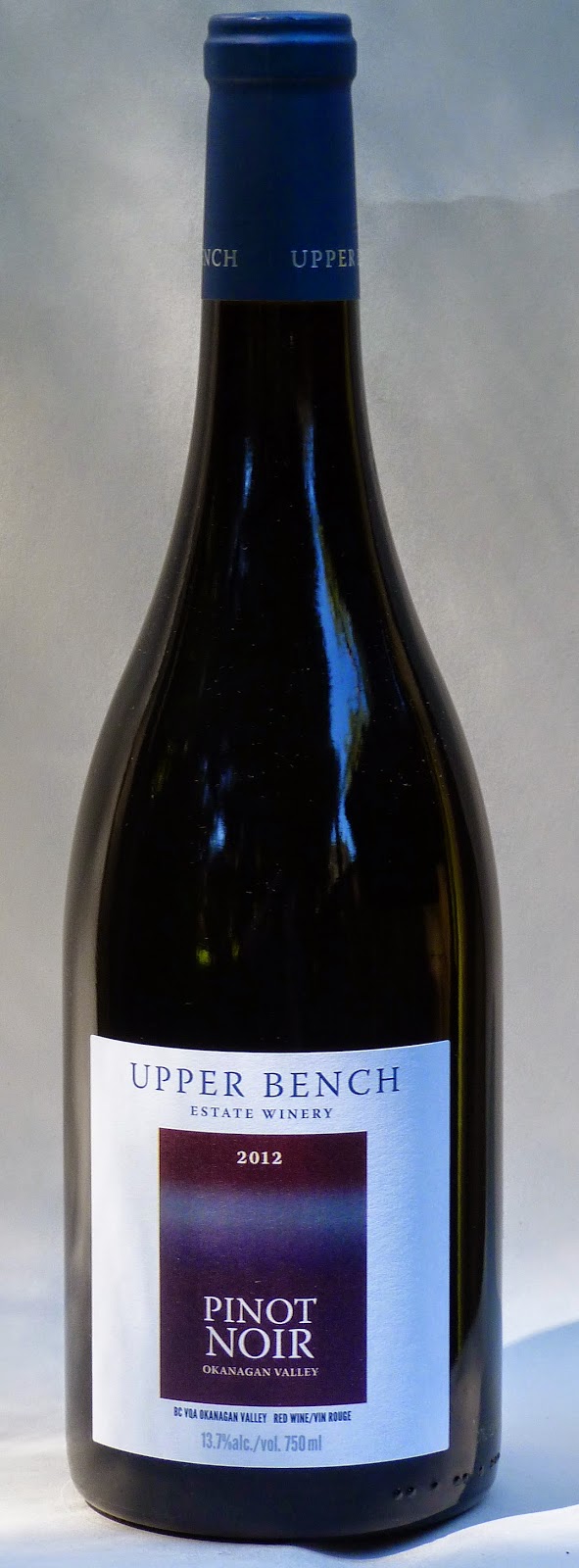
* Upper Bench Pinot Noir 2012 ($28 for 331 cases). The vines were cropped 3.4 tons an acre. This is a robust, earthy Pinot Noir with aromas of black cherry and spice. On the palate, there are notes of raspberry with chocolate and cherry on the finish. The tannins are smooth, if muscular, leading me to think this will benefit from three or four years of further age. 89-90.

* Upper Bench Merlot 2012 ($30 for 440 cases). The vines were cropped at 3.63 tons an acre. The wine is a tour de force of aroma and flavour, with a fine concentrated texture. Dark in colour, it begins with aromas of black cherry, mulberry, and black currant. On the palate, there are bold flavours of black cherry, spice, vanilla and chocolate. The alcohol of 14.3% indicates that very ripe grapes were used (the grapes were picked in early November 2012.) 92.

Upper Bench Estate Merlot 2012 ($35 for 154 cases). By cropping the estate Merlot vines at just 3.4 tons and acre, Gavin achieved a full-bodied and concentrated wine, turbocharged by aging 20 months in French oak (30% new). The wine begins with aromas of black cherry, plum and vanilla. On the palate, there are flavours of blueberries, black currants and chocolates. The texture is generous but firm enough to allow the wine to age gracefully for 10 years. 92.


Upper Bench Estate Cabernet Sauvignon 2012 ($35 for 188 cases). This wine was aged 20 months in French oak (40% new). There is a hint of oak in the aroma, along with aromas of mint and black currant. On the palate, there are flavours of black currants, cola and dark chocolate. The long ripe tannins make this wine approachable now but it should also age gracefully for 10 years. 90.

Thursday, March 12, 2015

Kettle Valley releases a Pinot trio


Photo: Kettle Valley's Tim Watts (r) and Bob Ferguson

The house style at Kettle Valley Winery has always been distinctive. Bob Ferguson and Tim Watts, the winemaker owners, make wines that are full of flavour and long-lived.

It flows from the way they grow their grapes, usually with low tonnages that concentrate flavours and textures. Then when they bring the fruit in, they set out to capture all the flavour that nature gave them.

One example is the winery’s gloriously eccentric Pinot Gris.  By coincidence, nearby Nichol Vineyard is the only other Okanagan winery that handles Pinot Gris quite like this.

Pinot Gris is a white wine grape that, at maturity, develops a pink hue to the skins. Most wineries chose to crush the grapes and press them quickly so as not to extract colour. A lot of excellent Pinot Gris wines are made this way.

At Kettle Valley, the grapes are crushed and then left to soak for two days on the skins before being pressed. That extracts a lot of colour. Crucially, it also extracts a lot of aroma and flavour. The result is a bold Pinot Gris that pairs admirably with food.

The winery has just released that wine, along with two of its Pinot Noirs.

The reserve Pinot Noir, with grapes from four vineyards in the central Okanagan, is the classic bold and ripe Kettle Valley style. The more floral Hayman John’s Block Pinot Noir, which is made from a single vineyard and a single clone.

“The Hayman Pinot Noir is Clone 13, commonly referred to as the “Washington State” clone, due to its popularity in Washington State in the mid-1980s,” Bob explained in an email.  “It is a thick skinned, late ripening clone.  Due to its tendency to late ripening, it is not so popular any more and much of the original plantings in Washington State have been pulled out and re-planted with either clone 72 (French clone 667) which is somewhat similar, or to clone 105 which is earlier ripening and thinner skinned.”

Clearly, Bob and Tim have learned to work with the clone, preferred to have older vines than to replant and wait for years for the concentration of flavour that older vines give.

I could not decide which of these Pinot Noirs I liked better because I enjoyed both. Here are my notes.

Kettle Valley Pinot Gris 2013 ($24). The wine begins with an appealing bronze pink hue. This wine has aromas and flavours of strawberries, with a touch of white pepper. A portion of the wine also was fermented in barrel, adding texture and complexity. The finish is dry and lingering. 91.

Kettle Valley Pinot Noir Reserve 2012 ($38 for 215 cases). This reserve is a selection of the best barrels of Pinot Noir made with grapes from four different vineyards. The wine, which was aged 20 months in French oak, begins with aromas of ripe plums, black cherries and vanilla. This is echoed by the ripe, even slightly porty, fruit flavours along with savoury hints of truffles. The tannins are elegant and silky, with a lingering finish.  The powerful wine is appealing now but also should cellar very well at least until 2022, developing further Burgundian complexity. 92.


Kettle Valley Hayman “John’s Block” Pinot Noir 2012 ($38 for 96 cases). This is a single vineyard wine from Kettle Valley’s Hayman Vineyard. It has been renamed John’s Block in memory of the legendary wine lover John Levine, who was Kettle Valley’s first customer and who died in 2012. This wine also has spent 20 months in French oak. However, it is a prettier, lighter and more feminine wine that the Reserve. It begins with aromas of raspberry and strawberry that are echoed on the palate. The wine has a graceful weight, with a silky texture and a seductive finish. 92.

Saturday, March 7, 2015

Inniskillin Dark Horse Meritage has a history


 Photo: Winemaker Sandor Mayer

One of the oldest and most consistent Meritage blends is the one that Inniskillin Okanagan has been producing since 1995 from its Dark Horse Vineyard.

It would be surprising to find older vintages in collector cellars. The consumers who collected Okanagan wines in the 1990s were hardly numerous. Okanagan wines were still being discovered in those days.

The winery’s current release is from the 2012 vintage. If you have not been collecting this wine, it might be time to consider it. The price still is affordable and the wine, in my view, is built to age at least to 2022.

This is the second last vintage that was made by Sandor Mayer, the veteran winemaker who returned to his native Hungary last summer.

The 9.3 hectare (23-acre) Dark Horse vineyard was first planted with hybrid varieties in the 1970s for a winery called Vinitera, which opened in 1979. The winery failed twice before it was taken over in 1987 by Alan Tyabji, who promptly uprooted the hybrids in the 1988 grape pull-out and then hired Sandor to replant with vinifera varieties.

Born in Hungary in 1958, Sandor had grown up on a farm with a modest vineyard. That led him to study horticulture and ultimately earn a degree in enology and viticulture from a leading Hungarian university. He emigrated to the Okanagan in 1988 (he had relatives here). The timing could have been better: there were few wine industry jobs because two-thirds of the vineyards had just been pulled out.

Reviving the Dark Horse Vineyard was one of the few jobs available. Sandor arrived in 1989 to find he first had to clean up a tangle of dead vines, trellis posts and wire. He accelerated the work by setting fire to the dead vines. The blaze was only prevented from incinerating nearby hillsides by the arrival of the Oliver fire department.

Sandor feared he would be fired but he was kept and replanted the vineyard. He made his first vintage there in 1992 and spent almost all of his Canadian winemaking career at Inniskillin Okanagan, as the winery has been known since 1996.

When Sandor returned to his native Hungary last year, he was succeeded by Derek Kontkanen, a Brock University graduate who had spent most of his career making white wines at Jackson-Triggs, a sister winery to Inniskillin Okanagan. He is also an authority on Icewine (his university thesis was on that topic). Inniskillin Okanagan’s Icewine is as renowned as the reds from Dark Horse Vineyard.

Several factors make the Dark Horse Vineyard special. The soils are complex and laden with volcanic minerals. The vineyard is nestled slightly in a bowl, with sun-bathed slopes facing south and southeast. In the early years, Sandor discovered the vineyard was too hot for a few of the varieties planted there, notably Gewürztraminer. But the heat units here are ideal for Bordeaux red varietals now dominating the vineyard.

The wines invariably have ripe flavours of dark fruit, with an earthy structure and firm tannins ideal for aging. The technical notes indicate a shift in style, with more robust alcohol levels since 2002 that suggest riper, fuller flavours. The earlier vintages had alcohol levels around 12.5%. Since 2002, the alcohol has been around 14%, which is what one would expect from this sun-bathed terroir.

The lower alcohol level in early vintages was due to above average crop and a vineyard that was still young,” Sandor explained in a recent email from Hungary.

Here is a note on the current release.

Inniskillin Okanagan Dark Horse Vineyard Meritage 2012 ($34.99 for 932 cases). This is 60% Merlot 60%, 30% Cabernet Sauvignon and 10% Cabernet Franc 10%. The three varietals are aged separately in French and American oak for 12 months before being blended. The wine begins with aromas of cherry, cassis and tobacco. There are flavours of black currant, blueberry, espresso and chocolate on the palate. At this stage, the wine has a firm texture that calls for decanting or, better still, the patience to let it develop in bottle for two of three more years. 90.


Tuesday, March 3, 2015

Baillie-Grohman Winery makes fast start


Photo: Baillie-Grohman's Bob Johnson

Baillie-Grohman Estate Winery in Creston has made a fast start since opening in 2010.

“In 2013 we produced 4,200 cases and in 2014 6,200 cases,” says Bob Johnson, who owns the winery with his wife, Petra Flaa.  “Our long term plan was to produce 4,000 to 6,000 depending on the season and the sales, so we are mature from the production point of view.”

The vineyard, which they began planting in 2006, has now grown to 17.5 acres, on the way to 23.5 acres. Half of that is dedicated to Pinot Noir, the signature variety for this winery. This spring the winery is releasing its first Reserve Pinot Noir.

Bob and Petra are former Calgarians who decided on a lifestyle change a decade ago. She had previously been a technology company manager who transformed herself into a good vineyard manager. Bob was a reservoir engineer with Sproule & Associates, an oil industry consulting firm. He retired from that company in 2013 to accelerate Baillie-Grohman’s wine marketing.

A New Zealand winemaking connection has been crucial to quality of the Baillie-Grohman wines. When the winery first advertised for a winemaker, no experienced Canadians applied.

“We had some very junior applications but we weren’t willing to bet the farm on someone who had a little bit of education and no experience,” Petra says. Like the neighbouring winery, Skimmerhorn, Baillie-Grohman recruited an experienced  New Zealand winemaker to come to the northern hemisphere during what is the off-season for southern hemisphere winemaking.

Since the first vintage at Baillie-Grohman in 2009, the wines have been made by Dan Barker (right), the owner and winemaker of the Moana Park Winery in Hawkes Bay. Among other kudos on his resume, he was New Zealand’s Young Winemaker of the Year in 2003.

Dan’s presence also inspired Wes Johnson, the proprietor’s son, to take up winemaking. Last fall, he completed his Bachelor of Science in Oenology in Napier, N.Z., where he also apprenticed with Moana Park. He has now joined Baillie-Grohman as assistant winemaker. 

In addition to Pinot Noir, the Baillie-Grohman vineyard grows Pinot Gris, Chardonnay, Sauvignon Blanc, Schönburger and Kerner, varieties that will mature in this relatively cool (compared to the Okanagan) climate.

The winery also buys Okanagan grapes to produce the big reds that cannot be grown in Creston. Bob has arranged to buy Merlot and Cabernet Franc from a grower in Osoyoos.

Here are notes on the current releases.

Baillie-Grohman Chardonnay 2012 ($25 for 169 cases). There are Chardonnay lovers who lament that boldly oaked Chardonnay seems out of fashion. Well, this is a wine for you. Barrel-fermented and aged in French oak (25% new), this wine has a good interplay of fruit and oak flavours. It has aromas of citrus and oak, leading to buttery flavours of baked apple and nectarine. 88.

Baillie-Grohman Récolte Rouge 2013 ($17 for 235 cases). The blend is not disclosed but the flavour suggests that Pinot Noir is the backbone for this juicy quaffer. It recalls Beaujolais with aromas and flavours of Byng cherries and with soft, supple tannins and a medium body. On the finish, there is a hint of spice and mocha chocolate. 88.

Baillie-Grohman Merlot 2012 ($22.50 for 653 cases). Because the Creston region is too cool for Merlot, the winery sources these grapes from vineyards near Osoyoos and in the Similkameen Valley. This is a dark wine with aroma of black currants and spice, leading to flavours of black cherry, liquorice, chocolate and coffee. The long ripe tannins give the wine a chewy, generous texture. 89.

Baillie-Grohman Cabernet Franc 2012 ($27 for 250 cases).  The grapes were sourced from an Osoyoos vineyard growing exclusively for Baillie-Grohman. The wine is delicious, beginning with aromas of blackberries and raspberries. The bramble flavours are lively, with notes of black cherry, blackberry, ripe raspberry and red liquorice. 90.

 Baillie-Grohman Pinot Noir 2012 ($25). The wine begins with aromas of ripe raspberry and cherry which are echoed in the flavours. Medium-bodied and juicy in texture, the wine is bright and vibrant. I would suggest cellaring this for a year. 88-90.

Baillie-Grohman Pinot Noir Reserve 2012 ($45 for 98 cases). This is the winery’s first reserve Pinot Noir, made by selecting the best barrels from the 40 barrels of Pinot Noir made in the 2012 vintage. Three clones went into this wine – 115, 667 and 777. The wine was aged in French oak (30% new). It has also had almost 18 months of bottle age before its official release in April. Even so, this remains a vibrant and youthful wine with dramatic aromas and flavours of black cherry and raspberry. I would suggest cellaring this until 2017. 91.


Monday, March 2, 2015

Hardy's Wines at Vancouver International Wine Festival


Photo: Bill Hardy, brand ambassador for Thomas Hardy & Sons

On its website, the Australian wine producer Thomas Hardy & Sons says that it is rated as “Most Powerful Australian Wine Brand” globally.

That speaks volumes for the ability of the Hardy’s brand to rise about the various crises the winery has come through since the founder, Thomas Hardy, planted grapes in 1854. That includes an entanglement with the conglomerate madness that swept through the Australian wine industry a decade ago.

Bruce Tyrrell, the proprietor of  Tyrrell’s Wines, another leading Australian producer, gives some of the credit to Bill Hardy, a veteran with 42 years in the business. He is now the brand ambassador for Hardy’s.

Both were among the Australian producers at this year’s Vancouver International Wine Festival. Bruce told me that Bill Hardy, besides being one of the nicest individuals in the Australian industry, logs countless miles each year, selling the Hardy’s brand to the wine trade and to consumers.

Bill is the fifth generation Hardy behind the family brand. And there is a sixth generation emerging.

The original Thomas Hardy was 20 when he emigrated from Britain in 1850. He tried to make his fortune as a gold miner and, when that did not work out, he became a butcher. He was so successful that, a few years later, he bought 46 acres for his first vineyard. He has sometimes been called the father of winegrowing in South Australia.

“He made his first wine in 1857 and exported two hogsheads to England in 1859, one of the first exports of wine from South Australia,” according to the Hardy’s entry on Wikipedia. “By 1863 his vineyards covered 35 acres (14 ha) of Grenache, Mataro, Muscat, Roussillon, Shiraz and Zante grapes. He also purchased grapes from other vignerons in the Adelaide area. By 1879 his vintage had reached 27,000 gallons (100,000 litres).”

(Zante is a seedless grapes often transformed into currants.)

Hardy continued making wine until 1890, turning the job over to a nephew so that he could concentrate on the business of what had become one of Australia’s leading wineries. The company was sound enough to survive the destruction of its original winery by fire in 1904.

His son, Robert, took over running the company in 1910, two years before Thomas Hardy died at the age of 82.

A nephew, Thomas Mayfield Hardy, took over the wine company in 1928, only to become part of one of the greatest tragedies in the Australian wine history. He died in an aircraft crash in 1938 that also took the lives of two other leading Australian winery owners - Hugo Gramp of Orlando and Sydney Hill Smith of Yalumba wineries.

His widow, Eileen Hardy, became legendary as the matriarch of the family, raising three Hardy sons. The winery honours her by labelling some of its best wines with the Eileen Hardy label.

One of those sons was Sir James Hardy, who took over in 1980 when an older brother, Thomas Walter Hardy, died of cancer. While he served as chair of the company, he was perhaps better known as a great yachtsman and an America’s Cup contender.

The winery’s expanded in both domestic and overseas market from the 1970s through the 1990s.

That success attracted the attention of Constellation Brands, the American company that now is the world’s largest wine company. In 2001, Constellation took over Hardy’s for A$1.85 billion.

Apart from the astronomical price, there was logic behind the deal. Hardy’s had very strong distribution in Britain while Constellation’s brands were weak there. Because the reverse was true in the United States, the synergy of the merger seemed obvious.

“We kept our end of the bargain,” Bill Hardy says. Constellation got better penetration in Britain but the Hardy’s brands did not get the lift they expected in the United States.

Constellation’s timing was terrible. It had waded into the Australian wine industry that, as a result of vineyard expansions, was swamping the world with wine, a lot of it called YellowTail®. By 2011 Constellation gave up trying to make money with Australian wine.

It sold 80% of Hardy’s for A$290 million to a private equity company in Australia. The current owner of Hardy is called Accolade Wines, a focussed Australian company that has put together a portfolio of premium brands. The legendary Grant Burge winery has also been acquired by Accolade and Grant Burge himself is now a brand ambassador as well.

Remarkably, the integrity of the Hardy’s brand has not suffered. “There is one of the things that our owners have never fiddled around with,” Bill says. “They have never dictated to production.”

The apparent strength of the Hardy’s brand likely is due to the good value its wines offer. The brand is well represented in British Columbia Liquor Distribution Branch. The listings include three $10 wines in the Hardy’s Varietal Range; four in the Hardy’s Stamp Series Range priced from $11 to $13 a bottle and $20 for a 1.5 litre Riesling Gewürztraminer; as well as a Nottage Hill Chardonnay at $12 and Nottage Hill Shiraz at $14.

At the wine festival, Bill Hardy was pouring some of Hardy’s premium wines, including two recent releases that bear his name. He is clearly proud of that honour. One member of each generation of the family has a wine named for a leading individual. Hopefully, some of these wines will also make it into the British Columbia market.

William Hardy Chardonnay 2013 ($16). This wine leans toward Chablis in style. It is crisp and refreshing with notes of citrus and apple. 90.

Eileen Hardy Chardonnay 2010 (N/A). This is an exceptional Chardonnay made with grapes from two cool climate vineyards – one in Tasmania and one in the Yarra Valley. Burgundian in style, this barrel-fermented wine has toasty notes in the nose and flavours of tangerine over subtle new oak. In Australia, where the Eileen Hardy Chardonnay wines have a long list of gold medals and best of show awards, this sell for about $65. 93.

William Hardy Barossa Shiraz 2012 ($16). This is a big juicy wine with aromas of black cherry and mulberry that are echoed on the generous palate. 90.

Hardy’s Tintara McLaren Vale Shiraz 2012 ($30). This wine is named for the McLaren Vale winery that Thomas Hardy bought in 1876. The wine is rich in texture, with vanilla and black cherry aromas. On the palate, there are flavours of black cherry, dark chocolate and coffee. There is a long and satisfying finish. 92.

Hardy’s HRB/D636 Coonawarra Cabernet Sauvignon 2007 ($35). HRB stands for Heritage Reserve Bin. This wine is 90% Coonawarra grapes and 10% Margaret River grapes. It is a full-bodied but elegant Cabernet Sauvignon with black currant aromas and flavours of black currant with a hint of tobacco and cedar. 91.