Thursday, July 23, 2015

LG award winner Noble Ridge pushes Pinot Noir boundaries


Photo: Noble Ridge's Leslie and Jim D'Andrea (courtesy Noble Ridge)

It has become a tradition that members of British Columbia’s consular corps accompany Lieutenant Governor Judith Guichon to the wineries that receive awards of excellence each year.

From all accounts, the consuls, who travel by bus, approach wine country with gusto. A few years ago, the consular wine purchases overloaded the bus baggage compartment. A truck was rented to transport the remaining purchases.

It is a welcome payday for winning wineries. This was probably not anticipated a decade ago when Government House began delivering the awards at the wineries. During the first two years of the competition, the award winners had to travel to Victoria to accept their trophies.

The awards parade has been happening this week, with the Lieutenant Governor and the consuls showing up at 14 winning wineries.

The award has enjoyed a much higher profile since the ceremony was taken to the wineries. It also has had far more impact on the wineries.

“We enjoyed winning the LG award last year,” says Gerry Thygesen, one of the owners of Krāzē Legz Vineyard & Winery in Kaleden. “On our web site, we had been averaging 3,000 to 4,000 hits a month. We went to 89,000 hits in a month just because of that award. It took us into a different realm.”

Noble Ridge Vineyards at Okanagan Falls will have known what to expect because the winery is a second time winner. This year the winery won with its sparkling wine, The One 2010, and received the award on July 20.

Noble Ridge was one of three Okanagan falls wineries to win this year. The others were B.C. Wine Studio (a first time winner) and Wild Goose Vineyards (a multiple award winner).

Earlier in July, I dropped in at Noble Ridge to find out what the consuls might be sampling with owners Jim and Leslie D’Andrea. I was impressed, as my notes will show.

I was also struck by an anomaly: Noble Ridge’s excellent Pinot Noir was not among the wines chosen for next month’s B.C. Pinot Noir Celebration.

As I understand it, a panel of sommeliers chose the participating wines and turned down the Noble Ridge wine because it was judged atypical. I won’t grizzle too much. I have also made mistakes as a wine judge (one of them involving a different Noble Ridge wine).

In defence of the Noble Ridge Pinot Noir, the style is indeed singular. Unlike many pretty “strawberries and cherries” Pinot Noirs, this wine invariable is rich and bold, with dark fruit on the nose and on the palate. I once reviewed the Noble Ridge Pinot Noir 2009, which had 15% alcohol, with the remark that this wine wanted to be a Zinfandel. Typical? No. Good? You bet it was.

Noble Ridge makes big Pinot Noirs intentionally. In the last three vintages, the Pinot Noir blocks have been picked at four different times to enhance the flavour profile.

It is unfortunate that attendees at the Pinot Noir Celebration won’t get to taste a Pinot Noir that pushes the boundaries the way Noble Ridge does.

Here are notes on current Noble Ridge wines. Prices include taxes.

Noble Ridge Mingle 2013 ($19.90).  This is a blend of Gewürztraminer, Chardonnay and Pinot Gris. It begins with aromas of citrus and spice, leading to flavours of apple, mango and citrus. There is a hint of sweetness on the finish. 90.

Noble Ridge Reserve Chardonnay 2012 ($29.90). This wine was best of class at a recent Los Angeles International Wine Competition. The wine is boldly oaked with rich flavours of butterscotch and marmalade. 91.

Noble Ridge Pinot Grigio 2013 ($19.90). This is a wine with a juicy texture and nice weight on the palate. There are flavours of apples and peaches with a spine of minerals. 90.

Noble Ridge Pinot Noir Reserve 2012 ($29.90). This is a typically ripe, succulent wine, enriched with flavours of plum, black cherry and blackberry. The wine spent between 14 and 16 months in French oak, further broadening the texture. The alcohol is 14.2% but there is no heat on the finish. 91.

 Noble Ridge Reserve Meritage 2012 ($29.90). This is a blend of Merlot and Cabernet Sauvignon enhanced with a touch of Malbec and Cabernet Franc. The aromas of black currant and black cherry continue to the palate where the fruit is rich, concentrated and sweet. Generous in body and satisfying on the finish, this is a delicious wine. 93.

Noble Ridge Meritage 2012 ($19.90). Here is the good value little brother. It is softer than the reserve but still delivers generous flavours of black currant and black cherry. 90.

Noble Ridge Reserve Cabernet Sauvignon 2012 ($44.90 for 200 cases). This excellent wine begins with aromas of cassis mingled with toasted oak. The texture is rich, deep and concentrated with flavours of cassis, vanilla, black cherry and blueberry. I recommend cellaring this wine another three years at least. It is drinking well now but is nowhere near its peak. 95.

Monday, July 20, 2015

CedarCreek's new winemaker inherits a clay amphora


Photo: CedarCreek winemaker Alexis Moore (courtesy CedarCreek)

In the past month, CedarCreek Estate Winery has made two momentous announcements and has released perhaps the most original wine ever made here, a Cabernet Sauvignon fermented and aged in a clay amphora.

Two of the announcements were made July 1. Given everything else happening on that day, the news was almost buried until a proper press release was put out two weeks later. Here is what you may have missed while watching the Canada Day fireworks:

  • CedarCreek’s 2012 Platinum Block 2 Pinot Noir got the trophy as Canada’s best red wine at Decanter Wine Awards in London.  In a review on this blog late last year, I wrote: “This is [a] pretty wine … with complex aromas of spice, cherry and strawberry and intense flavours of cherry and strawberry. The flavours are bright and vibrant and the finish is elegant and silky. 92-94.”
  • Alexis Moore, a Nova Scotia native who has been making wine in New Zealand, has been hired to take over from Darryl Brooker, recently named the chief winemaker at Mission Hill Family Estate Winery.

Alexis is a great catch. A winemaking graduate of Lincoln University in New Zealand, she has now worked 16 harvests in vineyards around the world. She started in Provence. She has worked in the United States at Flowers Winery in Sonoma, and at Penner-Ash Wine Cellars in Oregon.  "What an incredible winemaker!" says owner Lynn Penner-Ash, as quoted in CedarCreek’s news release.

In New Zealand, Alexis spent five years as assistant winemaker at Seresin Estate before becoming winemaker at Gladstone Vineyard.

“I never thought I’d leave New Zealand,” Alexis is quoted in the news release. “After ten years of successfully establishing roots in the wine world, New Zealand had definitely become my home. My great love is Pinot Noir and aromatic whites.” That lines up well with the major focus of CedarCreek production now that the winery is part of the quartet owned by Mission Hill proprietor Anthony von Mandl.

He is quoted as describing Alexis as “passionate and intellectual” and someone who “comes with an open mind.”

“And the fact that she is actually Canadian provides an extraordinary and very positive twist in the next chapter of CedarCreek’s proud history as one of the first eight pioneering wineries in British Columbia,” Anthony says. “Indeed what is New Zealand’s loss is most definitely British Columbia’s gain.”

It will be interesting to see whether her open mind will embrace such venerable Roman technology as making wine in a clay amphora.

In a commentary with the wine sample, Darryl Brooker (left), who joined CedarCreek in 2010, explained how it came about. “After collecting and trying a range of amphora wines made around the world, I decided to introduce a clay amphora at CedarCreek starting in the 2013 vintage. I sourced and ordered a clay amphora from Chianti in early 2013.”

Darryl chose to ferment Cabernet Sauvignon from the winery’s Desert Ridge Vineyard north of Osoyoos.

“The thought process behind this choice was that I wanted to leave the wine on skins for a long time and see what happened to the character of the wine,” he explains in a narrative released with the wine. “The wine was essentially an amphora trial. I decided not to line the amphora with beeswax or any other lining [leaving] completely natural clay in contact with the wine.”

Some 500 kg of berries, which were harvested October 28, 2013, went into the amphora without the addition of either sulphur or acid.

“We sealed the amphora and walked away,” he continues. “My big surprise was how hard it was to do nothing.”

He resisted the temptation to open the amphora and taste the wine. “This would have spoiled the trial,” he explains. “It took immense will power but I held strong and after almost eight months on the skins, we decided to open and press off the amphora. … I was totally expecting the wine to be challenging and potentially spoiled.”

Like a vintner in ancient Rome, Darryl pressed the grapes by foot, perhaps because CedarCreek did not have a basket press small enough. “The wine was exceptionally fresh with amazing earthy herb notes,” his narrative continues. “I was even more surprised by the rich and balanced tannins in the wine; they were not too harsh or extracted. I believe this is due to the high oxygen transmission rate in the amphora, which helped t0 polymerize and soften the wine.”

Deciding against putting the wine in oak, he aged it a further eight weeks in stainless steel and then bottled it, unfiltered and with no additives.

“The amazing part is that this wine has never had any added preservative (sulphur dioxide) and it has not had any yeast or malolactic bacteria added,” the narrative continues. “It is a truly natural wine at 14.8% alcohol. It has no residual sugar or residual malic acid. It is amazingly fresh and I now believe it will have a relatively long life ahead of it.”

The wine, a mere 30 cases, is available at the winery. If you miss the 2013, Darryl repeated this in 2014, using a blend of three Bordeaux varietals to give the wine more complexity.

Time will tell what Alexis puts in the amphora.

CedarCreek Amphora Wine Project Desert Ridge Cabernet Sauvignon 2013 ($52.99 plus tax for 30 cases). Dark in colour, the wine begins with aromas of plum and cherry. On the palate, there is an astounding purity of fruit flavours (cherry, plum, mulberry). The texture is rich and juicy. The wine is so fruity that it needs to be lightly chilled to be at its best, which is very good. Imagine drinking berry pie. 92.


Thursday, July 16, 2015

Tinhorn Creek releases four wines for summer


Photo: Tinhorn Creek Vineyards


It says volumes about how robust the rosé market is when a winery releases a reserve rosé.

Oldfield Series is the tag that Tinhorn Creek gives to its reserves. The current releases include two reserves – and two quite solid non-reserves.

The wines are also meant to draw attention to everything else going on at the winery this season. With an amphitheatre and the Miradoro Restaurant, Tinhorn Creek has emerged as one of the south Okanagan’s top destination wineries.

Details are on the website, www.tinhorn.com.

Here are notes on the wines.


Tinhorn Creek Pinot Gris 2014 ($16.99 for 8,478 cases). This is a textbook Pinot Gris, with citrus aromas and flavours of apple and pear with a lemony lift. The wine is crisp and quite refreshing. 90.

Tinhorn Creek Oldfield Series Rosé 2014 ($19.99 for 829 cases). This is a Cabernet Franc rosé, fermented in stainless steel with both wild yeast and cultured yeast. The colour is a light bronze pink, which the winery calls watermelon. It has aromas of blood orange. After the lightness of colour, the substantial weight on the palate is a welcome discovery. There are flavours strawberry and yellow raspberry, with a dry, lingering finish. 90.

Tinhorn Creek Pinot Noir 2012 ($19.49 for 2,262 cases). The wine begins with an appealing ruby hue, On the nose and on the palate, there is strawberry and cherry. The hint of oak adds some spice. The texture is silky and juicy. 90.


 Tinhorn Creek Oldfield Series Pinot Noir 2011 ($30.49 for 835 cases). It tells you about the vintages when you note this wine has 12.6% alcohol and its “little brother” from 2012 has 13.8%. Tinhorn Creek’s winemakers stood on their heads to make a reserve wine in a tough year. This wine has had 18 months in oak and two in bottle before release – and it is still firm. Time in a decanter delivers a more silky texture. It has aromas and flavours of raspberries and cherries. 89.

Monday, July 13, 2015

Poplar Grove releases include two Legacy vintages


Photo: Winemaker Stefan Arnason

The current wines being released by Poplar Grove Winery include, unusually, two vintages of The Legacy, the winery’s iconic red wine.

There appear to be two reasons for this. To begin with, the volumes of both vintages (2010, 2011) are small.

The 2010 vintage was cool, forcing Poplar Grove (and other wineries) to reduce crop load dramatically in order to ripen the grapes.

“We had forecasted a harvest of 220 tons,” winemaker Stefan Arnason says. “But because of the cool spring, cool summer and cold fall, we dropped the harvest to 80 tons.”

The Legacy is always blended from the best barrels but there were a lot fewer barrels to choose from in 2010. Production of The Legacy was limited to 350 cases, a volume that Poplar Grove’s wine club will buy in a heart beat if allowed to do so.

By releasing the 2011 vintage (550 cases) at about the same time, Poplar Grove has a fighting chance of satisfying both the wine club and restaurant clients.

“2011 was also tough vintage but the 2011 Legacy is very good,” Stefan says. “It’s pretty dense.” He would have preferred to make 700 cases but decided during blending that anything more than 550 cases risked diluting the quality.

The 2012 The Legacy, which is may be in bottle already, is from a very strong vintage. The winery will release 900 cases next year. Stefan thinks he could have produced twice as much easily but that risked saturating the market for a wine in this price bracket.

That brings me to the second reason for releasing two vintages at the same time. Traditionally, Poplar Grove held The Legacy back until it was five years old. Stefan is trying to move that to four years.

“Five years is unsustainable,” he suggests. “It is too hard to plan five years ahead.
We are on a three year release cycle with the other reds, so to go to a four year cycle is not that big a stretch. That we can plan for. By four years, the wines are really good.”

Judging by my recent tastings, the wines are good even earlier. Monster Vineyards is Poplar Grove’s value label. Here are notes.

Poplar Grove Pinot Gris 2014 ($19.90). This refreshing wine begins with aromas of citrus and apples. On the palate, there are layers of fruit flavours – apple, pear, nectarine, with a lively spicy finish that does not want to quit. 91.

Poplar Grove Chardonnay 2014 ($21.90). This is a fresh, fruit-forward Chardonnay that was fermented 80% in stainless steel. The 20% that was barrel-fermented adds a complexing hint of hazelnut to the palate. The wine begins with aromas of citrus and apples. On the palate, there are flavours of grapefruit, passion fruit and pear. 90.

Poplar Grove Blanc de Noirs 2014 ($24.90). Salmon pink in hue, the wine begins with aromas of strawberries. On the palate, there are flavours of strawberries, sour cherries, watermelon and rhubarb. This is a saignée rosé; the three red varieties has three hours of skin contact. The blend is 41% Malbec, 24% Merlot, 19% Syrah and 16% Viognier. The mid-palate is juicy but the finish is crisp and dry. 90.

Poplar Grove Cabernet Franc 2012 ($34.90). This has always been one of this winery’s signature red wines. It begins with brambleberry aromas and rustic tannins. Time in a decanter brings out a rich texture and generous flavours of black cherry, blackberry, plum and vanilla. The finish is long and satisfying. 92.

Poplar Grove Merlot 2011 ($29.90). This wine was aged 21 months in French oak and another 18 months in bottle before release. That is characteristic of the herculean effort the winemakers made to burnish a wine from one of the Okanagan’s most difficult vintages since 1999. For the most part, it is a great success. The wine’s texture is svelte and polished. The aromas of black currant, blackberry and tobacco continue to bright lingonberry and currant flavours. There is a slight note of spice and earth on the finish. 89.

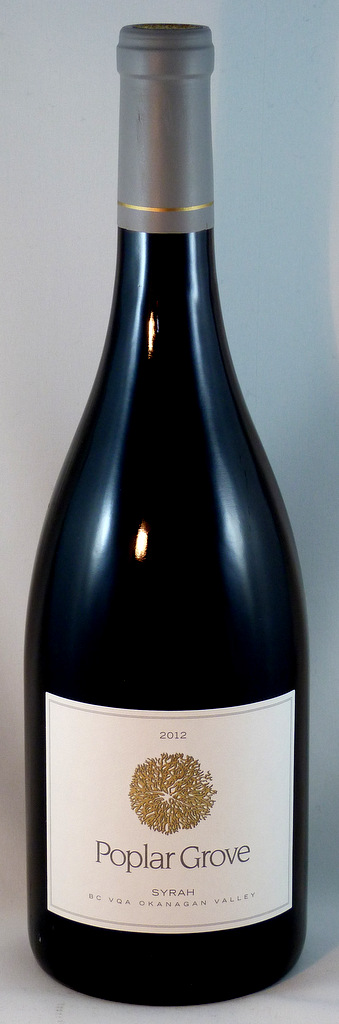
Poplar Grove Syrah 2012 ($31.41 plus tax; wine club only). This is a generous wine, beginning with aromas of black cherries, plum and boysenberries which are echoed in the flavours, along with white pepper and spice. The ripe tannins give this wine its rich texture and what the winery calls a “sultry expression” of Okanagan Syrah. 91

Poplar Grove The Legacy 2011 ($49.90 for 550 cases). The blend is Merlot 43%, Cabernet Franc 41%, Malbec 13%, Cabernet Sauvignon 3%. This firmly textured wine begins with aromas of black currant and black cherry, which are echoed on the palate, along with flavours of coffee and dark chocolate. There are spicy fruit flavours on the lingering finish. This wine will age for at least 10 years. 94.

Poplar Grove The Legacy 2010 ($49.90 for 350 cases). The blend is Merlot 33%, Malbec 24%, Cabernet Sauvignon 23%, Cabernet Franc 20%.  The wine begins with lovely cassis aromas which echo the cassis flavours on the palate. Lighter in body than previous vintages, this is nevertheless a wine of great elegance. It also has will age to its 10th birthday. 93.

Monster Vineyards White Knuckle 2014 ($17.90). This is a blend of 31% Pinot Gris, 25% Viognier, 17% Verdejo, 15% Riesling and 5% Chardonnay. Each varietal was fermented separately at a cool 16°C. It all adds up to a crisp and fruity blend with aromas and flavours of pears, apricots, melon and apple. 89.

Monster Vineyards Skinny Dip Chardonnay 2014 ($17.90). This is an unoaked Chardonnay. The touch of residual sugar gives the wine a juicy texture and accentuates the aromas of peach and melon and the flavours of apple and citrus. 89.

Monster Vineyards Riesling 2014 ($17.90).  This refreshing and fruit Riesling balances its bright acidity with a hint of residual sweetness. The moderate 12.3% alcohol adds to the wine’s ability to dance lightly across the palate. It has aromas and flavours of lime, lemon and green apples. 88.

Monster Vineyards Rose 2014 ($15.90). This is 64% Malbec, 17% Viognier, 15% Merlot and 4% Syrah. The juice of the red varietals was obtained by bleeding the tanks after minimal skin contact. The wine was cool fermented and was finished with seven grams of sugar per litre (and 7.5 grams of acidity). This balance gives the wine a juicy texture and a crisp finish. Bright pink in colour, the wine begins with aromas of strawberries and melon. It delivers flavours of cherries and cranberries. 89.


Thursday, July 9, 2015

C.C. Jentsch Cellars adds small lot wines


 Photo: Jentsch winemaker Amber Pratt


Grape grower Chris Jentsch launched C.C. Jentsch Cellars somewhat precipitously in the 2012 vintage when Andrew Peller Ltd. decided it did not need his 60 acres of grapes any more.

It was not a reflection on the quality of the fruit. Peller’s own substantial plantings had begun to produce more grapes.

Chris had been thinking of a winery but he had not had time to convert his fruit packing house into a production facility. So he arranged to have his 2012 wines made at Okanagan Crush Pad.

The new winery, on the highway midway between Osoyoos and Oliver, was ready for the 2013 vintage and for the new winemaker that Chris hired that summer.

Her name is Amber Pratt. Judging from the quality of the recent releases, she has put quite a positive imprint on this winery.

Born in Kamloops and raised in Victoria, she took an indirect path to winemaking, first training in horticulture at the Horticulture Centre of the Pacific. Just as she was getting her career launched, a pathogen forced the nursery she was working with to destroy its stock.

With time on her hands, Amber began taking professional courses on wine. “I was a novice wine drinker at the time, no stranger to labels like Yellowtail and Mateus,” she says. “And I took the first WSET course and then I took the second one - and I was just hooked.”

She moved to the Okanagan early in 2009 to enrol in Okanagan College’s winemaking and viticulture courses. She finished in June, a bit early to find a job in a wine cellar, so she went to work in the tasting room at Nk’Mip Cellars for the season.

That allowed her to research the industry and its wines. By fall, she was sending her résumé to select wineries. Michael Bartier, then the winemaker at Road 13 vineyards, offered Amber a job.

“I started with him in September 2009 on what I won’t even call a learning curve,” she laughs today. “It was vertical line straight up. I didn’t even know how to run a pump.”

In her second year there, Amber went France to visit wineries in the Loire that were making some of the varieties she was working with at Road 13, including Chenin Blanc. While there, she got an email offering her a cellar hand position at Black Hills Estate Winery. After a year in that position, she was promoted to assistant winemaker.

It is apparent that she is a quick study. “I have had the good fortune of working with people who are very free with knowledge and very willing to share their past experiences and what they knew,” she says. “I get asked all the time, is it really competitive; are you trying to keep your secrets? Grapes plus yeast equals wine! After that, there are no secrets.”

The move to C.C. Jentsch in 2013 promoted her to winemaker, with the opportunity to put her stamp on an emerging brand.

“I really like that owner is the grower,” Amber says. “The chain of communication is blessedly short. He is not living off in some location where he is hard to get. Chris Jentsch gets his hands dirty and he gets right in there. That makes you feel like you have a team mate.”

Both the 2013 and 2014 vintages produced good grapes, and lots of them. That has given Amber the opportunity to identify select lots for special treatment. The result has been the winery’s small lot series, wines that should turn heads.

Here are notes on the recent releases, along with the more affordable large volume releases.

C.C. Jentsch Cellars Small Lot Series Chardonnay 2014 ($35.90 for 82 cases). Barrel-fermented and aged in new French oak for six months, this wine mingles the oak and nutmeg with citrus flavours and aromas. The bright acidity give this wine age-ability. The winery suggests cellaring this at least for a year. Good advice; time will give a seamless integration to the wine. 91.

C.C. Jentsch Cellars Small Lot Series Viognier 2014 ($35.90 for 129 cases). The wine begins with lush aromas of nectarine, apricot and pineapple. Everything is echoed on the palate, including the sensually lush texture. The rich finish is persistent. 91.

C.C. Jentsch Cellars Small Lot Series Malbec 2013 ($49.90 for 45 cases). Dramatic aromas of blueberries and violets just jump from the glass, leading to flavours of blueberries, blackberries and cherries, with a hint of vanilla.  There is a very long spicy and peppery finish. The 17 months oak aging has given this wine finely sculptured tannins. 93.

C.C. Jentsch Cellars The Quest 2014 ($17.90 for 363 cases). This is a blend of Chardonnay 61%, Viognier 27%, and Gewürztraminer 12%. With 13.8% alcohol, this is a robust wine, bursting with fruit aromas and flavours. On the nose, there is apricot and tangerine. On the palate, there are rich flavours of apricot, baked apple, ripe pineapple and tangerine. 89.

C.C. Jentsch Cellars The Dance 2014 ($17.90 for 337 cases). This dry rosé is intense in aroma and presents in the glass with a vivid colour. The flavours include cherry, blackberry and raspberry with a hint of pepper on the finish. The wine is 55% Merlot, 20% Cabernet Franc, 12% Syrah, 11% Cabernet Sauvignon and 2% Malbec. The 13.4% alcohol peaks through the intensity. 88.

C.C. Jentsch Cellars The Chase 2013 ($20 for 7,488 cases). This Bordeaux blend is the winery’s signature red blend. The winemaker calls it a “hidden gem” because of the value/quality relationship. This is a blend of 32.5% Cabernet Sauvignon, 32.5% Cabernet Franc, 30% Merlot, 3% Petit Verdot and 2% Malbec. The wine has a generous texture with soft, ripe tannins. There are aromas and flavours of black currants, red fruit, chocolate and vanilla. 90.

C.C. Jentsch Cellars Cabernet Merlot 2013 ($16 for 1,062 cases). This is 43% Cabernet Franc, 37% Merlot and 20% Cabernet Sauvignon. The little brother to The Chase, it is designed for current drinking. It has a juicy texture, with aromas and flavours of raspberry, cherry, blueberry and strawberry. 89.

C.C. Jentsch Cellars Syrah 2013 ($29.90). This wine, dark in the glass, begins with smoky aromas of leather, deli spices and pepper. On the palate this is a bold, meaty wine with flavours of black cherry and black olives. There are appealing earthy and peppery notes. This wine is already piling awards at competition. 91.


Monday, July 6, 2015

Harry McWatters' Encore recruits winemaker Lawrence Buhler


Photo: Winemaker Lawrence Buhler

Harry McWatters appears to have landed a heavyweight winemaker for the collection of Okanagan wineries and labels under Encore Vineyards.

Encore is the holding company run by Harry (and several partners). It is the parent to McWatters Collection, Time Estate Winery and Evolve Cellars.

On August 1, Ontario winemaker Lawrence Buhler becomes Encore’s director of winemaking.

Encore’s announcement says that Lawrence (who has extended family in the Okanagan) has been involved in the wine industry since 1999. He is a graduate of Brock University’s Cool Climate Oenological and Viticultural Institute. He has “more than 10 years of winemaking experience,” the announcement says. “In the past, he has worked with Peller Estates and Angels Gate in Ontario, as well as with Cape Mentelle in Australia.”

Most recently, he spent several years as the head winemaker at Colio Estate Winery at Harrow (near Windsor). Since making its first vintage in 1980, Colio has grown into one of Ontario’s largest wineries, producing about 500,000 cases a year. That includes 25 VQA wines, so-called “value” wines, bag in box wines and even flavoured wines.

Lawrence is unlikely to have to juggle as many products in the Okanagan.  Evolve owns and operates the 60-acre Sundial Vineyard on the Black Sage Bench in Oliver. A 25,000 sq. ft. state-of-the-art custom wine production facility and winery is currently being constructed at the Sundial location. The Time and the McWatters Collection wines will be produced there.

Evolve Cellars opened in mid-May in the property that previously had been the now-closed Bonitas Winery, just north of Summerland. The wines currently available at Evolve were produced by Time.

Until now, the wines for the McWatters Collection and Time have been produced for Harry by winemaking consultants, including Brad Cooper and J-M Bouchard.

Lawrence takes over a portfolio of wines made from one of most mature vineyards on the Black Sage Bench. Sundial is part of 115-acre Black Sage Vineyard which was planted in 1993, largely to Bordeaux varieties.

When ownership of the vineyard was divided several years ago, Constellation Brands got half the vineyard and the Black Sage Vineyard name. Harry’s half was renamed Sundial.

Here is the current portfolio.

Time Chardonnay 2013 Sundial Vineyard ($27.99). Alcohol 13.9%. The wine begins with a lovely golden hue and aromas of orange marmalade mingled with butter and hazelnuts. On the palate, the wine is rich, with flavours of baked apple and citrus, touched with butterscotch and vanilla. This has the structure to develop further complexity with a few more years of cellaring. 91.

Time Sundial 2013 ($19.99). This is a blend of Pinot Blanc, Chardonnay and Sauvignon Blanc. It begins with aromas of melons, apples and herbal spice, leading to flavours of pears and apples. The wine has good weight, with a refreshing and lingering finish. 89.

Time Meritage 2012 ($29.99). This is 60% Merlot, 29% Cabernet Sauvignon and 11% Cabernet Franc, with all the grapes from the Sundial Vineyard. The wine has aromas of black cherry with a hint of cassis and oak. The wine has a generous texture, with spicy flavours of black currants and notes of sage, classic for the terroir of the South Okanagan. The tannins are long. The wine is drinking well now if one decants it, but it has the structure to age. The winery says the wine could be aged until 2022. 90.

Time Syrah 2012 ($35). Dark in colour, this is a classic Okanagan Syrah with aromas of black cherry mingled with pepper and rare steak. It follows through on the palate with bold flavours of dark fruit, delicatessen spices and pepper. 91.

McWatters Collection Chardonnay 2013 ($30 for 490 cases). Alcohol 14.2%. This is an elegant wine, beginning with aromas of citrus and peach. On the palate, the marmalade flavours mingle with delicate butterscotch. The weight is rich and the finish just goes on and on. 92.


McWatters Collection Meritage 2012 ($25). This is 68% Cabernet Sauvignon, Merlot 20% and Cabernet Franc 12%. The wine, which was aged 15 months in French oak, has aromas of black currant, black cherry and vanilla. These are repeated on the palate, along some chocolate on the finish. The long ripe tannins still are firm enough to support cellaring the wine. It was delicious on opening but blossomed with sweet berry flavours when left overnight. 91.

Thursday, July 2, 2015

Lariana Cellars releases entire portfolio


Photo: Lariana's Dan and Carol Scott

Lariana Cellars, the Osoyoos winery that is a literal stone’s throw from the U.S. border, now has released its entire portfolio.

That is just two wines, but what marvellous wines they are.

The winery is owned by Dan and Carol Scott. The winery is just three years old but Carol has a much longer connection to BC wines.

As a teenager when she spent several summers working in the Shannon Pacific Vineyard on Black Sage Road. Her father, Larry Franklin, was one of the vineyard’s owners. Until the hybrid grapes were pulled out in 1988, Larry and Carol picked some for home winemaking in the family’s Burnaby home. That vineyard, replanted with premium vinifera, now belongs to several top Black Sage Road wineries.

In the late 1960s, not long after Shannon Pacific was planted the first time, Larry Franklin also bought a four-hectare (10-acre) Osoyoos orchard property with what was then called the Shady Lagoon Campsite on the lake. Dan, a machinist, and Carol, a travel agent, took over the property in 1989. They still operate the lakeside recreational vehicle camp. Growing cherries and apples became uneconomic and the trees were pulled out in 2006. “It was kind of my dream to plant grapes,” Carol says.

Since 2007, they have planted 1.8 hectares (4.5 acres) of vines. The largest block is Cabernet Sauvignon, followed by Carmenère and Viognier. Accordingly, the winery’s red blend is anchored by Cabernet Sauvignon. The Merlot and the Syrah fleshing out the debut blend are purchased from nearby growers because Dan and Carol’s vineyard is fully planted. They have no current plans to double production by turning the campground into vineyard.

The modest winery is very well equipped. Lariana was one of the earliest wineries in the Okanagan to install an 1,800-litre concrete egg for fermenting and aging wine. This vessel, made in California, is used to ferment Lariana’s Viognier. The reds are fermented in small stainless steel tanks and aged in oak barrels.

Lariana’s winemaking consultant is Senka Tennant. She was the founding winemaker with Black Hills Estate Winery. Currently, she is the co-proprietor and winemaker at Terravista Vineyards.

Lariana’s decision to limit its red portfolio just to a premium red called Twelve echoes Senka’s strategy at Black Hills. That winery opened in 2001 with a Bordeaux blend called Nota Bene, which quickly became, and remains, an Okanagan icon.

Twelve is named for the vintage. At this time, the plan is that subsequent releases will also be named for the vintage in which the wine was grown.

Intrigue Winery in Lake Country used a similar strategy for a number of vintages of a white wine. Eventually, the owners found that unwieldy and rebranded the wine. It will be interesting to see if Lariana makes it work.

Here are notes on the wines.

Lariana Cellars Viognier 2014 ($23). This is the third vintage of Viognier from Lariana and it confirms the winery’s excellence with this varietal. This is an exquisitely balanced wine where the 13.9% alcohol is kept in check by the flavours, the texture and the refreshing acidity. The wine has aromas of lime and white peach with a floral note reminiscent of violets. On the palate, there are flavours of lime and melon with a hint of spice on the long, refreshing finish. 93.

Lariana Cellars Twelve 2012 ($44.90 for 480 cases). This is a blend of 53% Cabernet Sauvignon, 25% Syrah, 21% Merlot and 1% Carmenère. The wine was aged 18 months in oak (90% French, of which 45% was new). Dark in colour, the wine begins with dramatic aromas that jump from the glass – plum, black cherry, chocolate and spice. This is echoed on the palate, which delivers a delicious array of sweet red and dark berry flavours. The ripe tannins give the wine a generous and satisfying finish. 91.