Tuesday, January 19, 2016

SpierHead trio of 2014 Pinot Noirs


Photo: SpierHead proprietor Bill Knutson

SpierHead Winery president Bill Knutson accompanied the winery’s latest release of three Pinot Noirs with his usual informative note on what is happening in the SpierHead vineyard.

“The Kelowna area is emerging, or perhaps has emerged, as one of the most suitable regions in British Columbia for the production of Pinot Noir,” he wrote. 

By coincidence, I recently learned that Quails’ Gate Estate Winery has just purchased about 100 acres of vineyard land in East Kelowna, to be planted during the next five or six years. About 40 acres will be planted with Pinot Noir.

That is confirmation from a leading Pinot Noir producer that Bill is correct.

“At SpierHead,” he writes, “our plan is to offer a portfolio of Pinot Noir bottlings; differentiating on the basis of specific vineyard origins and clonal content.”

The winery currently grows Dijon clones 115, 667, 777 and 828, as well as the Pommard clone.

“We recently planted five or six acres of Pinot Noir,” he wrote. “That includes a half acre each of two California heritage clones: Mt. Eden and Swan. When those plants begin producing, we’ll increase our options to create small, unique bottlings of Pinot Noir. SpierHead is never going to be a big volume producer, but I am hopeful that we can establish a niche as a high quality producer of Pinot Noir known for its site and clone specific bottlings.”

The SpierHead Pinot Noir that keeps the lights on its white label Okanagan Valley appellation Pinot Noir. In the 2014 vintage, the winery produced 900 cases, which is about 60% of the winery’s production.

“This is our fifth vintage of Pinot Noir and we are hoping to achieve a house style that is new world, but with some Burgundian restraint and finesse,” Bill writes. “We are not looking to have our Pinot Noir mistaken for a Californian wine. Rather, we are trying to produce a wine with the body and aromas that would be closer to an Oregon Pinot Noir in style.”

The trio of 2014 releases includes a vineyard-designated Pinot Noir: Gentleman Farmer Vineyard Saddle Block. Gentleman Farmer is the name of the vineyard where SpierHead planted its original four acres of Pinot Noir in a site contoured like a saddle.

Part of SpierHead’s strategy is to develop a small group of vineyard-designated Pinot Noirs. A second was made in 2014, but not yet released, from the Golden Retreat Vineyard in Summerland.

The third wine in this release package is the winery’s second vintage designated as Pinot Noir Cuvée, a selection of the best barrels in the cellar.

“We produce the Cuvée in small quantity with the goal of creating a wine that will be worthy of mention along side the top Pinot Noirs in B.C.,” Bill writes.

I would say SpierHead has succeeded in that objective.

Here are notes on the three wines.

SpierHead Pinot Noir 2014 ($23 for 900 cases). This is clones 115, 667 and Pommard, barrel-aged for 10 months in French oak. The wine begins with aromas of cherry and raspberry. There are bright and vibrant red fruit flavours on the palate, with a hint of oak. The texture is still firm, a signature of a youthful Pinot Noir that can be aged for several years. 88.

SpierHead Pinot Noir 2014 GFV Saddle Block ($27 for 211 cases). This is 34% clone 115, 33% clone 777 and 33% clone 828, also aged 10 months in French oak. This dark-hued wine has good concentration and weight. It begins with aromas of cherries. This is echoed on the palate, along with plum and mocha. Decanting fleshed out the texture; this is definitely a wine to cellar for several years. 91.


SpierHead Pinot Noir Cuvée 2014 ($32 for 274 cases). The winery also bottled 48 Magnums and 12 Double Magnums. This is 46% clone 115, 21% clone 777. 17% clone 828 and eight percent each of clone 667 and Pommard clone, aged 10 months in French oak. The wine’s rich colour is immediately inviting, as are the complex aromas of cherry, strawberry and raspberry that are echoed in the flavours. The wine is concentrated and the texture is seductive, as it should in a fine Pinot Noir. There is a lingering finish with notes of spice, red fruit and mocha. The wine will cellar for seven years; the large format bottle even longer. 92.

Class of 2015: Chateau Wolff Estate Winery


Photo: Chateau Wolff owners Matt and Natalie Riga with daughter Siena

Nanaimo’s Chateau Wolff Estate Winery, which has been dormant since founder Harry von Wolff died in 2005, has been revived brilliantly by Ontarians Matt and Natalie Riga.


They opened their renovated tasting room last summer. Their debut vintage of 2014 was about 300 cases and most of those wines are entirely or almost sold out. In 2015, they have raised production to about 550 cases, thanks to their Herculean work to restore a vineyard that had fallen into neglect.

They have chosen to revive the memory of the founder both by keeping his original name for the winery and by retaining some of his artefacts. Harry also operated a store specializing in western-style garments and he was often garbed in those styles. One of Harry’s Stetsons now hangs on the tasting room wall.

“It was pretty personal, taking over the property [in 2014],” Natalie says. “At the time, his house was still there and not everything had been taken out of the house. There were all of his wine books that he had used. We have them in our office now. We go through them and read things … you can never read too much about wine … and he has his own notes in some of them. We have never met this man but we know quite a bit about him.”

It is one of those strange coincidences that Harry was born in Riga, the capital of Latvia, while the surname of the current owners is Riga.

Matt was born in Trenton, Ontario, in 1981 while Natalie is from London, Ontario. Both set out on career paths quite unrelated to wine. Matt, with a degree in sociology and a minor in criminology, spent several years as a youth counsellor in Victoria. Natalie has a sociology degree from the University of Victoria.

They first came to Victoria in 2007 to visit friends and fell in love with Vancouver Island. “We decided we were going to stay there fulltime,” Natalie says. That plan was upset in 2009 by a health crisis in Matt’s family, causing the couple to return to Trenton. “That took us on a whole other journey,” Natalie.

Matt had grown up working in a popular Italian restaurant owned by an uncle and aunt. So in 2010 Matt and Natalie opened their own restaurant, The Port Bistro.

“We had been talking about a small restaurant in Victoria,” Matt says. “We both love cooking and everything that goes along with that.” Their bistro, which served what they called gourmet comfort food, also put them in touch with the wineries in nearby Prince Edward County.

That fired their interest in a winemaking career. Soon they were exploring the wineries and volunteering to help at crush. After running the bistro for two and a half years, they decided against careers as restaurateurs. They began searching for winery opportunities, first in Prince Edward County, then Niagara and finally on Vancouver Island.

“We both wanted to move back to Vancouver Island,” Natalie says. “We had a hard time leaving Victoria originally. Moving back to the island was something we had in our hearts.”

An internet search led them to Chateau Wolff which Sotheby’s International Realty had listed for $859,000. Located on the western outskirts of Nanaimo, the property included five acres of vines, most planted in 1990. The mature vineyard appealed to Matt and Natalie. “Old vines produce less wine but they produce better wine,” he says.

The property also came with the larger than life stories of Harry von Wolff, (right) who had purchased the property in 1987 to develop Nanaimo’s first winery.

He had been a member of a prosperous family of landowners until World War 11 and the Soviet occupation of Latvia left his father in a Siberian prison camp and the rest of the family as postwar refugees.  Harry, with his mother and grandmother, immigrated to Canada in 1953. He worked on an uncle's ranch in British Columbia's Peace River country for a year and then began a peripatetic career through fifty-eight different jobs over eleven years. A hotel management course in Switzerland led to a career in the hotel business that fostered his interest in wines.

With his wife, Helga, Harry settled in Nanaimo in 1977 and prospered in retailing western clothing and footwear. Harry now became a competent amateur winemaker and, after planting a few vines at his home, established this vineyard. An admirer of the wines of Burgundy, he planted Pinot Noir and Chardonnay in the best site, a southwest-facing slope against a sunbathed cliff. His first commercial vintage was 1996 and he opened the winey in 1998.

After his death at age 71 in 2005 (Helga died shortly thereafter), his survivors struggled with the vineyard, leasing it to another Nanaimo winery, then selling the grapes and then finally letting it grow wild until Matt and Natalie came along late in 2013. Matt estimates that he pruned “about five years of wood” prior to the 2014 and 2015 vintages.

The couple recognized that they “could not wing it” and recruited Mackenzie Brisbois, a graduate both of Niagara College and the University of Guelph, with experience both in vineyards and in wineries. She had been an assistant winemaker at Norman Hardy Winery, Matt and Natalie’s favourite Prince Edward County winery. Ready to take on the challenge of helping the new owners turn around Chateau Wolff, she arrived in April 2014, staying through the season and the crush before returning to Prince Edward County in 2015.

“She showed us the ropes in both the vineyard and the winery,” Matt says. “It worked out really well. We couldn’t believe it was happening. I had underestimated what goes into winemaking and tending to a vineyard. We have learned that the vineyard is the most important place because that is where it starts. We were lucky to find someone like Mackenzie.”

Matt and Natalie (and their 18 month old daughter, Siena) handled the vineyard and the winemaking themselves in 2015. When they needed help picking the grapes, they invited about 25 volunteers. Matt dipped into his experience as a chef, roasting a pig over a spit to feed the volunteers. Some already have their names on the list for picking in 2016.

The hand of an experienced winemaker shows in the quality of the wines that launched the Chateau Wolff revival. These excellent wines, because production is limited, are available at the tasting room (open now on weekends and by appointment) and in a handful of Nanaimo and Victoria liquor stores and restaurants. They are well worth seeking out.

Here are notes on all the wines they released, except for Chardonnay, which is sold out.

Chateau Wolff White Blend 2014 ($15). This is about 85% Viognier with Bacchus and Siegerrebe completing the blend. The wine begins with fragrant floral aromas, leading to flavours of apples and pears and a crisp finish. 88.

Chateau Wolff Pinot Noir 2014 ($25). Aged in French oak for nine months, this wine has spicy aromas and flavours of cherry. It has good intensity on the palate and the fine tannins give it a good texture. 88-90.

Chateau Wolff Syrah 2014 ($25). Syrah grapes were purchased from Naramata Bench vineyards (and were purchased again in 2015) so that the winery could make a big red from a variety not grown on the island. This wine begins with an appealing aroma of red fruit and white pepper. It has classic gamy flavours of meaty red fruit and pepper. There is a hint of spice and raspberry on the long finish. 90.

Chateau Wolff Rouge 2014 ($18 for 375 ml). This fortified wine from the estate’s Dornfelder grapes is a tribute to the port-style wine that Harry called Grand Rouge. This wine begins with appealing sweet fruit aromas leading to flavours of black cherry, fig and liquorice. 88.


Chateau Wolff Sparkling Cider (Not for sale). This excellent cider is an extension to the traditional Wolff portfolio. Closed with a crown cap, it opens with froth of bubbles. You need to pour the first class promptly. It has fresh aromas and flavours of apples, with a defining note of tannin on the crisp, dry finish. With just 7.5% alcohol, this is easy to drink. 88.


Monday, January 18, 2016

Ruffino brings its Prosecco to the wine festival


Since Italy is the theme region at the Vancouver International Wine Festival, it is hardly surprising that numerous Prosecco wines which will on the tasting room floor.

The surprise is that one of them will be at the table of Ruffino, one of the great Chianti producers. It added a Prosecco to its portfolio five or six years ago. That tells you something about how Prosecco has been taking the world by storm.

The Ruffino winery was established in 1877 by Ilario and Leopoldo Ruffino. The winery was sold in 1913 to the Folonari family. Even though that is also a distinguished winemaking family, the Ruffino name has never been allowed to disappear.

The Ruffino reputation was made (and is sustained) with Chianti. Ruffino was the first Chianti producer to export to the United States.

The winery also was named an official supplier to the Italian royal family when Italy had a king. Riserva Ducale Chianti Classico, the winery’s flagship red, was first produced in 1927. The name recognizes the winery’s royal patronage at the time. Victor Emmanuel 111, the last king of Italy (and the king who had Mussolini arrested), abdicated in 1946 and died the following year in exile.

Why would a Chianti producer extend its production to Prosecco? The Glera grape, the main Prosecco variety, grows in northeastern Italy, across the Italian peninsula from Tuscany.

Well, consider how Prosecco sales have grown in British Columbia alone, never mind in the world at large. The first Prosecco was listed here in 1995. Now the Liquor Distribution Branch lists 28. That does not include the Ruffino example which is just being introduced to the market.

Sales of Italian sparkling wine in British Columbia (nearly all of it is Prosecco) hit $100 million in the 12 months ended March 31, 2015, up a whopping 28% from the previous year. In fact, Prosecco sales have nearly doubled in the past two years.

Prosecco gets its bubbles by being fermented in a pressure tank, not in individual bottles. The full-bubble wines are called spumante while those with less effervescence are called frizzanté. Tank fermentation has two advantages: the wines, which usually are dry, are much fresher than bottle-fermented wines; and are considerably cheaper to make. Most sell here under $20.

Barbara Philip MW, the LDB product consultant responsible for this category, explains the appeal of the wine.

“Prosecco tends to be softer on the palate that, say, Champagne or Cava, and is driven by upfront fruity aromas rather than toast and mineral,” she says. “Many are well packaged and that encourages consumers to pick them off the shelf. Then they taste it, like it, and come back. I also think that people love the name. It is easy for a non-Italian speaker to pronounce and sounds kind of fancy rolling off the tongue.”

The Ruffino Prosecco was poured at a recent tasting sponsored by the Wine Festival for media and trade. It is an impressive example, starting with elegant packaging. It is crisp and refreshing, with energetic bubbles, fruity aromas and flavours of apple. I scored it 90 points and I fully intend to revisit the wine at the Ruffino table during the festival and pick up a few bottles at the festival’s wine store.


Thursday, January 14, 2016

Joiefarm’s teambuilding vintage in 2015


Photo: JoieFarm's owner and winemaker Heidi Noble 

At the start of 2015 vintage in mid-August, I dropped in at JoieFarm Winery to see how owner Heidi Noble was doing.

She was a little stressed. Robert Thielicke, who had been a member of the winemaking team for a number of years, had left a month before this abnormally early and hot 2015 vintage began.

What happened next says volumes for the esprit de corps that the crisis of a very early vintage led to at the winery. “The team rallied around me in a difficult vintage,” Heidi told me this week. “It was a truly wonderful experience, from the sense of what was actually accomplished … and a sense of team building and coming together as a whole.”

This week, JoieFarm began bottling its aromatic whites and rosé from 2015. “I could not be more pleased with what has come out of 2015, as difficult and challenging as it was,” Heidi says.

“We really did make some spectacular wines: very naturally balanced in a difficult vintage, alcohol and acidity-wise,” she says. “We worked really hard, doing multiple picks for flavour and acid – and working doubly hard because the vintage was fast and hot and hard. I had a team in tow that was willing to go the extra effort to continue to make naturally balanced wines which I think has always been the hallmark of my winemaking.”

She has decided not to recruit another winemaker after seeing how JoieFarm staff rose to the challenge. Veteran cellar hand Karl Duda “challenged himself and competently worked by my side to tackle the harvest,” she says. Others into the fray included several people who had been hired earlier in the year to get JoieFarm’s new wine shop open.

These include Tyler Archer, who had come from Painted Rock Winery where he had opened a tasting room earlier. He has actually worked 14 vintages, both in B.C. and in the southern hemisphere.

“That was not necessarily what I hired Tyson for in the spring,” Heidi says. “But he was an invaluable asset to have in such an emergency situation, in terms of how early the crush was. He was able to jump in without very much guidance. Tyson, [tasting room manager] Jennifer Carter and [hospitality director] JJ Skidmore worked through August and September finishing our hospitality season while gracefully tackling harvest on the crush pad alongside myself and Karl as a unified team,” Heidi recounts. As well, the winery’s administrative staff  - General Manager Noelle Starzynski,  Amy Campbell and Sogol Jalali – all pitched in as needed.

The year was one of the most momentous for the winery since JoieFarm, now making 15,000 cases a year, opened in 2005.  

In 2015, Heidi became the sole owner after purchasing the interest of Michael Dinn, the winery’s other founding partner.

Secondly, the winery for the first time opened a tasting room, making the wines much more accessible to the crowds that tour along Naramata Road each season. Thirdly, the winery installed a pizza oven and began selling pizza to visitors.

Heidi says this was like “opening a new business.” However, increasing the winery’s direct-to-consumer sales had become critical.

“With the change of wine legislation in British Columbia, opening the tasting room was certainly the right thing to do,” she says. “More control of direct sales will be necessary for the survival of the smaller BC wineries. As Big Grocery comes into play, it is a tumultuous time in the wine business. In the next 12 to 18 months, with the uncertainty, all you can do as a mature business is to take as much of that control into your own hands through direct sales as you can.”

She goes into the new sales year in good shape. Virtually all of the winery’s 2014 and 2013 wines are sold out. The market will begin to see the 2015s in March.

“The brand couldn’t be stronger,” Heidi says. “There was a lot of revitalization this year within the trade. And certainly the public was thrilled to be able to come and visit the farm.”

Last year, I reviewed a number of Joiefarm wines. However, three that were released in the midst of that hectic vintage ended up being overlooked before Christmas. Since the wines still are available in the market, here are notes.

JoieFarm Gamay 2013 ($24 for 450 cases). In the notes on the wine, the winery explains that “we work with Gamay because we feel that it naturally excels in the cool climate desert of south-central British Columbia.” The grapes are from the nearby Deep Roots Vineyard whose own Gamay confirms that this is very good terroir for Gamay.  The JoieFarm example is a wine with bold aromas and flavours of plum, cherry and pomegranate. The wine has a velvet texture. The fruit flavours mingle with spice on a long and persistent finish. 91.

JoieFarm Pinot Noir 2013 ($24 for 718 cases). Four clones of Pinot Noir from two different vineyards were used to make what the wine calls a “fruit forward style for early drinking.” The aromas and flavours of cherry and spice fill the palate. Bright acidity adds a tangy note to the finish. 90.


JoieFarm PTG 2013 ($24). This wine is 55% Gamay and 45% Pinot Noir, made in a style that is called Passe-Tout-Grain in Burgundy – hence the name of the wine. This is a juicy-textured win with aromas and flavours of raspberry and cherry. There is a savoury note on the finish and perhaps even a hint of mocha. 90.

Sunday, January 10, 2016

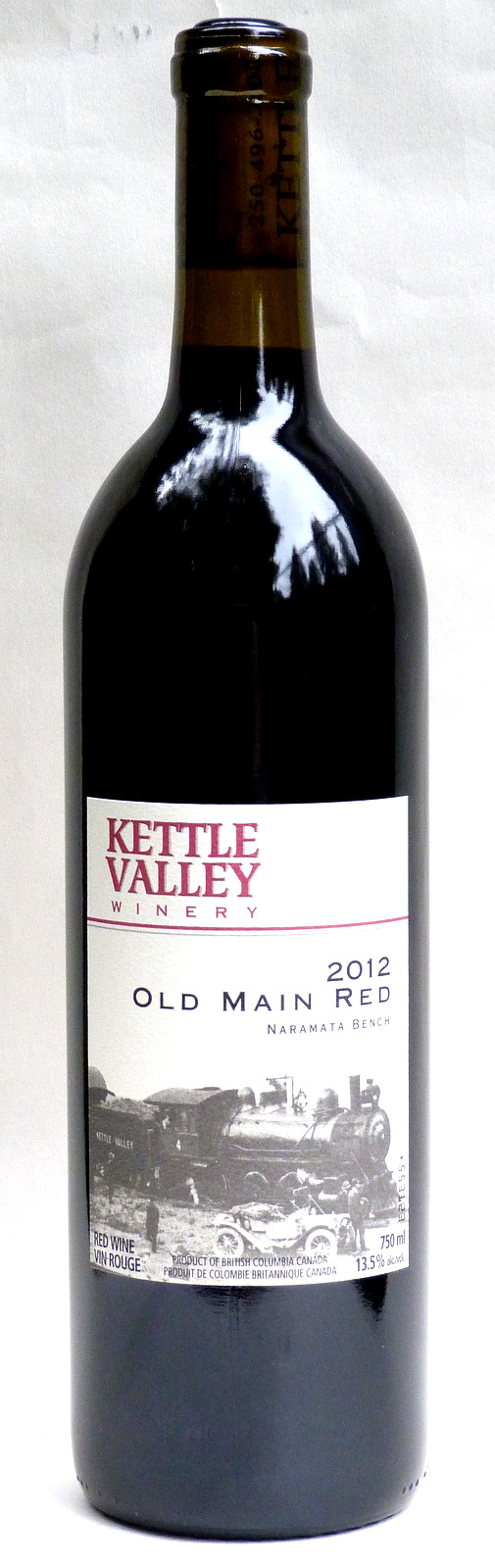
Kettle Valley’s Old Main Red 2012


Photo: Kettle Valley's Old Main Vineyard


The flagship red wine from Kettle Valley Winery is the Bordeaux blend, Old Main Red, named for the vineyard where most of the grapes are grown.

The wine is popular among those who collect and cellar red wines from the Okanagan. The winemaking style at Kettle Valley is well suited to collectible wines.  The winery’s reds, when carefully cellared, will live 15 years, perhaps longer.

I have been researching collectible wines for a forthcoming book. Old Main Red is among those wines. I am taking the liberty of quoting from the text to provide some background to the wine.

The Old Main Vineyard, 1.6 hectares (four acres) in size, is on Old Main Road, a thoroughfare near Naramata Village. It slopes to the west, close to Okanagan Lake; it is sun-bathed all summer but the lake effect tempers the summer heat and keeps the vineyard free of frost very late in autumn.

The vineyard was planted intentionally in 1990 and 1991 to make a Bordeaux blend. “We have three varietals in that one vineyard,” says Tim Watts, who operates the winery with partner Bob Ferguson. “We have a third each, Cabernet Sauvignon, Cabernet Franc and Merlot.” Malbec and Petit Verdot, the other varietals in the wine, were planted subsequently in a nearby Kettle Valley vineyard.

“We were told we were stupid to plant Cabernet Sauvignon,” Tim remembers. “We were told it would never grow. Then we were told after it grew that it would never ripen. Then we were told maybe it will ripen but it will never be any good.” Such was the pessimism in the Okanagan Valley in the early 1990s when the pioneering vintners took a chance on premium varieties.

The three varieties in Old Main Road usually ripen evenly enough that the winery picks them at the same time. The grapes for the Old Main Red blend are co-fermented rather than blended later. “We usually pick them together, crush them together,” Tim says. “There have been a couple of times when we have separated out the Merlot because acids were falling and it was not going to be ideal by the time the Cabernet Sauvignon was ready. For the most part, we pick them altogether. It makes a difference. If you wait a couple of years and then blend things, it will taste like a Cabernet and a Merlot blended together. If you start right from the beginning, it becomes much more harmonious and develops its own set of flavours rather than combinations of the components.”

Old Main Red ages an average of 2o months in French oak barrels (mostly used barrels) before being bottled.  “We started off with one year of barrel aging,” Tim says. “We did that for a while until we discovered that it made a huge difference when the wine aged in oak for a second year. There is so much concentration that goes on in that barrel. We don’t do any humidifying in the barrel room; we are actually looking to have some of that evaporation and concentration.”

Three other wines were included in the recent release from Kettle Valley. Here are notes.

Kettle Valley Adra Station Chardonnay Reserve 2014 ($38 for 119 cases). To make a wine that packs lots of power, the winery allowed the grapes to ripen to 25 brix and then left the crushed grapes cold-soaking three days on the skins before pressing them. The wine was barrel-fermented in French oak.  The slight note of gold in the hue likely is the result of skin contact. The aroma and flavours recall marmalade with a touch of oak. The stated alcohol is 13.5% but it tastes a little more robust than that. 88.

Kettle Valley Pinot Gris 2014 ($24). The winery’s Pinot Gris style also is singular. Two days of skin contact extracted both colour and flavour in this pink-hued wine. For added complexity, a portion was barrel-fermented. The wine is utterly delicious, with aromas and flavours of ripe apple and ripe pear. The spicy notes on the finish recall crab-apple flavours. The wine has good weight and the dry finish lingers. 92.

Kettle Valley Stern Vineyard Syrah 2013 ($38 for 48 cases). There is another powerful wine made with grapes from a Naramata vineyard where production is limited to two tons an acre. It begins with smoky aromas of black pepper. On the palate, there are flavours of figs, black olives, liquorice, dark chocolate and tobacco, with pepper on the concentrated finish. 93.

Kettle Valley Old Main Red 2012 ($38 for 430 cases). This wine begins with appealing aromas of spice, cassis, lingonberry and vanilla. On the palate, the vibrant fruit flavours of black cherry, blackberry and plum are framed with notes of vanilla and oak. The tannins are firm but not harsh. The wine should be decanted to immediate consumption; it has the structure and concentration to continue to improve for the next decade before it plateaus. 93.


Tuesday, January 5, 2016

Sperling Vineyards extends its line


Winemaker Ann Sperling

Kelowna’s family-owned Sperling Vineyards has at least two things going for it.

One: the vineyard in East Kelowna includes some of the most mature vines in the Okanagan, including a plot of Riesling planted in 1978 and a block of Maréchal Foch planted in 1964.

Two: Ann Sperling, one of the owners and the winemaker, is the most capable winemaker to ever grow up in Kelowna. She has been a winemaker since 1984, with a successful track record in B.C., Ontario and Argentina.

Winegrowing is her blood. Her ancestors on her mother’s side were immigrants from Italy called Casoro. You might guess at their importance from the fact that a Kelowna street is named for them.

Giovanni Casorso came from Italy in 1883 to work at Father Pandosy’s mission before striking out on his own (he was once the Okanagan’s largest tobacco grower). His sons started planting grapes in 1925. Formerly known as Pioneer Ranch, the 18.2-hectare (45-acre) Sperling Vineyards was planted initially in 1931 with grapes and apples by Louis and Pete Casorso. When Pete retired in 1960, Bert Sperling, his son-in-law and Anne’s father, switched to entire property to vines, both wine grapes and table grapes.

Ann began here winemaking career with Andrés (now Andrew Peller Ltd.) in Port Moody in 1984 after studying food sciences at the University of British Columbia. She moved to CedarCreek where she was the winemaker from 1991 to 1995, when she moved to Ontario.

“I have always wanted to make wine with my parents’ vineyard,” she said later. “I got to make wine with some of the grapes when I was at CedarCreek, but not anything extensive.”  She realized that ambition when, with other family members, Sperling Vineyards was opened in 2009.

Taking advantage of the vineyard, she began making an Old Vines Riesling in 2008. The wine vies with Tantalus Old Vines Riesling as one of the Okanagan’s best Riesling wines. The two vineyards have similar aspects in East Kelowna. The vines, clone 21B from the Mosel, were planted on the same day in 1978.

Since Sperling Vineyards had opened, the portfolio has been augmented to include sparkling wines and Pinot Noir table wines. In 2014, Ann began making orange wines or natural wines (Pinot Gris fermented on its skins without sulphur or any other additive). Something of a curiosity, these wines occasionally are served from kegs in select restaurants.

“Why make an orange wine?” she told me last year. “I am learning about winemaking by doing it. But also, there is an interest in things that are done differently.”

She has also begun to make small lots of premium wines, primarily for restaurants. So far, two have been released in bottles with edgy labels meant to suggest the winery is looking ahead. “This label is about the future – a vision, looking ahead, and working somewhat with varieties that are new to the site,” Ann says. “We are looking at styles, not going with what is established but what suits us and our terroir.”

She continues: “What we have for release right now are the Vin Gris Pinot Noir and the Chardonnay. The winemaking is similar: whole cluster pressing with barrel fermentation; wild ferment; full malolactic, all in puncheon barrels. These were about 12 months in barrels.”

Here are notes of currently available wines from Sperling.

Sperling Vineyards Pinot Gris 2013 ($19). Crisp and dry, this terroir-driven wine has aromas of herbs, with flavours of pear and with anise on the finish. 90.

Sperling Vineyards The Market White 2014 ($17). This is a lovely aromatic white with spice and citrus aromas and flavours of lime and ripe cantaloupe. The finish, which is off-dry, lingers. 90.

Sperling Vineyards Sper … itz 2014 ($22 for 750 ml; $12.99 for 375 ml). This is a light (7% alcohol) Muscat wine; the actual grape varieties here are Perle of Csaba and Bacchus. It delivers flavours of tropical fruit including mango, papaya and peach. 90.

Sperling Vineyards Old Vines Riesling 2012 ($32). A few years of maturity have allowed this wine to begin showing classic petrol aromas. It has flavours of honey and lime with a hint of botrytis. With good weight and with a tangy finish, this is a wine that will age well. 92.

Sperling Vineyards Old Vines Riesling 2014 ($32). This wine was fermented with wild yeast. It has aromas and intense flavours of lime and grapefruit with a good mineral backbone. 90.

Sperling Vineyards Chardonnay 2014 ($30). The wine has aromas of citrus with a toasty note from lees aging. On the palate, there are flavours of peach and apple with a subtle oak expression. 91.

Sperling Vineyards Orange Wine 2014 ($NA). Made with Pinot Gris fermented with whole clusters or on its skins, this is an unusual wine. It is bronze in colour, with flavours of apple and pear. The texture is firm and the finish quite dry. 90.

Sperling Vineyards Orange Wine 2015 ($NA). The wine’s hues recall blood orange or pink grapefruit. It begins with floral aromas and spicy grapefruit flavours. The texture manages to be firm and juicy at the same time. 90.

Sperling Vineyards Vin Gris of Pinot Noir 2014 ($30). The wine has a subtle blush from skin contact. It has aromas and flavours of apple and strawberry, with good weight on the palate. 90.

Sperling Vineyards Pinot Noir Rosé 2014 ($19). Dry and crisp, the wine has aromas and flavours of raspberry and strawberry. The texture is full for a rosé and the finish lingers. 90.

Sperling Vineyards Sparkling Brut 2010 ($40). Thirty-six months on the lees have give this wine a creamy mid-palate. It has toasty aromas, flavours of green apple and a crisp finish.  This is 100% Pinot Blanc. 91.


Sperling Vineyards Brut Reserve 2010 ($49.95). This wine is price like Champagne because it tastes like Champagne. It is rich on the palate, with toasty brioche aromas and flavours. This is 75% Pinot Noir, 25% Chardonnay. 92.

Wednesday, December 30, 2015

Clos du Soleil and the taste of regret


Photo: A vertical of Clos Du Soleil Signature

During a vertical tasting last fall at Clos Du Soleil Estate Winery in the Similkameen Valley, one guest sighed: “I taste regret!”

By that, he meant he regretted having not collected enough of a particular vintage of Capella, Clos’s signature Bordeaux-inspired white wine.

To be fair, until recently it would have been hard to collect Clos Du Soleil wines in quantity. The winery opened in 2008 with the release of just 200 cases of 2006 vintage wine, half red, half white.

However, Clos Du Soleil has changed significantly since Michael Clark, now managing partner and winemaker, joined the winery in 2012. Last fall, it repatriated production from rented space in a Kelowna winery to a new winery on its Similkameen vineyard. The new winery enabled Clos Du Soleil to raise its production, which had been growing slowly, to about 5,000 cases.

Given the winery’s small volumes in early vintages, it is perhaps surprising that enough wine had been kept back for vertical tastings. The tasting in October 2015 was the winery’s fourth annual.

Clos Du Soleil is among a small, but growing, number of British Columbia wineries that are beginning to offer vertical tastings to consumers - usually members of their wine clubs.

By definition, a vertical tasting is one where a number of vintages of the same wine are tasted side by side.

At last fall’s Clos Du Soleil tasting, the guests tasted nine vintages of Capella, from the inaugural 2006 to the unreleased (at the time) 2014. They moved on to vintages 2006 through 2012 of Signature, the winery’s Bordeaux-style red blend. They finished with three vintages (2010, 2011 and 2013) of Saturn, the winery’s Sauvignon Blanc dessert wine.

And there were two bonus wines: a 2012 Estate Reserve Red and a 2013 Estate Reserve White. These are very fine small lot wines meant to be the best expression of the terroir of the vineyard.

The point of sponsoring verticals is to encourage consumers who would prefer not to taste regret to get in the habit of collecting wines.

“It’s a cultural thing,” says wine educator Rhys Pender MW, who presided over the Clos Do Soleil tasting. “We have to get into the habit of doing that. B.C. wine is never bad when it is freshly bottled and just released, but these kind of wines are always better with two or three or four more years. I really encourage people to get into the habit of keeping some for cellaring.”

Vertical tastings provide insights into vintage variations, differing fruit sources, maturing vineyards and evolving winemaking practices. All of this was on display at Clos Du Soleil.

The winery did not plant its vineyard until 2007. The early vintages were made with grapes purchased both in the Similkameen and the Okanagan. Since 2012, all of the winery’s grapes have been either from its own organic vineyard or from other Similkameen growers. The change in the flavours and character of the wines is noticeable.

“We get a lot of calcium in the soils here,” Rhys explained. “A lot of that is eroded limestone.  It is a weak rock here. As the water washes through it, limestone leaches out and settles in the soil. That often gives acidity in the wines and minerality. There is almost a saltiness in wines. It enhances the freshness and the acidity in wines. That is what you get from the Similkameen. No matter what people do, it is there.” (One should note that Rhys also has a vineyard and a winery in the Similkameen.)

He continues: “The wines are not as intense in fruit but they are more complex in fruit. Think of old world versus new world. On Black Sage Bench, the wines are very intense but one dimensional. The Similkameen wines are less intense but have more red and black fruit components. The tannins here are much more elegant. The wines come across lighter, less firm and hard, but with more elegant tannins. If people want to make complex, interesting, age-worthy wines, it happens pretty naturally here.”

Making wines like that resonates with the French-inspired sensibilities of Michael Clark (below), a former banker and bond dealer who has emerged as one of the best winemakers in British Columbia.

“Anybody will tell you that I am a bit of a detail person,” he told guests at the vertical tasting. “It served me well in finance and it is serving me well now. I think that plays well in winemaking, which is the sum of a million little details that add up to the final wine.”

Michael, who was born in Cambridge, Ontario, in 1972, describes wine as “my number one passion literally before I could drink wine. When I was a kid, I was fascinated with wine. Champagne is for Breakfast – I read that book when I was probably 10 years old. I don’t know other children who love to read wine books.”

Initially, he set out on a career in theoretical physics with bachelor’s degree from Queens University and then a master’s degree from the University of British Columbia. Then he switched to finance with a master of business administration from UBC, where he also founded a campus wine tasting society.

“Then I worked in finance in Canada and in the U.S. and Switzerland, for about 15 years.” That included eight years with two Swiss banks where, in spite of holding senior positions, he committed to winemaking by taking winemaking and viticulture courses there in 2010. He then gained experience by doing crushes at wineries in Switzerland and in Bordeaux.

In 2011, he enrolled in the rigorous winemaking program from the University of California at Davis. While still in Europe, he began researching British Columbia winemaking opportunities before moving here in 2012 to become a partner at Clos Du Soleil.

He provided the missing link at Clos Du Soleil. None of the four couples in the founding partnership lived in the Okanagan or the Similkameen. Consulting winemaker Ann Sperling made the first five vintages and continues to consult after turning over the ultimate decision making to Michael.

As a winemaker, Ann is a Canadian superstar. However, she is responsible for the Sperling family winery in Kelowna, along with clients across Canada and a small winery in Argentina. Michael is totally focussed on Clos Du Soleil.

“Every single year with all of our wines, I am trying to tweak things to make it better than the previous year,” he says.  “Each year, we get more data on how each vineyard site reacts. I have more of a sense on how to deal with the grapes in a particular situation.”

He has introduced significant technical changes in Clos Du Soleil’s winemaking.

“All of our estate fruit in the recent vintages have been fermented with wild yeast,” he says. “That has changed some of the characters. It has made them a little more complex; it allows a little more of the minerality/pencil lead/slate character” of the Similkameen terroir to show through.

His detail-oriented approach extends to doing many small batch ferments. That gives him a better understanding of each vineyard block. Many of these are not just fermented individually but remain separate in barrel until final blending decisions are made.

“My focus on the crush pad and in the winery is to try to make each of those individual lots and individual barrels a complete wine in terms of balance and structure,” Michael explains. “Typically, they spend about a year and a half in barrel. I taste them over that period. I approach each barrel with an open mind. I have not decided what final wine they will end up in: whether our entry level Bordeaux red, our flagship Signature or our Estate Red.”

He says he does not want to be locked in on a blend too quickly.  “The whole magic of blending is that you take two barrels and they can work together synergistically, or not. So there are months of trialing; swapping out one barrel and putting in another to see how they work together. There are no magic formulas.”

His approach, he says, is “in line with the overall philosophy of Clos – being based on a Bordeaux aesthetic – where the art of winemaking reaches it pinnacle in the art of blending.”

Except for Saturn, the late harvest Sauvignon Blanc, the wines presented at the Clos Du Soleil vertical were blends. Capella, with the sole exception of 2006, is between 90% and 95% Sauvignon Blanc, with a small but important fraction of Sémillon completing the wine. The wine is priced $27.90. The barrel-fermented Estate Reserve White 2013 ($60) is two-thirds Sauvignon Blanc and one-third Sémillon. The style is quite reminiscent of an expensive white Graves from a classified Bordeaux chateau.

Signature, a $45 wine, includes the main Bordeaux varietals in a wine always anchored with Merlot or Cabernet Sauvignon. Signature 2012, which I scored 94 points, is 48% Cabernet Sauvignon, 42% Merlot, 9% Cabernet Franc and 1% Petit Verdot.

The $60 Estate Reserve Red 2012 – four barrels made from the winery’s own vineyard – is 53% Cabernet Sauvignon, 27% Merlot,  13% Cabernet Franc, six percent Petit Verdot and one percent Malbec. My score: 93-95.

These wines are capable of aging at least 10 years from vintage, based on how the wines showed.

Those who decided to collect Clos Du Soleil reds might also consider two other reds from the winery, both made to be consumed earlier while Signature and the Estate Reserve are aging.

Clos Du Soleil Célestiale 2013 ($26.90). This is a blend of 41% Cabernet Sauvignon, 39% Merlot, 15% Cabernet Franc, 3% Petit Verdot and 2% Malbec. It has aromas of black cherry and black currants. One the palate, there is a generous helping of ripe, red fruit supported by long, ripe tannins. 91.

Clos Du Soleil Makepeace Cabernet Merlot 2013 Grower’s Series ($24.90). This has aromas and flavours of black cherry, plum and raspberry with a touch of chocolate. The texture is juicy. 90.