Wednesday, December 9, 2015

Osoyoos Larose’s 2012 Le Grand Vin


Photo: Osoyoos Larose winemaker Mathieu Mercier 

Three vintages of Osoyoos Larose Winery’s flagship Le Grand Vin were released during the past 12 months.

The latest release, from the 2012 vintage, is one of the finest ever since the first vintage was made in 2001.

Multiple releases in such a short period are unusual, especially for a wine like this which benefits so obviously from bottle age. What Osoyoos Larose did was in response to its unusually low production volumes in 2010 and 2011.

The winery was able to keep some Grand Vin in the market by early releases. That retained Osoyoos Larose’s place on wine lists and among allocated customers. These days, consumers have a lot of fine British Columbia wines to choose from. Nature abhors a vacuum and so do restaurant wine lists.

The 2010 and 2011 vintages in the Okanagan were cooler than normal. Pascal Madevon, who was then the winemaker, took early defensive action. He dropped a lot of grapes in mid-season to make sure the remaining crop ripened properly.

In every vintage from 2003 to 2009, Osoyoos Larose produced between 8,000 and 10,000 cases a year. But in 2010 and again in 2011, the annual production was just 3,000 cases.

Production rebounded to 6,500 cases in 2012, a year in which growing conditions were favourable from flowering through harvest.

None of those figures include the production of the winery’s second label, Pétales D’Osoyoos, which has been produced every year since 2005.

The current winemaker is Mathieu Mercier, who took over from Pascal in 2013. He arrived in time to blend the 2010, 2011 and 2012 wines, since the five components in the Le Grand Vin blend spend 18 to 20 months aging separately in barrel before being combined.

Born in Cognac in 1988, Mathieu has degrees in viticulture and enology, along with a winemaking résumé that includes several distinguished Bordeaux producers as well as vintages in Chile and California.

His recruitment to Osoyoos Larose more or less coincided with the consolidation of the winery’s ownership. Initially, it was a joint venture between Vincor International and Bordeaux’s Groupe Taillan. A few years ago, the Bordeaux partners bought the 50% interest held by Vincor’s successor, Constellation Brands.

Osoyoos Larose continues to make and cellar its wine in the Jackson-Triggs winery at Oliver. However, plans are underway for a tasting room and a new production facility somewhere near Osoyoos.

There are indications that Mathieu may tweak the Osoyoos Larose style, making the wine a little more accessible when young without sacrificing its longevity. In the past three vintages, he has done trial lots of barrel-fermented red varietals. The barrel samples I have been able to taste have been impressive. I don’t know where those trial lots have ended; very likely into Pétales for the time being.

Mathieu has had better vintages to work with since arriving in the Okanagan. During a recent visit and tasting at the winery, I was quite impressed with barrel samples of the five component varietals that will make up the 2014 blend. That is a wine we should anticipate eagerly.

Here are notes on this year’s releases.
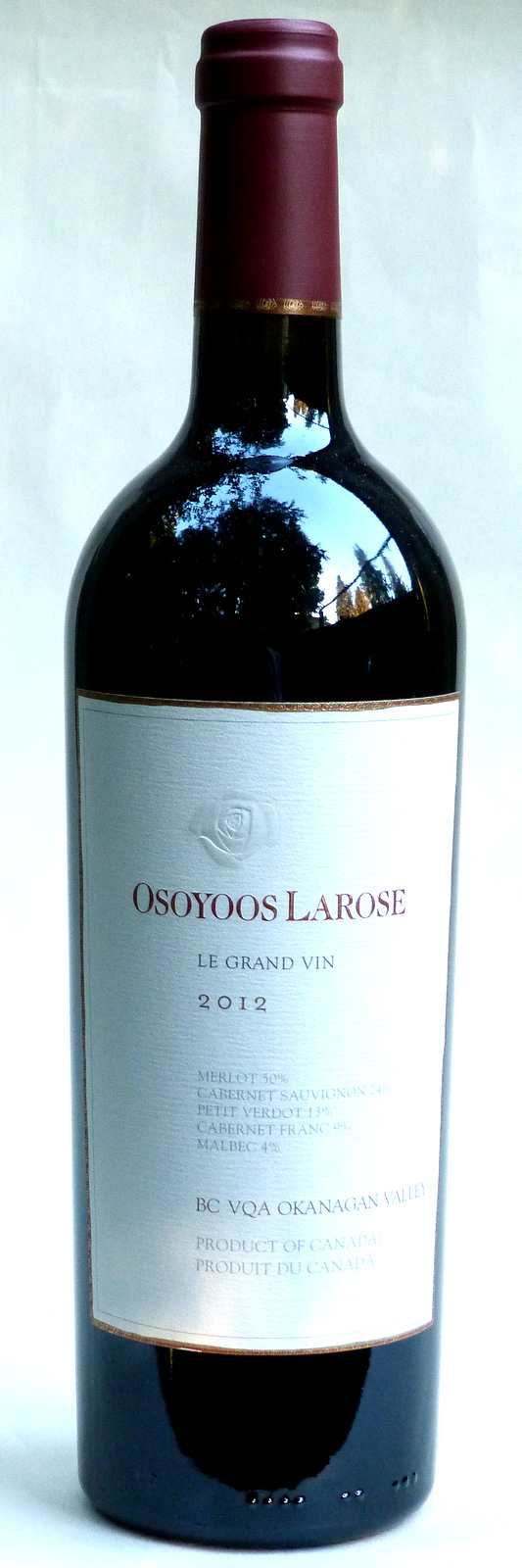
Osoyoos Larose Le Grand Vin 2012 ($40). Merlot 50%, Cabernet Sauvignon 24%, Petit Verdot 13%, Cabernet Franc 9%, Malbec 4%. Production 6,500 cases.  The wine begins with aromas of vanilla and cassis and continues with flavours of black cherry and black currants, along with hints of espresso and dark chocolate on the finish. The wine has great elegance and polish. 94.

Osoyoos Larose Le Grand Vin 2011 ($40) Merlot 48%, Cabernet Sauvignon 33%, Petit Verdot 10%, Cabernet Franc 6%, Malbec 3%.  Production 3,000 cases. The wine begins with aromas of cassis and spice, leading to flavours of black currant, mulberry, espresso and dark chocolate. The tannins are polished but firm. There is a hint of cedar on the finish. 92.  


Osoyoos Larose Pétales D’Osoyoos 2012 ($24.49). This is a blend of 67% Merlot, 16% Cabernet Franc, 15% Cabernet Franc and one percent each of Petit Verdot and Malbec.  This wine is made to be consumed earlier that Le Grand Vin, which is one reason for the high Merlot percentage in the blend. The wine begins with aromas of cassis and black cherry. It is juicy in texture and full-bodied, with ample red fruit flavours and ripe tannins. Aging this wine in used French oak, not in new barrels, contributes to the accessibility and the bright fruit. 91.

Monday, December 7, 2015

Blue Mountain classy RD bubbles for the holidays


 Photo (courtesy Blue Mountain): festive bubbles


In the fall of 2010, Blue Mountain Vineyard & Cellars celebrated its 20th vintage by hosting an extensive tasting of its reserve wines.

The wines in the tasting included a 1994 Reserve Brut R.D., which means recently disgorged. If my files are correct, the winery released its next R.D. sparkling wine from the vintage of 2004. That wine would have been released about three years ago.

Happily, the winery has begin to release is classy R.D. wines a little more often now.

Blue Mountain has produced an excellent sparkling wine every year since the winery was founded in 1991. For many of those years, the production volume was too limited (or sold too quickly) to allow the winery to hold back a portion each vintage for extended aging on the lees.

In recent years, the winery has been able to do that. The result is a series of sparkling wines that stand side by side with Champagne.

Blue Mountain Gold Label Brut, the winery’s bread and butter sparkling wine, spends two years on the lees before being disgorged, bottled and released. Wines made in this style are typically crisp and fresh. At $24 a bottle, this wine represents outstanding value for its quality.

The R.D wines necessarily are more expensive, reflecting the additional years these wines are aged. The reward for tying up capital for another five years to eight years is the enhanced complexity that the wines develop from extended lees contact.

These are not wines to be squandered with the party trick that, alas, has become popular: opening bottles with a sabre. That is quite dramatic; not much wine sprays over the floor when the sobering is successful. Of course, it is a mess if the neck does not break off cleanly.

But these wines are so good that you will want to savour every drop rather than sabre every drop.

Currently, the winery has three R.D. releases available.

Blue Mountain Brut Rosé 2011 R.D. ($33). The base for this wine is 65% Pinot Noir and 35% Chardonnay. After secondary fermentation in the bottle, the wine aged three years on the lees before being disgorged. The dosage is 10 grams of residual sugar per litre – just enough to add flesh to the texture while retaining a crisply dry finish. With its pink hue and fine bubbles, the wine gives a fine display in the glass. The aroma is fruity. Creamy on the palate, the delicious wine delivers flavours of strawberry and brioche that coat the palate and linger on the finish. 92.

Blue Mountain Blanc de Blancs 2008 R.D. ($40). Made with Chardonnay grapes, this wine, after its secondary fermentation, remained seven years on the lees, to be disgorged in March 2015. It is finished in the brut style, with almost no sugar in the dosage. In the glass, the wine has a fine and vigorous mousse. It has nutty toasty aromas and flavours, with hints of lemon and green apple and a crisp finish. The elegance of this wine is quite striking. 92.


 Blue Mountain Reserve Brut 2007 R.D. ($40). This is 50% Pinot Noir, 50% Chardonnay. This wine has had approximately eight years on the lees before being disgorged. In the glass, the mousse is fine and active. The wine has aromas of citrus and toast, going on to delicate fruit and brioche on the palate. The finish is almost austerely crisp, but not so as to take away from its classy elegance. 92.

Saturday, December 5, 2015

Class of 2015: Blind Tiger Vineyards


 Photo: Blind Tiger proprietors Charlene and Jerry Wowchuk

Blind Tiger Vineyards
11014 Bond Road,
 Lake Country, BC
T. 250.766.0622
T. 250.718.5901
250-718-5901


This winery takes its name from one of the terms (blind pig is another) for illegal bars operated in the United States during, and even before, Prohibition.

It seems that the operators got around the law by charging customers to see performing pigs, tigers or other animals while serving “free” drinks.

It is a flight of fancy to apply the name to a perfectly legal winery in Lake Country. Jerry Wowchuk, who operates this winery with his wife, Charlene and their daughter, Morgan, just wants to attach an aura of history to the winery.

“Canada is very young,” he explains. “It is hard to celebrate any history when there is none.”

However, his ancestors in both the Ukraine and on the Prairies knew the art of distilling and probably shared a drop or two with friends. But they surely were too busy as hard-scrabble farmers to run blind tigers.

The closest Jerry has come to a blind tiger is presiding in his winery’s charming tasting room. “I love working in the tasting room,” he says. “I get people coming in from the Prairies. I like to talk. I am an auctioneer, so that is all I do, is talk. There is always a connection.”

The background music is from his vinyl collection because he believes that vinyl sounds better than digital music. The wines are served in generously-sized Riedel stemware. “Even bad wine tastes good in that glass,” he says. “I will never have those cheap little glasses.”

The decision to plant five acres of grapes in 2010 was inspired by earlier vacations in Bordeaux and Tuscany.  “We fell in love with vineyards,” Jerry says. They moved from Vancouver to Lake Country in 2007, looking for a quiet community in which to raise children.

“When I came onto this property, I said this is perfect,” Jerry remembers. “Look at the hills on here. This is great, just like Tuscany.” Prudently – because Lake Country is cooler than Tuscany – no Tuscan varieties were planted. The two largest blocks in the vineyard are Gewürztraminer and Riesling, with small blocks of Pinot Noir and Chardonnay. The winery also buys grapes to round out its portfolio.

The property had been a llama farm and then a goat farm. Since it was already organic, Jerry and Charlene turned for guidance to one of the Okanagan’s leading organic authorities, Karnail Singh Sidhu, the owner of Kalala Organic Estate Winery.

They not only tapped Karnail’s advice; they also have relied on him and consultant Dr. Alan Marks as winemakers, starting with the 2013 vintage, when they produced about 1,000 cases of wine.

Jerry is determined to continue as an organic producer. “Even if it bankrupts me, I am not changing to conventional farming,” he asserts. “If anything I will go more biodynamic, except for some of the weird stuff. We’re small enough where we can just baby these vines and make some really great wines.”

Running a winery is a long way from his roots in Winnipeg, where he was born 49 years ago and where he and Charlene, his business partner, met in high school. He started his career in the trucking industry, moved on to manufacturing jobs, to plumbing and then to the repair of restaurant equipment.

“Because we renovated restaurants, we would have a bunch of equipment left over,” Jerry says. “So we started taking them to auctions. I realized it was a good way to make money.”

He moved his family to Vancouver in 1994 and started a construction company that evolved into Kwik Auctions, the business that Jerry and Charlene operate now from a warehouse in Burnaby and their home in Lake Country.

“Kwik Auctions has over 19 years of experience in the Restaurant Industry, from service to the liquidation of restaurant equipment,” the company says on its web site. “Kwik Auctions sells restaurant equipment, accepts consignments, buys restaurant equipment or entire restaurants, and also conducts appraisals. Of course, we specialize in Restaurant Equipment Auctions. Our goal is to supply you with anything and everything you need for your food service establishment. No food equipment is too large or small- we deal with it all!”

The business allows them to develop Blind Tiger Vineyards and to support other interests, such as the Harley-Davidson motorcycle that Jerry acquired last summer.

In the 2015 vintage, Blind Tiger produced about 2,000 cases, a level at which they intend to keep the winery for a while. “That is our focus,” Charlene says. “This is a little pet project because everybody said we couldn’t do it.”

Here are notes on the wines, except for the Gewürztraminer, sold out before the end of the season.

Blind Tiger Pinot Gris 2014 ($16.95). The wine, made in a juicy off-dry style, has aromas and flavours of apple, pear and peach. 88.

Blind Tiger Riesling 2012 ($17.95).  This is an appealing wine, with aromas and flavours of lime and green apple. The racy acidity balances the residual sugar, giving the wine a crisp, tangy finish. A slight hint of petrol is developing (which is positive). 90.

Blind Tiger Pinot Noir 2013 ($22.95). The wine has aromas of strawberry and vanilla, leading to flavours of strawberry and cherry. It is a light but pretty wine with a silky texture. 88.

Blind Tiger Pinot Noir 2014 (Not yet released). The wine has aromas and bright flavours of strawberry and raspberry with a touch of pepper on the finish. The firm texture has just begun to evolve toward the variety’s classic silkiness. 89.

Blind Tiger Speakeasy Red 2011 ($23.95). This wine, which was aged one year in American oak, is a blend of Merlot, Cabernet Sauvignon and Cabernet Franc, with a touch of Syrah. The wine has aromas and flavours of vanilla, black cherry and blackberry with a hint of chocolate on the finish. The tannins are long and supple. It is a wine for current consumption. 89.


Thursday, December 3, 2015

Wineries in Vancouver's "backyard"


Photo: Backyard Vineyards winemaker James Cambridge

Now that the Okanagan wineries are a winter highway away from Vancouver, it is useful to remind wine tourists that  a dozen wineries are just beyond the Port Mann Bridge.


One of these wineries, Backyard Vineyards in Langley, makes the point of its accessibility in its very name.

Except for the fruit wineries, all of wineries in Vancouver’s “backyard” make wines both with Okanagan or Similkameen fruit and with grapes from Fraser Valley vineyards.

This blog reviews six wines from Backyard Vineyards and three from Singletree Winery in Abbotsford, which opened earlier year.

A recent blog looked at the current releases from Township 7 Vineyards & Winery. Township 7 operates a winery near Penticton but also another (its original winery) in Langley Township.

A future blog will deal with Chaberton Estate Winery (formerly known as Domaine de Chaberton). Established in 1991, Chaberton was the first grape winery in the Fraser Valley and now is by far the largest. It attracts visitors not just with its wines but also with a popular French bistro which offers lunch and dinner during the latter days of the week and on weekends.

I will list all the other valley wineries after these reviews.

Backyard Vineyards, which opened in 2002 as Glenugie Vineyards, changed names and ownership in 2008. The wines became worth a visit after the winery hired James Cambridge, a seasoned winemaker, in 2013.

“Cambridge started his career in oenology 15 years ago,” the winery said when announcing his hiring. “He studied at Niagara College, completing a fully integrated Oenology/Viticulture Program and graduated at the top of his class. Cambridge has since gone on to work for some of Canada’s most respected wineries including Henry of Pelham, Creekside Estate Winery, Summerhill Pyramid Winery, Le Vieux Pin, LaStella Estate Winery, and Fort Berens Estate Winery.”

Here are notes on the wines.

Backyard Vineyards Riesling 2014 ($20.25). This wine, which has won three gold medals, begins with citrus aromas mingled with herbal notes. On the palate, there are flavours of ripe grapefruit, with a hint of green apple. The wine has a good mid-palate weight. It is balanced to finish dry. 88.

Backyard Vineyards Gewürztraminer 2014 ($20.25). The wine begins with floral aromas lightly spiced with a hint of ginger. It has flavours of lychee and honeydew melon with a hint of grapefruit on the finish. 88.

Backyard Vineyards Merlot 2013 ($21.98). The wine begins with aromas of blueberry and black currant jam. Soft on the palate, the wine has flavours of cassis and plum, with a hint of cedar and spice on the finish. 88.

Backyard Vineyards Cabernet Franc 2013 ($21.98). The wine begins with aromas of blackberry, raspberry and black currant. The palate is generous, with flavours of black cherry and black currant, mingled with hints of dark chocolate and espresso.  The wine has a lingering, spicy finish. 91.

Backyard Vineyards Gossip 2012 ($19.98). Gossip is a blend of 28% Cabernet Sauvignon, 25% Merlot, 25% Syrah and 22% Cabernet Franc. The wine begins with aromas of cassis, plum, vanilla and oak. I can’t do better than winemaker James Cambridge’s tasting notes: “Ripe raspberry, black cherry, cocoa, black forest cake, white pepper, black olive and mint.” 9o.


Backyard Vineyards Porch Wine NV ($24.25 for 500 ml). The word, Port, is off limits to wineries not in Portugal, which leads to inventive naming of fortified wines made elsewhere. I am still chuckling at this winery’s pun for its fortified (19% alcohol) red. This is a reasonably full-bodied wine with aromas of vanilla and figs. On the palate, there are flavours of black cherry, figs and chocolate with a finish recalling spicy fruit cake. 89.


Singletree is operated by Garnet Etsell with his son, Andrew (above). The Etsell family also happens to be one of major turkey growers in the Fraser Valley.

The turkey business is on a 67-acre property that the Etsells bought in 2001. This land has been farmed since the 1870s. “It has been a dairy farm, a vegetable farm, a soft fruit operation, a turkey operation and now a vineyard,” Garnet said. “We have the remnants of the old orchard.”

They began planting vines in 2010. They now grow about 10 acres of grapes and they lease a 1.5-acre Siegerrebe vineyard near the Abbotsford International Airport. Except for a few experimental rows of Pinot Noir, the Singletree vineyard is planted entirely in white varieties: Siegerrebe, Pinot Gris, Chardonnay, a small block of Grüner Veltliner and a large block of Sauvignon Blanc.


With Andrew as the understudy, the winemaking is handled by another seasoned vintner, Matt Dumayne, the chief winemaker for Okanagan Crush Pad Winery.

The winery’s name has an agricultural root. A singletree is part of a working horse’s harvest that is positioned at the animal’s shoulders and anchors straps used in pulling a buggy or a plough.

Here are notes on the wines:

Singletree Winery Siegerrebe 2014 ($19.04 for 395 cases). This early ripening white grape is well suited to cool coastal vineyards. This wine is an example of how showy and tropical this varietal can be, with aromas of grapefruit, raisins and spice that leap from the glass. Juicy on the palate, it is refreshing and lingering, with bright, but well-balanced, acidity. 90.

Singletree Winery Farmhand White 2014 ($17.30 for 95 cases). This is a blend 77% Pinot Gris and 23% Sauvignon Blanc; both are grown in the estate vineyard. The wine was barrel-fermented. It begins with intriguing aromas of butterscotch and tangerine, leading to citrus flavours. It is light and refreshing, with 11.8% alcohol and with a crisp dry finish. 88.

Singletree Winery Pinot Noir 2014 ($21.65 for 169 cases). Light and charming in style, the wine begins with aromas of cherry and toasty oak. On the palate, there are flavours of cherry and raspberry, with spice on the finish. The texture is typically silken, as one expects from this variety. 88.


The wineries

Backyard Vineyards
3033 – 232nd Street, Langley, BC.
Toll Free: 1.866.233.9463
T: 604.539.9463

Blackwood Lane Vineyards & Winery
25180 8th Ave, Langley, BC
T. 604.856.5787

Campbell’s Gold Honey Farm & Meadery
2595 Lefeuvre Road
Abbotsford, BC, V4X 1L5

T. 604.856.2125

Chaberton Estate Winery
1064 216 St, Langley, BC V2Z 1R3
T. 604.530.1736

The Fort Wine Co.
26151 - 84th Avenue,
Langley, B.C. V1M 3M6
T. 604.857.1101

Krause Berry Farms & Estate Winery
6179 248th Street,
Langley, BC, V4W 1C3
T. 604.856.5757 

Lotusland Vineyards,
28450 King Road,
Abbotsford, British Columbia, V4X 1B1
T. 604.857.4188

Maan Farms Estate Winery
790 McKenzie Road, 
Abbotsford, BC, V2S 7N4
T. 604.864.5723

Mt Lehman Winery
5094 Mt Lehman Rd, 
Abbotsford, BC V4X 1Y3
T. 604.746.2881

Singletree Winery
5782 Mount Lehman Rd,
Abbotsford, BC, V4X 1V4
T. 604.381.1788

Township 7 Vineyards & Winery
21152 16th Ave, (at 212th St), 
Langley, BC, V2Z 1K3
T. 604.532.1766

Vista D’Oro Winery
346 208th Street, 
Langley, BC, V2Z 1T6
T. 604.514.3539


Tuesday, December 1, 2015

Burrowing Owl and Calliope tour three vintages


Photo: Burrowing Owl vineyard and winery (courtesy Burrowing Owl)


The most recent releases from Burrowing Owl Estate Winery reflect three of the best vintages so far in the Okanagan and the Similkameen – 2012, 2013 and 2014.

They follow on from the cool 2010 and 2011 vintages. Many producers, including Burrowing Owl, made good wines – especially whites - in those years as well. But after tasting a lot of lean reds from 2011, I am delighted with the ripeness and the harmony of the 2012 vintage.

Some producers may have moved on to reds from 2013 and 2014. However, collectors who want cellar-worthy reds need to stock up on 2012 while still available. The Burrowing Owl wines are a good place to start.

Calliope Wines is Burrowing Owl’s budget label. While all Burrowing Owl wines are estate grown, the Calliope wines are a blend of estate grapes and purchased grapes. The Calliope wines are not structured to cellar very long; their strength is to over-deliver value for money in wines ready to drink today.

Burrowing Owl describes the conditions for each vintage in the notes that accompany the wines.

“2012 made for a great growing season, giving warm temperatures without being too hot,” the winery writes. “Optimal conditions allowed the grapes to bring sugars and acids into perfect harmony. The grapes were allowed a long hang time, contributing to their phenolic ripeness.”

The notes continue:

“Spring arrived early in 2013, followed by a warm summer producing good concentration levels of ripeness in the grapes. The cool autumn provided conditions for the acidity to be retained, giving the wine a lively freshness to balance the ripe fruit.”

As for 2014:

“The 2014 season presented the ideal conditions for for the production of intensely aromatic and concentrated wines for both whites and reds: the dry and warm spring favoured blossoming. Exceptional levels of heat during the summer time provided for sufficient energy for an even ripening. The beautiful late season gave us time to pick the grapes at will, when they had reached our optimum standards of maturity.”

Here are notes on the wines.

Calliope Gewürztraminer 2014 ($13.99 plus tax). This wine begins with aromas of ginger. On the palate, there are flavours of ginger and grapefruit. The wine has a generous texture. It is dry with a long lingering finish of spice. 88.

Calliope Sauvignon Blanc 2014 ($13.99 plus tax). The wine begins with grassy and herbal aromas. The complex palate offers flavours of lime, guava and grapefruit, leading to a long, dry finish. 89.

Calliope Viognier 2014 ($13.99 plus tax). The wine begins with floral and fruity aromas, including apricot and mango. On the palate, this richly textured wine has flavours of stone fruits and ripe cantaloupe. The finish is persistent and pleasantly fruity. 90.

Calliope Figure 8 White 2014 ($13.99 plus tax). This is a fine blend of 35% Pinot Gris, 31% Chardonnay, 18% Gewürztraminer, 13% Viognier and 3% Sauvignon Blanc. The fragrant aroma is a subtle combination of citrus, peach and banana. The wine has good weight and delivers flavours of peach, ripe apple and citrus, with a zesty herbal note on the dry finish. 90.

Calliope Figure 8 Cabernet Merlot 2013 ($15.29 plus tax). This is 58% Merlot, 30% Cabernet Franc, 8% Malbec and 4% Syrah. The object here is a wine that is juicy and approachable. Only half was aged in barrel (75% French), only for eight months; 25% of the barrels were new, 20% one year old. It begins with aromas of black cherry, blueberry and plum, all of which are echoed on the palate. The wine is delicious. 90.

Burrowing Owl Sauvignon Blanc 2014 ($25 but sold out). The wine begins with appealing aromas of lime and grapefruit. These are echoed on the palate, along with a hint of sweet oak from partial barrel fermentation. The texture is rich and the finish lingers. 91.

Burrowing Owl Merlot 2012 ($30). Dark in colour, this wine begins with aromas of cassis, blueberry and chocolate. On the palate, this is a wonderfully full, concentrated Merlot, with flavours of black cherry, black currant, dark chocolate. On the finish, it is spicy with notes of sage and cedar. The finish goes on and on. This is a benchmark Okanagan Merlot. 93.

Burrowing Owl Cabernet Sauvignon 2012 ($35). The wine begins with alluring aromas of cassis, cherry and plum, repeated on the palate along with notes of plum, cassis, blackberry, chocolate and marzipan. The structure and texture have elegant harmony, a fine expression of the vintage.  This is drinking well now but will blossom with another five years of bottle age. 92.

Burrowing Owl Meritage 2012 ($45). This is a blend of 43% Cabernet Franc, 28% Merlot, 20% Cabernet Sauvignon and 9% Petit Verdot. The wine was aged almost two years in barrels, mostly French and 25% new. Accordingly, there is a slight hint of cedar on the nose, along with cassis, black olives and spice. On the palate, there are flavours of prune plum, black cherry, black currant and Christmas spices. The texture is firm. This harmonious and concentrated wine needs to be decanted for drinking now but it has the bones of a wine meant to be aged at least 10 years. The finish is long, with savoury flavours that linger. 93.


Saturday, November 28, 2015

Township 7 releases show off two good vintages


Photo: Township 7 winemaker Mary McDermott

With these releases, Township 7 Vineyards & Winery shows off two strong vintages just in time for holiday buying.

Both of the firm’s wineries conveniently have seasonal open houses.

The 2014 Gewürztraminer, available just to the wine club members, was made by Mary McDermott, the winemaker who joined Township 7 that year from Ontario.

The 2013 wines were made by Brad Cooper, the former winemaker. However, Mary had a major hand in finishing and blending the reds, in effect giving those wines two parents.

Well, the quality is such that there is plenty of credit to go around.

With the exception of the Merlot, the volumes of these wines are relatively limited. They are available on line and also at Township 7’s wineries near Penticton and in Langley District.

The Naramata Bench winery offers visitors a Dickens-inspired Christmas on December 5, with live music, mulled wine and hot chocolate for the children.

The Langley winery has a Christmas open house on December 12 and 13. This is a charity event for Ronald McDonald House.

Here are notes on the wines.

Township 7 Gewürztraminer 2014 ($17.97  for 278 cases). The wine begins with aromas of ginger, orange peel and lychee. It presents intensely on the palate, with flavours of citrus. The finish is dry, punctuated emphatically with spice. 90.

Township 7 Merlot 2013 ($22.60 for 1,178 cases). The wine begins with aromas of plum, black cherry and vanilla. On the palate, there are flavours of black currant, tobacco and chocolate. Full in texture thanks to the 15% Cabernet Sauvignon in the blend, the wine has long ripe tannins, with a lingering finish of Christmas spices. 90.


Township 7 Cabernet Sauvignon 2013 ($23.47 for 478 cases). The grapes for this are from the Blue Terrace Vineyard at Oliver, a long-time grower for Township 7. This wine has 15% Merlot in the blend to enrich the texture and mid-palate. The wine begins with aromas of black cherry and vanilla mingled with spice and cassis. On the palate, there are flavours of black cherry, vanilla, tobacco and chocolate, with a spine of minerality. The long ripe tannins give the wine a polished texture. It is drinking well now but the patient consumer who cellars this for another five years will be well rewarded. 92.

Township 7 Cabernet Franc 2013 ($27.97 for 278 cases; wine club only). The grapes for this are from the Rock Pocket Vineyard, also near Oliver. The wine begins with almost perfumed aromas of blackberry and black cherry. On the palate, there are flavours of spicy cherry with hints of cigar box on the finish. The tannins are firm. The wine needs to be decanted for immediate consumption but it will develop spectacularly in bottle over the next five or six years. 92.


Township 7 Reserve 7 2013 ($32.97 for 468 cases). This blend is 60% Merlot, 35% Cabernet Sauvignon, 3% Cabernet Franc and one percent each Malbec and Petit Verdot. This wine begins with aromas of black cherry cassis and vanilla; the later reflects the 24 months of aging on French and American oak barrels. The wine is harmonious and full on the palate, with flavours of cassis, chocolate, tobacco and cedar. The ripe tannins allow for drinking this now, with decanting, but the wise choice would be to cellar the wine for five more years and let it blossom in the bottle. 92.

Friday, November 27, 2015

Steller’s Jay Sparkling Shiraz


Under the Steller’s Jay brand, Sumac Ridge Estate Winery has released just its second Sparking Shiraz.

This style of wine has been produced for many years in Australia. The Liquor Distribution Branch used to list several examples. There are none in its product catalogue now, which speaks to the limited popularity of this novel style of sparkling wine.

The first Okanagan Sparkling Shiraz was released in 2006 under the Sumac Ridge brand.

The second release, 1,000 cases, has just appeared under the Steller’s Jay brand. Several years ago, Constellation Brands, which owns Sumac Ridge, decided to turn Steller’s Jay into a stand-alone brand. The object is to reinforce the eminence of Steller’s Jay as a leading sparkling wine producer in British Columbia.

Almost a decade between sparkling Shiraz releases? That also seems to speak to comparatively limited demand for the wine that consumers hardly know.

It appears that Constellation Brands may allow another gap to develop before the next release.

To quote the Steller’s Jay news release for the current example: “… Holiday revellers are encouraged to add this exclusive wine to their cellars early as Sparkling Shiraz will not be available again next year.”

Why not? There is no explanation. If the wine is not made regularly, no one will expect to buy it regularly. Remember the chicken and the egg.

If you do find a bottle or two in a private wine store, I would encourage you to pick them up. Not for your cellar (it will not cellar was long as a more acidic sparkling wine) but for the festive fun you will have with this dark, frothy wine.

I think it would be a great base for cocktails and for punch bowls, even though punch bowls generally are a waste of good wine. This wine has such fruity flavours and looks so good that it will transform the punch from an afterthought to something rather special.

This is a bottled-fermented sparkling wine (like Champagne). Jason James, the winemaker who made it, is quoted as saying: “This is a very special wine with a lot of depth and complexity. Only premium grapes were selected and blended to produce this special sparkling wine. The base Shiraz was treated like a red wine; harvested at 24 brix and fermented on the skins. As a result, there is more tannin than in a normal sparkling.”

Both Jason and the back label recommend the wine be served with food, such as beef short rib. This is robust sparkler.

Here is a note on the wine.

Steller’s Jay Sparkling Shiraz NV ($25.99 for 1,000 cases). Open this wine carefully to avoid having the energetic magenta-coloured bubbles frothing all over the table cloth. With its deep colour and its bubbles, this is a spectacular wine in a Champagne flute. The flavours are intense, starting with black cherry and going on to chocolate, coffee and spice. The wine is technically dry, with its 25 grams of residual sugar balanced with modest acidity. The texture is plush and rich. This is a tour de force. 90-92.