Tuesday, October 7, 2014

The Poplar Grove/Monster Vineyards strategy for quality


Photo: Poplar Grove's Tony Holler

Founded in 1993, Poplar Grove was still a boutique winery in 2007 when Tony Holler acquired majority ownership from founder Ian Sutherland.

Born in Summerland, Tony had already succeeded as a doctor and pharmaceutical entrepreneur. He had bigger ambitions in the wine industry and more resources to invest than his partner.

“I wasn’t that interested in having a tiny boutique winery,” Tony told me in an interview a few years ago. “I wanted to really develop a winery that was a sustainable business. What I mean by sustainable is that this business could become a family business that might go through generations of our family. In order to do that, you have to have a certain size.”

Since then, two new wineries have been built: the Poplar Grove winery still retains the boutique size and image while the nearby Monster Vineyards winery has the capacity to produce and cellar most of the wines for both labels. The capacity is 25,000 cases. With the space available at the Monster facility, the premium Poplar Grove reds now have the luxury of two years, or so, in barrel and another two years in bottle before being released. That is one reason for the noticeable rise in the complexity and quality of those reds in recent years.

The other reason, and a more fundamental one, is that Poplar Grove gets almost all of its grapes from vineyards owned by Barbara Holler, Tony’s wife.

 “When we looked at what we needed to make high end wines, one of the things that Ian Sutherland brought up was that he was buying a lot of fruit,” Tony says of his winery planning with Ian in 2007. “That was really going to be an issue. If we were going to develop a 25,000-case winery, and we are buying all the fruit, I don’t believe we can get the quality that is needed. So my wife, Barb, and I decided we have to become an estate winery. We have to control all our own fruit; we need to plant our own vineyards. That was why we ended up buying the roughly 100 acres, half here on the Naramata Bench and half on the Osoyoos East Bench.”

The Monster label, which was created several years ago, enables winemakers Stefan Arnason and Nadine Allander to keep a clear distinction in style and quality between Poplar Grove’s premium wines and Monster’s fruit-forward, easy-drinking wines.

“You can dilute those top brands by having wines that I would say are not at that level,” Tony says. “We decided [Monster] will be fun wines that people can enjoy on a patio in the afternoon.”

Monster has certainly won enough awards to prove that these are also very well made wines. The latest releases have the double appeal of being tasty and affordable.

Here are notes.

Monster Vineyards White Knuckle 2013 ($17.90). This is a blend of 50% Riesling, 24% Chardonnay, 21% Pinot Gris and 5% Viognier. The wine begins with aromas of peaches, apples and citrus. On the palate there are gobs of tropical fruit, with flavours of lychee, tangerine, and apricot. The texture is juicy, with bright acidity nicely balanced with a trace of sweetness. I am not sure why it is called White Knuckle because there is nothing scary at all about quaffing it happily. 88.

 Monster Vineyards Skinny Dip 2013 ($19.90). This is 90% Chardonnay, 10% Viognier. The wine begins with aromas of ripe apple and ripe pears, with a hint of honey and lemon. On the palate, there are flavours of apples and grapefruit. The texture is generous but the finish is dry; and that results from superb winemaking. The technical note shows the wine has 10.5 grams of residual sugar. One might expect a sweet finish but the bright acidity leaves the wine crisp and refreshing. 89.

Poplar Grove Chardonnay 2013 ($21.90). This is a bright and fresh Chardonnay, beginning with aromas of apples and honeydew melon. On the palate, there are flavours of citrus and nectarine with a subtle toasty hint of French oak. The subtlety came from the winemaking decision to put 14% of this wine in new French barriques, and just for three months. The rest aged in stainless steel; malolactic fermentation was discouraged so that the lively fruit flavours could be preserved. The texture is ever so lightly creamy. This is quite an appealing wine. 90.

Poplar Grove Viognier 2013 ($24.90). This wine is available only in the winery’s tasting room and to those fortunate enough to have joined the wine club. It begins with lovely aromas of orange blossoms and fresh apricots. On the palate, there are flavours of apricot and peach with a touch of ripe pineapple. The texture is rich with the classic spine of minerality this variety displays. The fruit flavours are exceptionally pure and intense, with a refreshing brightness reflecting good acidity. 91.

Poplar Grove Blanc de Noirs 2013 ($24.90). There are five varietals in this rosé which was made by the saignée method (bleeding juice from freshly crushed red varieties). This wine is 41% Merlot, 27% Syrah, 25% Malbec, 5% Cabernet Franc and 2% Cabernet Sauvignon. The wine has a lovely pink watermelon hue (in the style of a Provence rosé).  It begins with aromas of raspberry and strawberry, leading to flavours of raspberry and cherry. The wine’s residual sugar gives the flavour a hint of mid-palate sweetness while the bright acidity gives the wine a crisp finish. 90.
   

Monster Vineyards Monster Cabs 2012 ($19.90). This is 37% Cabernet Franc, 32% Cabernet Sauvignon, 27% Merlot, 4% Malbec. This is a juicy wine with a wallop of fruit on the palate. There are aromas and flavours of black cherry, black currant and spice. The long ripe tannins give this wine immediate drinking appeal but there is enough backbone to hold the wine for several years in the cellar. 89.

Monster Vineyards Merlot 2012 ($19.90). This is 92% Merlot with 4% Cabernet Sauvignon, and 2% each of Malbec and Cabernet Franc. Dark in colour, the wine begins with aromas of black currant, blueberry and cocoa. The palate is generous with flavours of cherry, plum, blueberry and sage. This wine overdelivers for the price. 90.

Monster Vineyards Red Eyed 2012 ($19.90). This is 83% Merlot, 7% Malbec, 6% Syrah and 2% each of Cabernet Sauvignon and Cabernet Franc. A minor quibble: the term, Meritage, should not be on the bottle because Syrah is not part of a Meritage blend, even if it almost certainly improves the wine. The wine begins with aromas of dark plum, black cherry and vanilla, with the perfumed note of Malbec. On the palate, the wine has abundant flavours of black cherry and black currant with a hint of cedar and sage on the finish.  90.

Poplar Grove Merlot 2010 ($29.90). How do you make a great wine in a cool vintage? In 2010, Poplar Grove reduced the yield of its total production from a potential to 210 tons to just 80 tons to assure good ripeness. It worked. This Merlot has 14.8% alcohol. There is also 10% Malbec in the blend. It begins with powerful aromas of black currant and vanilla, leading to flavours of black currant, black cherry, cola and chocolate. The ripe tannins give this a concentrated texture. The wine is drinking well now but will age well. 91.


Poplar Grove Cabernet Franc 2011 ($34.90 for 450 cases). This wine is 85% Cabernet Franc, 10% Malbec and 5% Merlot. This is arguably the signature varietal for Poplar Grove. This wine, whose polished texture comes from 21 months barrel aging and 18 months bottle aging, begins with spicy aromas of raspberry and blackberry. On the palate, there are flavours of black and red currant, with hints of black cherry, chocolate and vanilla. An ageable wine, it benefits from decanting if you must drink it now. 92.


Poplar Grove Syrah 2011 ($34.90). There is 4% Viognier in this wine, co-fermented with the Syrah. The wine begins with bold, meaty aromas of deli counter spice, plum and vanilla. On the palate, there are flavours of spicy black cherry, plum and prune, with lack pepper on the finish. The texture is generous. 91.


Thursday, October 2, 2014

Culmina releases its first 2012 wines.


Photo: Gates at Culmina Family Estate Winery

Culmina Family Estate Winery enjoyed two advantages in the 2012 vintage that it did not have in 2011, its first vintage.

The first: 2012 was the riper vintage in the Okanagan. The second: the wines were made in a new and well-equipped winery whereas the 2011 vintage was made in a garage. The debut wines were very good but it is no surprise that the 2012s are better.

Culmina is the winery opened on the Golden Mile Bench by Donald and Elaine Triggs (right) and their daughter, Sara. Development of the 56-acre vineyard began in 2007, a year after Vincor International – where Don was the CEO – was taken over by Constellation Brands.

Retirement did not appeal to him when there was an opportunity, he believed, to start a new winery that might raise the bar for winegrowing in the South Okanagan.

“We are trying to achieve the very best we can from our terroirs and our vineyards,” he says. “We wanted to find a site that could consistently ripen Bordeaux varietals. We knew we needed degree days between 1,550 and 1,580. We looked at five sites from Naramata right down to the Osoyoos border before we picked the site that we are on now.”  The major benches at the Culmina vineyards average about 1,600 degree says while the highest bench, where the winery has Chardonnay, Riesling and Grüner Veltliner, is cooler, with Burgundian degree days.

The Triggs family has spared no expense on a vineyard that is expected to deliver superior grapes.

“We are not farming one large vineyard of 56 acres,” Don says. “We are micro-farming 44 individual blocks. We selected the size of the block [to achieve] uniformity of the soil. Our French consultant matched the rootstocks to each specific block, so we can ripen the vines perfectly on each block. We are farming blocks that average 1.2 acres – the largest would be three acres, the smallest is half an acre. Some of the blocks are smaller than the back yard of your house.”

Irrigation is tailored to the blocks. “We are using a very sophisticated vineyard monitoring system, the first in BC, which allows us to monitor soil moisture at five different levels down in the ground,” Don says. “Our vineyard has 108 valves managing 56 acres; so we have a valve for every half acre. It allows us to water each block precisely according to its needs.”

The family’s willingness to spend what it takes for superior results lies behind the name of the Chardonnay: Dilemma.

When Don bought the property, there were Merlot, Cabernet Sauvignon and Chardonnay vines that the previous owner had planted in 1993 and 1994. That presented a dilemma: should they keep the old vines, since old vines are supposed to give better quality grapes; or should they replace the varietals with better clones on better rootstock?

“We had the tough decision of ripping out 26 acres of 18 year old vines,” Don says. “We had Cabernet and Merlot from the old vineyard that we compared to those varietals in the new vineyard – new high density plantings of 2,044 vines to the acre. The new plantings of Cabernet and Merlot were just so superior to the old vines that I knew I had to rip them out.”

The Chardonnay vines performed better, producing the grapes for both the 2011 Dilemma and the 2012 Dilemma. But those 20-year-old plantings also will be replaced when the new plantings come into production. However, it is likely that the Dilemma brand will continue for Culmina’s Chardonnay.

Hypothesis also seems to be establishing itself as the proprietary brand for Culmina’s Bordeaux blend.

In February, Culmina released three wines from 2013 as well: a Riesling called Decora; a Grüner Veltliner called Unicus; and a rosé called Saignée. These wines have previously been reviewed and are now sold out, or nearly sold out.

Here are notes on the newly released team of 2012 wines.


Culmina Dilemma 2012 ($28). Some 85% of this spent a year in new French oak barrels; 15% was raised in stainless steel. Burgundian elegance is the model here. The wine begins with toasty aromas of lemon and apple, delivering rich flavours of tangerine subtly touched with notes of the new French oak in which the wine was fermented and aged for 12 months. About 15% was fermented in stainless and only 60% went through malolactic fermentation. As a result, the flavours are crisp and fresh. Delicious now, the wine also will develop more complexity with several more years of aging. 91.


Culmina Hypothesis 2012 ($44). This is 57% Merlot, 24% Cabernet Sauvignon and 19% Cabernet Franc. It was aged 16 months in French oak (70% new). The blend here is a significant departure from 2011, which was 40% Cabernet Franc, 36% Merlot and 24% Cabernet Sauvignon. The 2012 presents a fuller, juicier arrays of flavours and textures. It has aromas and flavours of spicy black currant, along with red plum and toasted oak. The 16 months this wine spent in French oak (70% new) has polished the ripe tannins. The finish is elegant and persistent. The winery estimates the aging potential is five to 10 years. 92-94.

Tuesday, September 30, 2014

Langley's Chaberton Estate Winery rebrands - slightly


Photo: Chaberton winemaker Barbara Hall

A harvest of spectacular quality is underway in the largest and oldest Fraser Valley vineyard – the 40 plus acres behind Chaberton Estate Winery south of Langley.

The vineyard was planted in 1982 by Claude and Inge Violet. They planted only early-ripening white varietals like Siegerrebe, Madeleine Angevine  and Madeleine Sylvaner, all suited to this cool terroir. The winery’s red varietals have always come from sun-bathed vineyards in the south Okanagan.

The Violets emigrated from France in 1979. When they opened the winery in 1991, they named it Domaine de Chaberton for the farm that Claude (who had been a wine grower and wine merchant) had owned in France.

The winery was purchased in 2004 by Vancouver lawyer Eugene Kwan and Hong Kong businessman Anthony Cheng. With the wines released within the past year, they quietly dropped “Domaine de” from the labels.

Retaining Chaberton indicates that the owners value continuity in a brand that sells about 40,000 cases a year. They also have maintained the bistro started by the Violets. This is one of the most popular and best country restaurants in the Fraser Valley.

However, Eugene and Anthony have also made some key changes, including the hiring in 2011 of Barbara Hall, a rising star among Okanagan winemakers. Dr. Elias Phiniotis, the consulting winemaker here since 1990, continues to offer some consulting services but Barbara was promoted to chief winemaker in 2013.

Born in Ontario, she acquired her passion for wine as a sommelier in Whistler. “I would go home after serving wine at Araxi’s,” she recalls “and I would research the wines that I had just sold: where they were from, areas where they were grown, everything that I could get to know about them.”

To learn winemaking, she moved to the Okanagan in 2002. She enrolled in studies at Okanagan University College, subsequently transferring to the University of British Columba for a degree in biochemistry. She supported her studies with a succession of jobs in the wine industry. That including vineyard work at Quails’ Gate Estate Winery, sorting table work during the crush at Mission Hill and retail work at Discover Wines, a VQA store in Kelowna.

In 2006, she went back to Quails’ Gate where Grant Stanley, the winemaker then, put her to work in the laboratory. He also assigned her to participate in a research project on wild yeast strains in Pinot Noir fermentation. The work, which helped her graduate, has been continued by several Okanagan winemakers and by academics at UBC Okanagan.

“One of the reasons I went to university to become a winemaker is I saw what kind of a winemaker I wanted to be and I knew that would require a science degree,” Barbara says. “With biochemistry, I understand a plant’s needs to survive and produce seeds; I see a fermenting yeast’s needs to stay alive. We are putting them under conditions they are not used to. I see things metabolically rather than just chemically sometimes.”

After graduating in 2009, she worked the crush that year at Red Rooster Winery, took time off to go to Chile and came back to the Okanagan. While working at Volcanic Hills, she learned that a winemaking job was open at Chaberton.

“When I came for my interview, I first went to the wine shop to try the wine,” Barbara says. “I did not want to work at a place where I didn’t like the wines. I tasted some of the wines. At that time, they had the 2006 Canoe Cove Shiraz on the shelf. I recognized there was an international palate behind the wine. It stood out.”

Her interview with Anthony Cheng led to a six-month contract that evolved to a permanent post. Shortly after, Anthony involved her in a blending project for a premium red modelled on Cheval Blanc, his favourite Bordeaux red. Those limited wines, all from the 2008, have since been released under the AC label.

“2008 was a fantastic year,” Barbara says. “We will work toward making AC wines from newer vintages. For wines like that, you have to organize your barrel program and source the fruit for it. That is just part of the journey. It is good that something like that has started to emerge after eight years” [under the new owners].

Chaberton is not the most modern of wineries but Barbara, after 10 years of “crawling around vineyards,” has never been happier.

“I think you have to have a sense of pride in what you do,” she says. “It was really important when I got here and I saw that sense of pride of everyone that was working here; and a sense of family among everyone working here.”

Here are notes on her wines.

Chaberton Siegerrebe Reserve 2013 ($17.95). This may be the first time I have seen this varietal released as a “reserve” – which speaks volumes for the care that winemaker Barbara Hall gives to the estate-grown grapes. This wine shows the typical floral and spicy aroma of the variety. The wine delivers intense flavours of Muscat raisins, grapefruit and apricot. The slightly off-dry finish gives the wine a rich texture. 90.

Chaberton Dry Bacchus Reserve 2013 ($17.25). Made from Fraser Valley grapes, this is 95% Bacchus with 5% Sémillon to add complexity. The wine has appealing aromas of rose petals, green apples and spice. It is crisply dry on the palate, with intense flavours of grapefruit and apple. 91.

Chaberton Gewürztraminer Reserve 2012 ($17.95). This is 88% Gewürztraminer, 12% Pinot Blanc. The wine has rich aromas of spice and orange peel, leading to a rich palate, with flavours of tangerine, peach and apricot. The slightly off-dry finish adds a honeyed note. 90.  

Chaberton Valley Chardonnay 2012 ($14.95). This is 90% Chardonnay, 10% Viognier. It begins with aromas of pear and citrus. On the palate, there are flavours of apple and tangerine. 88.

Chaberton Valley White 2013 ($14.95). This is 50% Madeleine Sylvaner and 50% Sauvignon Blanc. The wine begins with citrus aromas, leading to flavours of lime, honeydew melon and pineapple. The finish is crisply refreshing. This light-bodied white was great with summer salads. 89.

Chaberton Valley Pink 2013 ($14.95). This off-dry wine is 95% Zweigelt and 5% Viognier. Dark in hue, it has aromas that recall bubble gum and strawberries. On the palate, there are flavours of raspberry, strawberry and cherry candy. 87.

Chaberton  Valley Cab 2010 ($15.95). This is 84% Cabernet Franc, 16% Cabernet Sauvignon. The spicy blackberry aromas reflect the Cabernet Franc in this blend. The aromas carry through on the palate, with black cherry, brambly and minty flavours, a hint of tobacco and pepper on the finish. This is astonishingly good value. 90.

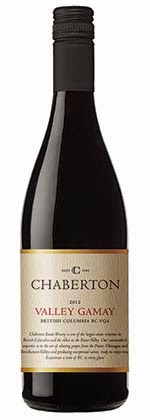
Chaberton Valley Gamay 2012 ($17.95). There is five percent Merlot added to this Gamay. The wine is full-bodied for a Gamay, with jammy cherry and strawberry flavours and a spicy finish. Give this wine a few minutes on opening – it has a screw cap closure – for the whiff of sulphur to dissipate. 87.

Chaberton Reserve Meritage 2011 ($25.95). This is 45% Cabernet Sauvignon, 30% Cabernet Franc and 25% Merlot. The wine saw 12 months in French and American oak barrels. It begins with aromas of black currants, cherries, vanilla and cedar. On the palate, the wine has flavours of spicy red berries. The tannins are ripe but the firm texture suggests cellaring this another year or two. 90.

Chaberton Reserve Merlot 2011 ($25.95). The wine, which was aged 12 months in French and American oak and which has had the benefit of additional bottle age, has an elegantly silken texture. It begins with aromas of cherries and red liquorice, leading to flavours of cherry and lingonberry with a hint of spice on the finish. 89.

Chaberton Reserve Syrah 2011 ($31). Dark in colour, the wine begins with meaty aromas incorporating red berries and pepper. On the palate, there are flavours of black cherry and blackberry crisply wrapped up with notes of black pepper and vanilla on the finish. The texture is medium to full-bodied, with a a long finish. 90.

Chaberton AC 50 2008 ($47.50 for 163 cases but sold out).  The AC series of wines – named for winery owner Andrew Cheng, who assists in blending – all are based on Merlot. This is a 50/50 blend of Merlot and Cabernet Franc. The wine begins with aromas of spice, black cherry and blackberry. On the palate, there are flavours of black currant, black cherry, vanilla, espresso coffee and dark chocolate.  Prolonged barrel aging has contributed to a firm and ageable tannin structure. 91.

Chaberton AC 70 2008 ($47.50 for 139 cases). This is 70% Merlot, 20% Cabernet Franc and 10% Cabernet Sauvignon. The wine begins with aromas of vanilla, black cherry and cassis, leading to flavours of black currant and vanilla with a touch of sage on the finish. The Cabernet Sauvignon has lent a firm, ageworthy texture to the wine. 90.


Chaberton AC 100 2008 ($47.50 for 282 cases). This elegant, full-bodied wine is an excellent expression of Okanagan Merlot. It begins with aromas of black currant and vanilla, leading to flavours of black currant, black cherry and dark chocolate. The ripe tannins give this wine a generous weight and a long finish. 91. 

Friday, September 26, 2014

Gold Hill adds a Meritage


 Photo: Gold Hill Winery: you can't miss it


There is a house style emerging a Gold Hill, a winery that opened in 2011 not far north of Osoyoos.

The style is unapologetically big and ripe, with flavours that fill the mouth and have such a long finish that you need a stop watch to time it.

It is a style that can be achieved in the south Okanagan, especially in warm vintages like 2012, 2013 and 2014. Gurbachan and Sant Gill, the winery owners, have become adept at growing grapes since 1991, a few years after arriving in the Okanagan from India. They now own 65 acres of vineyard, most of it in the south Okanagan.

Gold Hill was launched in the 2009 vintage. That was another hot season and there was no shortage of ripe grapes for Phil Soo, the consulting winemaker. The Cabernet Franc from that vintage won a Lieutenant Governor’s Award of Excellence, helping to establish Gold Hill’s profile.

Of course, the gold-hued winery beside the highway also helps the profile with those wine tourists who turn in.

The current releases include the winery’s first Meritage. Aged 16 months in French oak, this wine aims to be Gold Hill’s entry into the ranks of producers of icon reds.

Those are the wines that consumers buy not just for Saturday’s barbecue but to lay down, and to accumulate several vintages with an eye to vertical tastings in the future. Wines like that signal a growing confidence consumers have in the rising quality of British Columbia wines.

The wines don’t have the longevity (yet) of collectible and expensive Bordeaux reds. However, the reasonably priced British Columbia red icons will age, on average, 10 years. The Gold Hill Meritage is a little softer and I would sample the bottles by their fifth year to see how they are developing. It is always better to drink a wine too young and too old.

Here are notes on the current releases.

Gold Hill Chardonnay 2013 ($20.90). This is a refreshing, unoaked Chardonnay, with appealing aromas of green apples and citrus. On the palate, there are flavours of apples and white peach. This delicious wine has a crisp finish. 90.

Gold Hill Viognier 2013 ($21.90). This is a big ripe Viognier with a rich texture and honeyed aromas and flavours of apricot and guava. The alcohol is a warming 14.9% but it is balanced by the abundant fruit on the palate. 90.

Gold Hill Rosé 2013 ($18.90). This dark-hued rosé is mostly Cabernet Franc, with a dash of Pinot Gris. The jewel-box colour comes from fermenting on the skins for two days, a technique that also turbocharged the cherry aromas and the cherry and black currant flavours. A touch of pepper on the finish wraps up this full-bodied rosé. I wonder if the wine is not too full-bodied for a rosé. Why ferment on the skins for two days? Did the winemaker forget to rack off earlier?  87.

Gold Hill Cabernet Merlot 2013 ($19.90) This has big ripe stewed black cherry and vanilla aromas. The wine is juicy on the palate with fig, cherry and blueberry flavours. 87

Gold Hill Pinot Noir 2012 ($24.90). The wine begins with aromas of cherry, raspberry and a touch of oak. On the palate, the flavours begin with spicy cherry; there is even a hint of white pepper. The texture is silky. 89.

Gold Hill  Cabernet Franc 2012 ($26.90). The wine begins with appealing aromas of toasty oak, blackberry and black currant. That leads to flavours of black cherry with a hint of ripe raspberry and pepper on the finish. The tannins are ripe and the finish is satisfying and persistent. 92.

Gold Hill Merlot 2012 ($24.90). Here is another boldly ripe wine (15%) but with long, silky tannins. It begins with aromas of cherry and blackberry. There are flavours of black cherry and vanilla with a hint of tobacco and chocolate on the finish. 90.

Gold Hill Syrah 2012 ($26.90). Dark in colour, this wine begins with classic deli meat aromas, along with spicy black cherry and plum. On the palate, there is a satisfying gob of cherry and plum enlivened by black pepper on the earthy finish. This is a deliciously ripe Okanagan Syrah, with a very long finish. 92.

Gold Hill Meritage Family Reserve 2012 ($34.90). This is 33.3% Merlot, 22.2% Malbec, 22.2% Cabernet Franc and 22.2% Cabernet Sauvignon. The wine begins with perfumed aromas of cassis and blueberry (that’s the Malbec asserting itself). The wine needs to be decanted to let the berry flavours and the texture develop. 90.


Wednesday, September 24, 2014

Garlic meets Merlot on the Golden Mile


Photo: Hester Creek general manager Mark Sheridan

On October 4, during the Okanagan Fall Wine Festival, Hester Creek Winery is hosting its third annual garlic festival.

Here is a chance to sample and buy locally grown garlic; and to taste wines paired with garlic-influenced dishes prepared by the winery’s in-house chef, Roger Gillespie.

This event – admission by donation – is a fundraiser for the Farm to Table Lunch Program at the Oliver elementary school. Twice a week, the students are treated to lunches made with ingredients from local farms.

Mark Sheridan, Hester Creek’s general manager, calls it a “terrific” program. “It promotes the use of ingredients from our local producers as well as healthy eating,” he says. “It also helps raise awareness in the next generation of Okanagan residents.”

They don’t, of course, get a taste of Hester Creek wines, which will be poured during the garlic festival, as well as in at nearby Terrafina Restaurant. And the current Hester Creek releases include an exceptional Merlot.

Tinhorn Creek Vineyards, one of Hester Creek’s neighbours on the Golden Mile, also has a suite of events to show off its newest reds – a 2012 Cabernet Franc and a 2012 Merlot. Both also are outstanding.

No doubt, the chef at Tinhorn Creek’s Miradoro Restaurant will use the occasional garlic clove in the recipes there as well. The events include an October 2 dinner, Hops, Grapes and Grub, which involves beer pairings as well as wine pairings. It is a recipe for a boisterous evening.

There is a good chance there will be a bit of garlic around on October 10 when the winery hosts the 18th  of the 20 events to celebrate its 20th anniversary. This is a dinner at Miradoro prepared by guest chef Angus An (of Vancouver’s Maenam Restaurant) and Jeff Van Geest, Miradoro’s chef.

Even if you don’t go, here are notes on the three red wines. You can find them in private wine stores and the Liquor Distribution Branch. All are made in good volume. And all three are made with grapes from older vines, which accounts for the generous and satisfying texture of the wines.


Tinhorn Creek Cabernet Franc 2012 ($24.99 for 4,782 cases). The vines were 19 years old in 2012. The wine explodes with aromas of raspberry and blackberry. Rich in texture, the wine has flavours of blackberry and black cherry. There is a subtle note of oak here; the wine spent a year in two and three-year-old French and American oak barrels. It is a delicious wine. 91.


Tinhorn Creek Merlot 2012 ($19.99 for 7,790 cases). Once again, bold aromas of black cherry, black currant and plum roar from the glass. It is a big ripe (14.9% alcohol) wine with flavours of plum, prune, black cherry and vanilla. The texture is generous, almost fleshy. The wine, which aged a year on American and French oak, is quite satisfying to drink. 91.

Hester Creek Block 2 Reserve Merlot 2012 ($28.95 for 800 cases). Hester Creek has some of the oldest vines on the Golden Mile; the plantings began here in 1968. The Merlot in Block 2, if not that old, certainly has been producing for a couple of decades. This wine is also bold and ripe, with enveloping aromas of plum, vanilla, coffee bean and sage. Rich and soft in texture, the wine has flavours of black currant, black cherry, plum and vanilla. This wine was aged between 12 and 16 months in French (75%) and American (25%) barrels. 92.


Monday, September 22, 2014

Sage Hills stands in for fine Burgundy


Photo: Sage Hills owner Rick Thrussell

Rick Thrussell, the owner of Sage Hills Estate Vineyard and Winery in Summerland, chose to release his 2013 Pinot Noir on September 17, 2014.

Almost certainly, that release date is premature. It is an excellent wine that has just begun its development in the bottle. However, Rick felt under pressure to release it after his debut 2012 Pinot Noir was something of a sensation.

How much of a sensation?

“I have a fabulous story I like to tell people,” Rick told me recently. “I got a phone call about six months ago from the sommelier at Hy’s Steakhouse in Whistler to re-order wine. She said, ‘This party of six came in and they were from France. They asked for the sommelier’. The individual who was head of the party asked for ‘your finest bottle of Burgundian Pinot Noir’.”

The sommelier could not find even one bottle of red Burgundy in the cellar, never mind the finest. But she grabbed a bottle of Sage Hills 2012 and returned to the party – being careful to crack the screw cap closure before reaching the table. Without showing the label, she poured a taste and stood back for the verdict.

“He picked it up and swirled it around and put it to his nose,” Rick continued the story. “He said, “Ah yes, I know this vineyard very well. This is the Grand Cru vineyard on such and such’.”

The sommelier said no. The guest again swirled and tasted and admitted he was mistaken. “This is the other side of the river,” he ventured. Again, the sommelier told him he was wrong. And when his third guess also proved incorrect, he demanded to know what appellation in Burgundy the wine was from.

“The sommelier said it is actually here in British Columbia, in the Okanagan Valley,” Rick says. Now, she presented the bottle and poured more wine in his glass. “He took another sip and said, ‘How much of this do you have?’ She said, ‘I have six bottles.’ He took all of them.”

In light of that story, you can understand why Rick released the 2013 as soon as it was drinking well. It is a wine of limited distribution, mostly allocated to fine dining restaurants. However, Sage Hills wine are available in VQA stores.

“Our wines are on the drier side,” Rick explains. “We have targeted the market of very high end restaurants and hotels. That’s what the chefs are looking for and the sommeliers listen to the chefs as to what wines go best with the food.”

Sage Hills is an organic producer. The 11-acre Summerland vineyard was planted in 2007 with – on the advice of a French consultant – just three varieties: Gewürztraminer, Pinot Gris and three clones of Pinot Noir. Rick did not let the vines produce a crop until 2012 when the vines were well established.

Rick also leases two acres of organic vineyard at Covert Farm, just north of Oliver. This is the source of the winery’s Syrah. Sage Hills has had two vintages of rosé from those vines and has a delicious 2013 Syrah table wine still in barrel. He expects to release it this fall at $42.

“Our wines aren’t cheap,” he says. “I believe the success of the BC wine industry is not in making cheap wine. I believe it is in making very good high end wine that can compete with some of the world’s best wines, at a price point that is respectable but still worthy of what you are asking.”

Here are notes on the current releases.

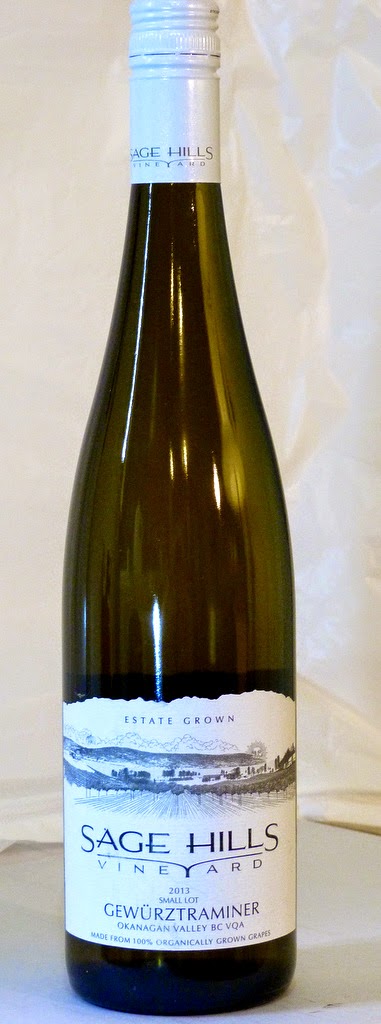
Sage Hills Vineyard Gewürztraminer 2013 ($27.90 for 342 cases). The wine begins with a whiff of lime and grapefruit which carry through to the palate. Of course, there is also spice in the aroma … this is a Gewurz, after all. The fruit favours are both intense and pure. The acidity is refreshing and the finish is dry. The juicy fruit flavours go on and on. 90.

Sage Hills Vineyard Pinot Gris 2013 ($26.90 for 844 cases). Some tasters compare this wine to an Alsace Pinot Gris. It begins with aromas of citrus and toasty lees. The richly textured palate has flavours of pear, citrus and apple with an echo of bready lees. The finish is crisp and dry, with bright but balanced acidity. 91.

Sage Hills Vineyard  Syrah Rosé 2013 ($27.90 for 287 cases). The wine has a lovely rose petal hue, with aromas of plum and strawberry that are echoed in the flavour. A hint of white pepper ties up the dry finish of this elegant rosé. 90.


Sage Hills Vineyard Pinot Noir 2013 ($44.90 for 191 cases). This wine explodes with aromas and flavours of spicy cherry and raspberry with a backbone of minerality. The texture is silky already. Even though the wine is drinking well know, it is several years away from peaking. Cellar this wine if you can keep your fingers away from it. 90-92.

Thursday, September 18, 2014

Noble Ridge and friends: tasting Okanagan Falls wines


Photo: Noble Ridge vineyards in the autumn

The Okanagan Falls region has come into its in recent years for wine touring.

The area got a major lift a few years when the wineries formed an association and when Blue Mountain, the area’s anchor tenant, began opening its tasting room regularly.

I have wandered the region again during the spring and summer and visited most of the wineries. One exception has been Wild Goose Vineyards because I could never work my schedule to east at the new bistro there. I will: I hear nothing but rave reviews for the food. It goes without saying that the wines are outstanding. No winery has won more Lieutenant Governor’s Awards of Excellence. Another exception was Blue Mountain Vineyards, only because I have blogged on their wines separately.

Here are notes on some of the other wines I have tasted.

Blasted Church Unorthodox Chardonnay 2013 ($18.50 for 584 cases). This is an utterly delicious unoaked Chardonnay that includes some of the spicy Chardonnay Musqué clone in the blend.  It begins with aromas of peach and citrus. The wine gives the impression of rich palate weight because it brimming with fruit (peaches, apples, lime). The finish is tangy and quite refreshing. 91.

Blasted Church Pinot Gris 2013 ($20.50 for 2,500 cases). The wine was released in May and only 700 cases remain. It is no wonder it sells so quickly. The wine begins with appealing aromas of peach, apricot and pear. The flavours are packed with stone fruit and pear, with a touch of anise on the finish. The texture is generous and the finish is refreshing. 91.

Blasted Church Mixed Blessings 2013 ($18.50 for 605 cases). This delicious wine also is close to being sold out. It is a blend of Viognier (60%), Chardonnay Musqué (18%), Ehrenfelser (10%), Sauvignon Blanc (8%) and Pinot Gris (4%). Both the Viognier and the Chardonnay spent 24 hours on the skins for additional flavour. Dare I repeat myself: brimming with fruit! This is a wine that begins with aromas apples, pears and citrus, leading to generous flavours of melon, apple and apricot. The finish is long. 91.

Blasted Church Sauvignon Blanc 2013 ($19.50 for 343 cases). This lean wine begins with aromas of herbs and tea. On the palate, there are flavours of lime, herbs and minerals, wrapped up with a crisp, dry finish. 88.

Blasted Church Big Bang Theory 2013 ($19.50 for 3,300 cases). This is an  easy-drinking red with aromas and juicy flavours of spicy black cherry. The blend is Merlot (48%), Cabernet Sauvignon (17%), Syrah (13%), Pinot Noir (10%), Lemberger (8%), Malbec (3%), Cabernet Franc (1%). 87.

Blasted Church Merlot 2012 ($26.50 for 714 cases). This wine invites the consumer with aromas of cassis, blackberry and vanilla. The long, ripe tannins give the wine a full texture, with juicy flavours of black currant, cherry and plum. This is a delicious, drink-now red. 90.

Blasted Church Syrah 2012 ($26.50 for 1,584 cases). The blend is 95% Syrah, tweaked with 2% Petit Verdot, 2% Viognier and 1% Merlot. The ripe tannins have given this wine a supple and juicy texture. It has aromas of red fruit and vanilla (from 15 months in barrel) with a hint of pepper. The flavours include black cherry and plum wrapped up with the classic notes of black pepper. 90.

Liquidity Bubbly NV ($23.90 for 71 cases). This is the winery’s first sparkling wine. Crisp and refreshing with flavours of apple and grapefruit, it is a 70% Chardonnay and 30% Pinot Noir cuvée. The finish is dry. 90.

Liquidity Riesling 2013 ($23.90 for 97 cases). This is a finely balanced wine, with lemon and lime aromas and flavours. The hint of residual sweetness is offset with bright acidity, giving the wine a dry finish. 90.

Liquidity Pinot Gris 2013 ($19.90 for 417 cases). The grapes are from own-rooted vines planted in 1996. That maturity shows in the good backbone of minerality in this dry wine. It has refreshing aromas and flavours of citrus and pears. 90.

Liquidity Viognier 2013 ($23.90 for 465 cases). An exceptionally complex Viognier, this wine was begun by giving skin contact to some of the grapes. Winemaker Matt Holmes then used wild yeast (for the most part). Then he aged the wine four months in older oak barrels. The wine is generous in the mouth, with aromas and flavours of apricot and fresh apple. The bright acidity gives the wine a refreshing lift on the finish. 92.

Liquidity White Blend 2013 ($19.90 for 394 cases). The winery describes this wine as a summer sipper. It is a little more complex than that. The blend is 64% Chardonnay, 25% Viognier and 11% Pinot Gris. The aromas are floral and tropical, leading to flavours of apple and pineapple. A touch of residual sugar balanced with good acidity broadens the texture. 90

Liquidity Chardonnay 2012 ($23.90 for 330 cases.) The winery is fortunate to have 20-year-old Chardonnay in its vineyard. The wine was barrel-fermented with wild yeast and aged in barrels and on the lees for 10 months. The wine is full on the palate, with butterscotch, hazelnut and citrus aromas and with tangerine flavours. 89.

Liquidity Rosé 2013 ($20.90 for 90 cases). This wine is made from the Dornfelder grape, a German varietal planted in the Okanagan for its ability to add colour to red wines. The winemaker fermented this in older French barrels with wild yeast. It is a vibrantly-hued rosé, with aromas and flavours of strawberry and cranberry. 90.

Liquidity Pinot Noir 2012 ($24.90 for 405 cases). The winery also has mature Pinot Noir vines, and five clones. Once again, the winemaker fermented the majority of this wine with wild yeast, giving the wine about 20 days of skin contact. The colour is dark. There are aromas and flavours of spice and cherry, with savoury notes of mushroom and earth. 89.

Meyer Family Vineyards Chardonnay Stevens Block 2013 ($24 for 113 cases). This elegant wine is from grapes on the winery’s Naramata Bench vineyard. It begins with aromas of toasty oak and citrus, leading to citrus and ripe apple flavours. While generous on the palate, the wine has a crisp finish. 91.

Meyer Family Vineyards Rosé 2013 ($20 for 150 cases). Made with Merlot, this exuberant rosé delivers a blast of cherry and strawberry flavours with a crisp and dry finish. 90.

Meyer Family Vineyards Okanagan Valley Pinot Noir 2012  ($25 for 1,600 cases). This is the entry-level Pinot Noir from a winery that has made Pinot Noir (and Chardonnay) its speciality. This is a concentrated wine with juicy flavours of raspberry and strawberry, and a silky but full texture. 89.

Meyer Family Vineyards Reimer Pinot Noir 2012 ($40 for 318 cases). Made with grapes from a Kelowna area vineyard, this is a Pinot Noir with both intensity and length. It has a good dark colour, with aromas and flavours of cherry and spice. 90.

Meyer Family Vineyards McLean Creek Pinot Noir 2012 ($40 for 360 cases). This is a seductively pretty wine, with delicate notes of cherry and strawberry on the nose and palate. The texture is ever so silky and the wine is ever so elegant. 91.

Noble Ridge Mingle 2013 ($17.99 for 487 cases). This is a blend of 40% Chardonnay,  38% Gewurztraminer, 18% Pinot Grigio and 4% Pinot Noir. A double gold winner at the All Canadian Wine Championships this spring, this is a zesty and delicious wine. It is packed with flavours of spicy citrus, peach and apple. It has good volume on the palate, along with a refreshing and dry finish. 90.

Noble Ridge Pinot Grigio 2013 ($18.90 for 405 cases).  This wine has two gold medals and a silver in competition, so far. The wine begins with appealing aromas of peaches and pears, with a touch of orange. The wine has a generous texture, with citrus and pear flavours. The finish is refreshing, with just enough acidity to give the wine a crisp tang. 90.

Noble Ridge Reserve Chardonnay 2011 ($23.90 for 426 cases). Best of class in the Okanagan Spring Wine Festival, this Chardonnay begins with aromas of buttery tangerine, pear and vanilla. On the palate, the crisp, bright apple and pear flavours are framed subtly with oak. The wine was cold-fermented in stainless steel and then aged 14 months in French and American oak, a quarter of it new. 90.

See Ya Later Ranch Jimmy My Pal 2012 ($16.90). Jimmy My Pal was one of about a dozen dogs owned by one of the former owners of the property. Some of the proceeds of this wine are donated now to the SPCA. The wine is a blend of 87% Chardonnay and 13% Pinot Gris. The wine is crisp and fresh, with aromas and flavours of citrus and apples. 88.

See Ya Later Ranch Gewürztraminer 2013 ($Sold out). Without a doubt, this winery has one of finest Gewürztraminer blocks in the Okanagan. This wine begins with herbal and spicy aromas and goes on to spicy grapefruit flavours. The finish is dry. 90.

See Ya Later Ranch Pinot Noir 2011 ($20). This is a pretty wine, with a fine colour and aromas of strawberry and cherry. The texture is silky, perhaps the result of 18 months in French oak. 89.

Stag’s Hollow Tragically Vidal 2013 ($19 for 400 cases). This fruity white is always the crowd pleaser in this winery’s wine shop. The winery once grafted Chardonnay onto the Vidal roots and subsequently reversed the grafts to satisfy the demand for Vidal. People like it because the aromas and flavours of tropical fruit and lime explode from the glass. 89.

Stag’s Hollow Renaissance Sauvignon Blanc 2013 ($25 for 81 cases). This wine was barrel-fermented in new French oak; just half went through malolactic fermentation. As a result, the wine has bright fruit flavours of grapefruit and gooseberry, with herbal and lime aromas. 91.

Stag’s Hollow Riesling 2013 ($20 for 380 cases). Some of the grapes were touched with botrytis. As a result, there is an appealing note of honey in the aroma, along with lime and peach. Those fruit flavours carry through to the palate and the wine ends with a vibrant, tangy finish. 89.

Stag’s Hollow Syrah Grenache Rosé 2013 ($22 for 168 cases). The wine is 85% Syrah, 15% Grenache and 100% delicious. The hue is dark; the aromas are bold, with lots of strawberry and plum which carry through to the full palate. The finish is dry. 90.

Stag’s Hollow Grenache 2012 ($30 for 170 cases). The varietal is rare in the Okanagan because the vines do not handle winters well. This is a delicious wine, with aromas and flavours of spiced plums, currants and even strawberry. 92.


Stag’s Hollow Tempranillo 2012 ($30 for 305 cases). This varietal is one of the major reds in Spain. Stag’s Hollow winemaker Dwight Sick followed the Rioja tradition of using American oak when he aged the wine in barrel for 15 months. The wine has slightly toasty aroma mingled with dark fruit notes. It has flavours of blackberry and pomegranate. 90.