Writer and wine columnist John Schreiner is Canada's most prolific author of books on wine.
Monday, August 1, 2011
Class of 2011: Gold Hill Winery
Photo: Gurbachan and Sant Gill
When a widening of Highway 97 was completed this spring midway between Oliver and Osoyoos, it moved the new Gold Hill Winery from highway frontage to a parallel service road.
The winery’s owners actually see this as an advantage. The winery is still visible to passing motorists but the access now is far safer. This had been a stretch of road notorious for mishaps. No one in the wine business wants to be associated with that, much less two of the most recent entrants.
Theirs is the classic immigrant story. Joining an uncle already here, brothers Sant and Gurbachan Gill came from India with only a few dollars and took $6 an hour farm worker jobs. A quarter century of hard work later, they opened their own winery.
Sant, who was born in 1958, emigrated to the Okanagan in 1984. Younger brother Gurbachan, born in 1967, followed him in 1989, in the same year that Sant bought his first house in Osoyoos. After a few years of orchard work, the brothers in 1991 began working in vineyards owned by Kal Gidda, one of the principals at Mt. Boucherie Estate Winery. The experience they picked up during almost a decade with Kal and his brothers shaped the future for the Gill brothers. Today, they plant and manage vineyards for others as well as looking after their own vineyards.
The winery is based on a farm that they bought in 1995. They continued to grow peaches, apricots and cherries there until they switched to grapes in 2007. The rocky slope is either the southernmost extension of The Golden Mile or the northernmost extension of the Osoyoos Lake Bench, since the winery and 7.3-hectare (18-acre) vineyard are almost midway between Oliver and Osoyoos.
In plantings since 2007, the brothers have put in the mainstream varieties – Merlot, Cabernet Franc, Cabernet Sauvignon, Syrah, Malbec, Pinot Gris, Chardonnay, Viognier and Gewürztraminer. They also own or lease smaller vineyards in Osoyoos, Okanagan Falls and Kaleden; the latter produces Pinot Noir for the winery.
The winemaker for Gold Hill is consultant Philip Soo. Formerly a winemaker with Andrew Peller Ltd. in Port Moody, Phil since 2006 has become of the Okanagan’s busiest consultants with a client list that includes Dirty Laundry, Noble Ridge and Cassini Cellars. He crafts wines that are distinctive and different with each client, reflecting both individual vineyards and client preferences. The Gill brothers grow grapes that are ripe and full of flavour and that was reflected in the winery’s three bold reds from 2009, all of which spent 16 months in French oak, and the 2010 unoaked Chardonnay, the debut wines. Additional varieties – Gewürztraminer, Pinot Gris, Pinot Noir - are planned in subsequent vintages.
Always willing to learn new skills, Sant is picking up some of the art of winemaking from his consultant. “Phil is a really nice guy,” Sant says. “He explains lots of things to me when he comes here.”
Here are notes on the wines.
Chardonnay 2010 ($19.12). This has the classic freshness of an unoaked Chardonnay, with aromas and flavours of apples and with a crisp finish. 88.
Merlot 2009 ($22.48). This is a concentrated and firm Merlot, with aromas of cassis and with flavours plum, pomegranate, liquorice and chocolate. 88 and it will add a few points with cellaring for a year or decanting now.
Cabernet Franc 2009 ($24.72). Here is another wine that makes the case for this under-appreciated variety. It is big and juicy, with aromas of cassis and blueberry, and flavours reflecting those fruits, with a spicy note. 89.
Syrah 2009 ($26.96). This is a generous red with aromas of lavender and iodine; with flavours of plum and cherry and a touch of pepper on the finish. 88.
Gold Hill Winery
29014 Highway 97
Osoyoos BC V0H 1V0
T 250.495.8152
Open daily in summer from 10 am to 6 pm.
Wednesday, July 27, 2011
Mark Wendenburg takes over at Blasted Church
Photo: Mark Wendenburg
Mark Wendenburg, a consulting winemaker and a veteran of 30 vintages, has taken over as the new winemaker for Blasted Church Vineyards.
He dates his introduction to the wine industry from 1980, when he and his father, Chris, planted the five-acre family vineyard near Penticton.
He is best known for his 18 years as winemaker at Sumac Ridge Estate Winery. He left that winery in the spring of 2010 and hung out his shingle as a consultant. Blasted Church is now his major client.
The winemaking job at Blasted Church came open in March when that Okanagan Falls winery parted company with Richard Kanazawa.
Richard, who is now the winemaker at Lang Vineyards on the Naramata Bench, had been at Blasted Church for four years (the longest any winemaker has been at a winery with a bit of a turnover history).
Mark took over the Blasted Church cellar in June. He has inherited a portfolio of wines that, with very few exceptions, are impressive. (See my blog of March 28, 2011, for reviews of most of the wines.) At a tasting in Vancouver this week, it was obvious that Mark is also impressed with what has been handed to him.
Two months into the job, he is considering one change: the winery’s Pinot Noir table wine could be dropped from the portfolio because the grapes will be needed for an expanded sparkling wine program. Mark, after all, has a long and distinguished track record for making award-winning sparkling wine.
He was born in Penticton in 1961, shortly after his parents arrived in Canada. They had owned agricultural land in Germany’s Harz Mountains until the East German government relieved them of their property.
After helping plant the family vineyard, Mark went to Germany in 1982, apprenticing with wineries in three regions, and earning a winemaking diploma at the Bavarian State Institute for Viticulture and Enology in Franconia.
On returning in 1987, he started working at the T.G. Bright & Co. winery near Oliver. In winter of 1988, Mark did a crush at the Nobilo winery in New Zealand; the following winter, he did the crush at S. Smith & Sons in Australia (better known as Yalumba).
In between those assignments, he resumed working at Brights but also became involved in a sparkling wine project that had been launched on the Okanagan by California’s Schramsberg Cellars with Inkameep Vineyards and what is now Blue Mountain Vineyard & Cellars. One of his bosses at Brights told him to choose between Brights and the sparkling wine project. Mark chose the sparkling wine project.
After that project wound up in 1991, Mark joined Sumac Ridge which was just getting its Steller’s Jay Brut sparkling wine launched. Sumac Ridge had begun handcrafting the wine in 1987 but production was insignificant until Mark came on board and until the winery installed adequate equipment for producing bubbly.
Steller’s Jay is now one of Canada’s best traditional method sparkling wines, an elegant blend of Chardonnay, Pinot Noir and Pinot Blanc. The awards won by this wine are legendary. Among others, Steller’s Jay Brut 2001 was sparkling wine of the Canada in the 2004 Canadian Wine Awards and also got a Lieutenant-Governor’s Award of Excellence in Winemaking. The current release, from the 2006 vintage, won a Lieutenant-Governor’s Award this year.
Sumac Ridge has piled up an astonishing array of firsts and awards during the past 18 years with Mark in the cellar, including Canada’s first red Meritage in 1993 and its first White Meritage in 1995. Pinnacle, first made in 1997, was the Okanagan’s first luxury red blend, selling then (and now) for $50. Sumac Ridge began making Gewürztraminer well before Mark joined the winery but his refinements to the wine help explain why it is Canada’s largest-selling Gewürztraminer.
At about 20,000 cases a year, Blasted Church is roughly a quarter the size of Sumac Ridge but with a similar portfolio of blends and varietals.
The Vancouver tastings also included three wines from Blasted Church’s Revered Series (as it calls its premium tiers). These are small volume wines made only in top vintages. All are still available from the winery. Here are my notes.

Holy Moly 2008 ($34.99 for a production of 57 cases). This is Petit Verdot. It is a dark red with the spectacular perfumed aroma of the varietal (there is even a hint of iodine). There are flavours of blackberries and boysenberries; and the wine has a dense, satisfying texture and a long finish. 92.
Cross to Bear 2008 ($34.99 for a production of 96 cases). This is a blend of Syrah and Malbec and, as Mark observed, the varieties “sit well together.” The wine has the peppery aroma and flavour of Syrah with the brooding black cherry and plum flavours of the Malbec. This is a big and demonstrative red. 93.
Nothing Sacred 2008 ($39.99 for a production of 195 cases). This is a blend of 50% Merlot, 40% Cabernet Sauvignon, and 5% each of Malbec and Petit Verdot. It is a bold, concentrated red with aromas and flavours of currants, cedar, even a touch of chocolate. The soft ripe tannins encircle a core of sweet fruit. 91.
Tuesday, July 26, 2011
Dogfish and other culinary delights of Victoria
Photo: Dan Hayes, the London Chef, about to slice up dogfish
Someone told me last week that Victoria has more good restaurants per capita than any North American city of its size.
That is debatable (have you been to New Orleans?). But I would not disagree that Victoria’s food and wine culture has come alive. That was highlighted last week at Taste, the city’s third annual food and wine festival.
After struggling in its first two years, Taste this year sold out a number of events – and not just to the locals. At one event, I met a couple from Atlanta who had booked a west coast vacation to escape the oppressive heat on the east coast. We had a great conversation until Barack Obama’s alleged progress to Marxism came up.
Today’s Victoria has changed remarkably from the quaint faux-English government town that I recall from the 1960s and 1970s. It still has plenty of quaint charm: tea in the Empress; boutique hotels; Murchie’s Tea Room right next to Munro’s Books; the gardens at Government House; Beacon Hill Park; pipers, buskers and artists; horse-drawn carriages; and more. And now, there is the burgeoning food and wine culture. The Union Club is no longer the only place to go for a power lunch.
Perhaps the corner was turned in the early 1990s when the first modern era wineries began opening on Vancouver Island at the same time as Okanagan winemaking began to take off. Good food and good wine go together. The results can be found on the great wine lists at (to name a few) Sooke Harbour House and Butchart Gardens.
Butchart Gardens won the award this year for the best list featuring British Columbia wines. In recent years, the sommelier there has replaced nearly all imported wines on their extensive list with British Columbia wines. Butchart Gardens takes the view that its visitors – many from other countries – have the opportunity at home to drink French or American wine; but when they visit British Columbia, they have a once in a lifetime chance to drink our wines, which is seldom exported.
There are many unique food and wine experiences to discover in Victoria and its environs. A group of us went on a guided walk one afternoon that began at The London Chef on Fort Street. This restaurant and cooking school was opened three years ago by Dan Hayes, a Londoner with a special passion for seafood. Not just any seafood, but underutilized species like dogfish and skate.
“In Britain, we use it for fish and chips,” he said while filleting a dogfish. A small member of the shark family with an unfortunate name, dogfish is a coincidental catch with the more commonly used species. Dipped in batter, deep-fried and served with house-made tartar sauce, the dogfish was delicious.
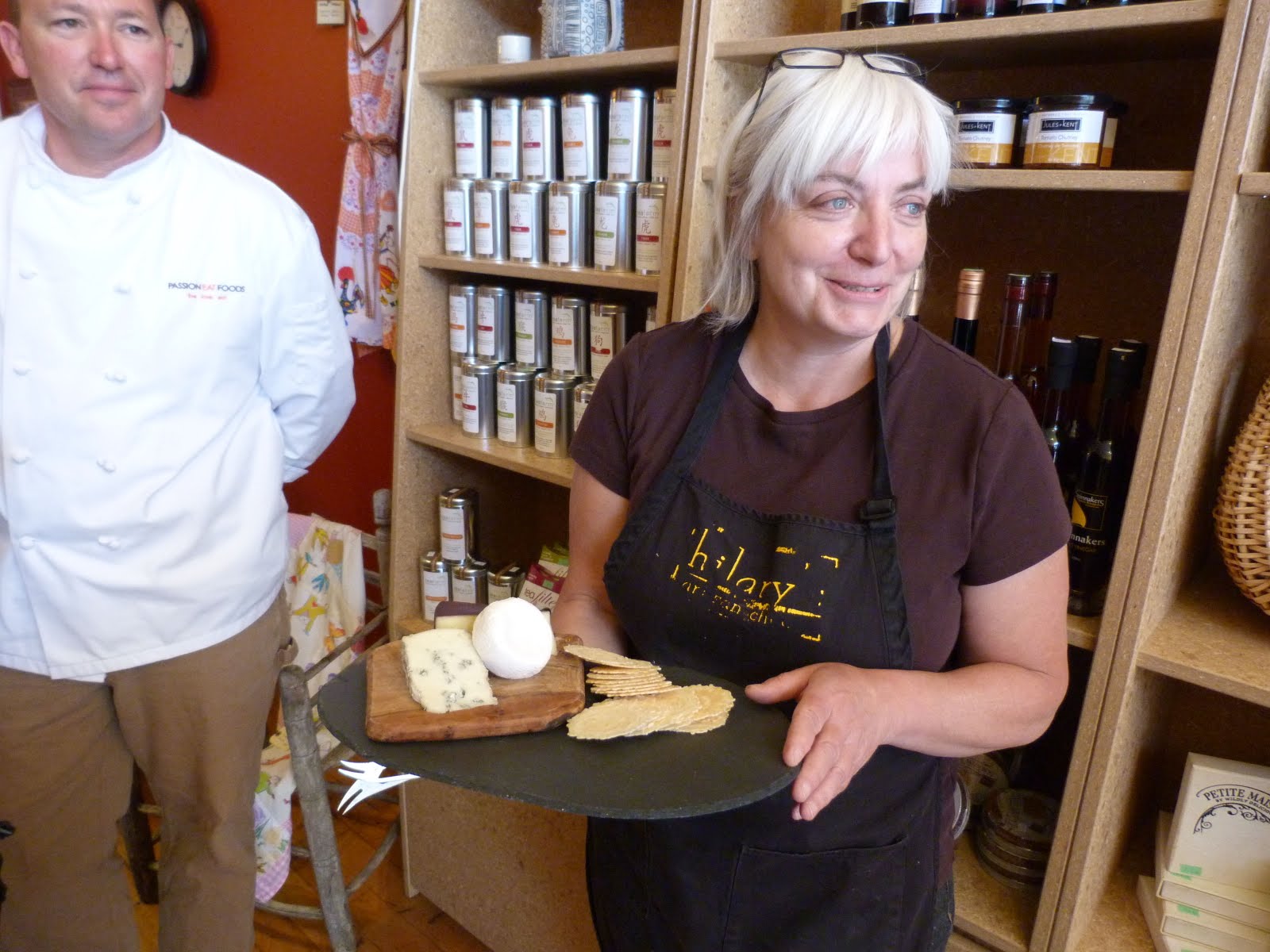
Near Dan’s restaurant, Hilary’s Cheese – the 10-year-old Cowichan Bay cheese maker – has its recently opened shop, its first one outside the Cowichan Valley. In parallel with island winery development, at least half a dozen cheese producers have opened on Vancouver Island or Salt Spring Island in the past decade. In fact, the Little Qualicum Cheeseworks opened its own fruit winery, called Mooberry, two years ago.
Photo: Patty Abbott of Hillary's Cheese
These are substantial businesses making world-class cheese. Patty Abbott, whose husband is Hilary, says that Hilary’s Cheese processes about 2,000 litres of milk a week, including 700 litres of goat’s milk.
Photo: Specials at Choux Choux Charcouterie
Further along Fort Street is Choux Choux Charcuterie, a tiny place that draws in trade with the most remarkable aromas of spice and meat products. Many of the meat products are made right there with premium cuts of fresh meat. On this particular day, the proprietors were dealing with a freshly butchered pig in the back of the store (out of sight from patrons).
Still on Fort Street, the Dutch Bakery is one of Victoria’s retro gems. It was established 54 years by emigrants from Holland and still uses grandfather’s recipes for some of its best pastry. The restaurant is authentically 1960s in style with formica tables and stools along the counter. Even the modest prices seem a decade or two old.
Photo: Silk Road's Daniela Cubelic
Another remarkable Victoria institution, right on the edge of the city’s China Town, is Silk Road, established in 1992 by tea master Daniela Cubelic. The experience here is totally sybaritic, offering not only exotic teas but aroma therapy and spa treatments. Daniela is also passionate about chocolate and argues for the merits of pairing teas and chocolate: black teas with dark chocolates, fruit-infused or green teas with milk chocolate, white tea (yes, there is such a tea) with white or light chocolate.
While there is more than enough to keep one occupied in Victoria, wine country is only half an hour from downtown, whether one goes to the Saanich Peninsula or to the Cowichan Valley.
Photo: Damali winery amid lavender
I chose the Cowichan Valley to visit the recently opened Damali Winery & Vinegary. The owners have created an oasis of lavender and vines, making an array of products that incorporate lavender, including two wines. I particularly liked Mure Lavande, a dry blackberry table wine with a subtle hint of lavender.
That put me in the mood for blackberry wine and I carried on a few minutes to Cherry Point Estate Winery. This Cowichan Valley winery, now owned by Colombian economist Xavier Bonilla and his wife Maria, pioneered blackberry “port” in the 1990s.
Photo: Cherry Point's Xavier Bonilla
Eight years ago, Simon Spencer, then Cherry Point’s winemaker, took blackberry port to a higher level by creating a solera-style version. It is arguably the best of the island’s numerous blackberry ports.
Xavier has an elegantly simply explanation of the solera process, illustrated by a three-barrel pyramid on display beside the wine shop. One begins solera aging by putting wine in all three barrels. When the wine is sufficiently aged, half of the volume in each of the bottom barrels is drained out for bottling. The wine in the top barrel refills the bottom barrels and fresh wine goes into the top barrel.
The actual barrel stack in the winery is much larger but the principle is the same. When aged wine is pulled off for bottling, it makes room for younger wine to cascade down the pyramid. The mixing of vintages adds to the complexity of the wine.
The wine is labelled Solera. I scored it 91 points and longed for a wedge of Hilary’s cheese to enjoy with it.
Tuesday, July 19, 2011
Dinner in the vineyard at Noble Ridge
Photo: Jim D'Andrea in the Noble Ridge cellar
What would you do if it rained on your dinner party?
It happened last week to Jim and Leslie D’Andrea, the owners of Noble Ridge Vineyard & Winery at Okanagan Falls, when they were hosting about 30 guests for a dinner in the vineyard.
They turned it into an educational opportunity, entertaining the guests with a barrel tasting of 2010 Cabernet Sauvignon while the staff of Bogner’s, the caterers, moved the table and the dinner settings into the winery.
The Okanagan weather this year has been no more conducive for dining under the open skies than it has been for growing grapes. The temperature was pleasant enough for a reception outdoors at the Noble Ridge winery. We were treated to canapés and glasses of Mingle 2010, the winery’s white blend, which will be released as soon as the last of Mingle 2009 has been sold.
This is a delicious $18 blend built around Pinot Gris and other varieties that are not disclosed. This allows the winery to keep its options open, changing the components of the blend from year to year, depending on what the vintage gives them to work with.
It is an excellent wine, tasting of apples, peaches and citrus. Even though there is a touch of residual sweetness, the 2010 has exquisite balance, with a refreshing and crisp finish. My score: 88.
The guests had barely been seated at the long table in the vineyard when black clouds moved overhead and fat drops of rain splashed down. We dashed for shelter in the winery, leaving the caterers to bring the table inside and set it up all over again.
Jim and Leslie needed to occupy the half hour that Bogner’s required to reset the table. They took this chance to recount their history, finishing with a barrel tasting.
Photo: Leslie D'Andrea
Calgary natives, they bought a 15-acre vineyard property just south of Okanagan Falls in 2001. Jim is a senior lawyer and Leslie was a hospital administrator. They were attracted to the lifestyle of winery owners during vacations in France and even considered buying a vineyard there. Then they discovered the remarkable wines that were beginning to emerge from the Okanagan. It was much more practical to set up their winery here than in distant France.
Noble Ridge opened in 2005. The following year, they bought a 7 ½ vineyard across Oliver Ranch Road from their original property, partly for the additional grapes but also for the sturdy building (a massive garage for trucks) they turned into a winery. It took Jim’s considerable skills as a lawyer to persuade the regulators that the winery could be on one side of a public road while the tasting room was on the other.
The disciplined planting on these vineyards gives Noble Ridge the grapes to produce a focussed portfolio of about six table wines. Coming fall is the winery’s first sparkling wine which Jim and winemaker Phil Soo have benchmarked against good Champagne. Also coming soon is 120 cases of 2009 King’s Ransom, a limited release of the icon Bordeaux blend the winery produces only in the best years. First dibbs on both wines belongs to those on Noble Ridge’s email list (free registration).
The barrel tasting of the 2010 Cabernet Sauvignon was revealing. That is a late ripening variety and the 2010 vintage was almost as cool and late as the 2011 is turning out to be. Not an ideal Cabernet year. I expected the wine to show some green aromas and flavours but I was quite surprised to find both samples were ripe and full of clean fruit flavours. It was obvious that Noble Ridge has a very good vineyard crew. If they delivered ripe Cabernet Sauvignon to the winemaker last year, you know they got everything else right, too.
The table was now set up in the winery and we sat down to dinner which included an excellent Chateaubriand paired with an award-winning Noble Ridge library wine, a Meritage 2006 that I scored 91. There might be a few bottles left under the counter in the wine shop. The Meritage 2007 (89 points) is the current release on sale here, $10 off the usual $30 price in celebration of the owners’ 1oth anniversary in the Okanagan.
The rainstorm having passed, the uncomplaining crew from Bogner’s moved the table back into the vineyard for desert. (Bogner’s, of course, is the renowned restaurant in downtown Penticton.) And there was still time for a late evening visit to the wine shop.
The other wines here include:
Pinot Grigio 2009 ($18.90). The wine begins with aromas of pear and citrus and tastes of pears and bake apples. The alcohol is a touch generous for the Pinot Grigio style and the wine might better be called Pinot Gris. The finish is long and rich. 88.
Chardonnay 2009 ($23.90). There was no opportunity to taste this wine, which has already won gold at the All-Canadian Wine Competition. The 2008 vintage, which was served at dinner and is now sold out, garnered medals at several competitions including Chardonnay du Monde.
Pinot Noir 2008 ($27.90). This will be released in the fall when the 2007 has been sold. While the 2007 Pinot Noir is lean, with cherry notes on the nose and palate, the 2008 is a glorious wine. It has aromas of strawberries and flavours of strawberry and cherry. The velvet texture is rich and concentrated. 90.
Noble Ridge has expanded its Pinot Noir plantings, both to support this varietal and for its sparkling wine program. After a decade in this vineyard, they have concluded, as Leslie says, that “Pinot Noir is happy here.”
Tuesday, July 12, 2011
He's back! Harry McWatters unveils his own label
Photo: Harry McWatters
Sumac Ridge Estate Winery founder Harry McWatters has been such a force in British Columbia wines for at least 35 years that it is startling that he has never put his name on a brand of wine until now.
This week, at media lunches in the Okanagan and in Vancouver, he is formally unveiling the McWatters Collection 2007 Meritage.
“I never planned to put my name on it,” he says. “It was Christa-Lee and Darren that encouraged me to do it,” referring to his daughter and his son.
Christa-Lee, who also runs Local, the McWatters-owned restaurant in Summerland, argued that it would be prudent to establish the family brand. It is possible that this release could be the forerunner of a family-run winery.
Christa-Lee convinced her father that “if we are going to do something long-term, we might as well get something out there now.”
The 2007 Meritage has had a soft release already. It retails for $25 in the Summerland wine shop that Harry owns and it has been on Local’s wine list since spring. The initial release is only 500 cases.
No Meritage was made in 2008; but in 2009, 800 cases of Meritage and 200 cases of Chardonnay were produced. The Chardonnay is expected to be released this year but the 2009 Meritage is not likely to be released until next year.
The 2007 Meritage was made under Harry’s direction by Brad Cooper at the Township 7 Winery in Penticton. It is 60% Merlot, 35% Cabernet Sauvignon and 5% Cabernet Franc. The grapes are all from Harry’s vineyard on Black Sage Road. The wine spent 15 months in French oak barrels and another 15 months in bottle prior to release. It is a delicious 90-pointer that does Harry proud.
There are two explanations for Harry releasing a wine with his own name on the label (aside from the encouragement of his family).
First of all, he has been passionate about wine longer than most of us have been drinking wine. He started making wine at home when he was 16 (he was born in 1945). In 1968 he quit as a United Van Lines manager to work in sales for Casabello Wines in Penticton. He started Sumac Ridge in 1980 with Lloyd Schmidt, who was then the vineyard manager at Casabello.
When Vincor Canada bought Sumac Ridge in 2000, Harry remained in Vincor’s management group until 2008. He “retired” to set up The Vintage Consulting Group which now has winery and vineyard clients throughout British Columbia.
Secondly, Harry has the grapes in his superb vineyard on Black Sage Road. The vineyard was planted in 1993 and at the time was one of the largest plantings of Bordeaux reds (primarily) in Canada. Over the years, some of Sumac Ridge’s best wines were made from the Black Sage Vineyard grapes.
The vineyard was owned under a structure in which Harry and the winery were roughly equal partners. That has now been formalized in a way that leaves Harry with the front 60 acres and Vincor with the back 55 acres. Harry has been selling the grapes from his vineyard to various clients including Vincor. He made no Meritage in 2008 or in 2010 because his grape supply was already spoken for.
His obligation to Vincor ends this year, with Vincor buying 20% of the fruit. Harry is planning to make Meritage and Chardonnay this vintage. Where and how much has yet to be decided.
The vineyard – which needs to be renamed because Vincor owns the Black Sage Vineyard brand – grows enough varietals to support a good portfolio, should the McWatters Collection develop beyond Meritage.
“The largest variety I am growing is Merlot; then Cabernet Sauvignon,” Harry says. “I have only a small amount of Cabernet Franc. I am going to plant more. We did pull out our experimental vineyard there and planted just over an acre of Syrah. It is in its second leaf. In whites, I have Sauvignon Blanc, Chardonnay, a little bit of Pinot Blanc.”
He is considering pulling out half of the Pinot Blanc to make room for Malbec and Petit Verdot. “The vineyard is so good for reds,” he believes.
“I don’t think I will sacrifice the Chardonnay; we get a lot of tropical fruit characteristics that make a big Chardonnay,” Harry says. “I like that style and I certainly have demand for it.”
Friday, July 8, 2011
Calliope Wines take wing with 2010 releases
Photo: Jim Wyse
Jim Wyse and his family have always had a deep interest in birds which they made clear by naming their winery Burrowing Owl Vineyards after a particularly endangered owl.
“That is one area of our operations that Jim will be involved with forever,” says Kerri McNolty, his daughter. “He is the one who personally does all the bat boxes and cleans out and repairs all the bluebird boxes. That is his passion. He spends most of his time on the Burrowing Owl captive breeding program. They have had great success this spring with four pairs of burrowing owls that had complete nests with six to eight eggs that all hatched.”
Given that background, it is not surprising that the new label from Burrowing Owl is Calliope Wines, named for the hummingbird. The first Calliope wine was released last year. This summer, four Calliope wines have just been released. The fifth, a red blend called Figure 8, will be out this fall. Figure 8 describes the motion of a hovering hummingbird’s wings.
The Calliope label was created initially by winemakers Ross and Cherie Mirko. They launched it in 1999 (with two partners) and operated as a “virtual” winery until 2005 when they moved to New Zealand and wine industry careers there.
As they were leaving, they sold the brand to bird lover Jim Wyse. “He thought the bird allusion was neat and he would tuck it away and save it for some future date, when we had a brand that needed a name,” Kerri says.
About the same time, the Wyse family purchased property near the Grist Mill at Keremeos, planting primarily Sauvignon Blanc, a variety that has never been in the Burrowing Owl portfolio. The first Calliope wine released last year was a Sauvignon Blanc.
“The Calliope concept is to try new varieties we are not producing at Burrowing Owl,” Kerri says. “And with different techniques, perhaps.”
The four 2010 releases are Sauvignon Blanc, Viognier, Riesling and a Syrah rosé. The wine to be released this fall is a Syrah Merlot blend.
Photo: Bertus Albertyn
The project also gave Burrowing Owl winemaker Bertus Albertyn an opportunity to expand his repertoire. He had never before made a Riesling. For that matter, Burrowing Owl has never had a Riesling either.
Bertus, who joined Burrowing Owl in October, 2009, was born in South Africa in 1978. While his father was a banker, his grandfather had been a grower and winemaker and his uncle, Chris, heads the viticulture department at the big KWV winery. When Bertus completed his training at the Stellenbosch wine school, he joined a small co-operative winery and then moved to Avondale, a premium wine producer about twice the size of Burrowing Owl. He came to Canada with his wife, Elzaan, now a family doctor in Osoyoos.
The Calliope label gives Burrowing Owl, strictly an estate producer, the option of making wines with purchased grapes as well as grapes from its own plantings.
The 2010 Sauvignon Blanc, made mostly with grapes from the Keremeos vineyard, also has grapes purchased from a Summerland vineyard. The Riesling grapes were purchased from a young vineyard near Oliver. The Viognier grapes came from a Summerland vineyard.
“It seems to me that the Okanagan has a natural high acidity,” Bertus observes. Generally, he sees that as a benefit; all of the 2010 releases are crisp and refreshing.
However, he also had to dip into his bag of winemaking tricks to manage the acidity in a cool year like 2010. “Because of the high acidity [of the Riesling], I put it in the barrels just to develop more mouthfeel and to balance it,” he says. “The residual sugar in this wine is not high, about seven grams.”
The soundness of all the Calliope wines is testimony to the experienced winemaking that Bertus has brought to the Okanagan.
Here are notes on the wines.
Calliope Sauvignon Blanc 2010 ($16.99 with a production of 662 cases). This wine begins with the classic grassy and citrus aromas of the variety. It has lime and grapefruit flavours with a crisp but lingering finish. 90.
Calliope Riesling 2010 ($14.99 for a production of 190 cases). The wine begins with attractive floral aromas and shows flavours of peach and lime, with a delicate mineral backbone. The finish of this light but well-balanced wine is tangy and refreshing. 88.
Calliope Viognier 2010 ($13.99 for a production of 175 cases). The wine also begins with floral aromas and has flavours of pineapples and peaches. All of the wine was fermented in five-year-old barrels where it remained on the lees for three months. That added to the texture. 88.
Calliope Rosé 2010 ($13.99 for a production of 334 cases). The wine was made with Syrah juice that had one day of skin contact, which extracted a lovely hue. The wine, which has a touch of Viognier, has aromas and flavours of strawberry and raspberry. Juicy and refreshing on the palate, the wine is packed with fruit, the flavours of which are lifted by a touch of natural sweetness. 89.
Thursday, June 30, 2011
Wine touring in the Shuswap
Photo: Vineyard at Celista
If the number of wineries you can visit comfortably in one day constitutes a critical mass, the Shuswap region around Salmon Arm qualifies with six wineries.
It has taken a while. Larch Hills Winery, which opened in 1997, was the first in the area. Sunnybrae Estate Winery, profiled in a previous blog, is the most recent, opened this spring.
This is British Columbia’s northernmost cluster of wineries and vineyards, an hour’s drive from the north end of the Okanagan and half a day’s drive from the great concentration of British Columbia’s wineries. It is easy for wine tourists to overlook this group.
You shouldn’t. If you are driving by on the Trans-Canada or taking in the Adams River Salmon Run or vacationing on a Shuswap houseboat, save a little extra time for touring these northern wineries. Here is a modest guide to the wineries and some of their best wines.
Photo: Hazel and Jack Manser
Larch Hills Winery, about a 15 minute drive south of Salmon Arm, is British Columbia’s highest elevation vineyard at 2,480 feet. From the top of the steep south-facing vineyard, you can see the beginning of the Okanagan Valley in the distance.
The owners are Jack Manser, formerly a forester in Switzerland, and his wife, Hazel, who bought the winery in 2005 from founders Hans and Hazel Nevrkla. The non-irrigated vineyard grows the cool-climate varieties appropriate for the location, including Ortega, Madeleine Angevine, Siegerrebe and Maréchal Foch.
The Larch Hills wines are consistent and reliable.
Mad Angie 2008 ($15.40). This is the winery’s cheeky name for its Madeleine Angevine, a white with a floral aroma, flavours of melons and green apples and a dry finish. 88.
Siegerrebe 2008 ($16.40). This early-ripening white invariably is a crowd pleaser because of the dramatic aroma of spice and fruit and the tropical fruit basket of flavour. The Larch Hills example is particularly intense and exotic. 88.
Gewürztraminer 2009 ($16.40). This is an appealing wine with a spicy aroma, lychee flavours and a satisfying weight and texture, with a dry finish. 89.
Tamarack Rosé 2008 ($15.40). A juicy wine with a crisp finish, this has flavours of raspberry and cranberry. It is made with Lemberger and St. Laurent grapes. 89.
Grandview Bench Red 2009 ($16.40). A full-bodied blend of Maréchal Foch, Merlot and Lemberger, this has flavours of plums and red berries. 88.
Maréchal Foch Special Reserve 2008 ($19.40). A good concentrated red with soft tannins and flavours of black cherries and plums. 89.
Lemberger Dessert Wine 2010 ($20.90 for a half bottle). This is a cheerful dessert wine that tastes like cherry and mint candies, with a good balance of acidity and sugar. 90.
Photo: Maureen and Graydon Ratzlaff
Recline Ridge Vineyards & Winery, located at Tappen, just west of Salmon Arm, was established in 1999 by Mike Smith and was taken over last year by Graydon and Maureen Ratzlaff. They moved from Metro Vancouver where Graydon has had a long career in the food processing industry. He was drawn to wine during a four-year-stint when he set up and ran the wine products plant for Vincor’s Spagnols division in New Westminster.
“We view the wine industry as a happy industry,” Graydon says. “There are trials and tribulations and hard work, but by and large people in the industry are generally very positive about the products and what they are doing. There is a lot of pride as a result of that.”
The winery relies on grapes from its 7 ½- acre vineyard and also buys a large vineyard nearby. Graydon would prefer to showcase the wines of this northern region rather than padding this list with wines made from Okanagan grapes.
My recent visit was a little too early: the winery had not yet bottled and released its 2010s. The wines to come this summer will include Recline Ridge’s first Bacchus; a rosé called Make Me Blush; and Optima desert wine called Hummingbird’s Kiss; and a Zweigelt/Blaufrankisch blend called Hawk’s Haven. The latter two wines are tributes to Graydon’s parents, Jack and Agnes, who both died in the past year.
Of those wines on the current list, try the Siegerrebe 2009 ($17.90), another spicy and tropical crowd pleaser. 88.

Photo: Doug and Gary Kennedy
Granite Creek Vineyards, just a kilometre further along the road from Recline Ridge, was opened in 2004 by Gary and Heather Kennedy with their son, Doug, and his wife, Mayka. Their 10-acre vineyard, planted in 2003, grows similar varieties as the other vineyards in the region.
They also make wine from Okanagan grapes, reflected by the current offerings in the tasting room. Viognier 2008 ($20) has the creamy, rich texture of the varietal, with flavours of apricot and pineapple. 88. Riesling 2009 ($17) shows tropical flavours of lime and grapefruit, with a refreshing finish. 88. Syrah 2006 ($23) shows aromas and flavours of black cherry, plum and pepper. 87.
Meritage 2007 – the winery prefers to give its reds plenty of bottle aging before release – has a firm structure with flavours of currants, a hint of coffee and chocolate and a long finish. 88.
The newest products in the tasting room include excellent wine jellies made by Heather.
Photo: John Koopmans
Ovino Winery was opened last year by John Koopmans on what was a former dairy farm about twenty minutes south of Salmon Arm. There is a small flock of sheep on the property now. That inspired the winery name, ovino being a word for sheep in several romance languages.
John keeps it simple, pricing every wine at $15 and producing between 800 and 1,000 cases a year. His initial preference would have been to make just dry white wines but, recognizing consumer demand, he also has reds and a few off-dry whites.
Pinot Gris 2010 is crisp and clean, with aromas and flavours of citrus. 88.
Pinot Tramino 2010 is one of the winery’s best sellers. It is an off-dry blend of Gewürztraminer and Pinot Gris, with rose petal spice on the nose and with flavours of citrus and peach. 87.
Gewürztraminer 2009 has good weight, with aromas and flavours of spice and orange peel. 88. Gewürztraminer 2010 reflects the vintage, being lighter and crisper, with delicate rose petal aromas. 87.
Pinot Meunier 2010 is a light, easy-drinking summer red, with aromas and flavours of cherry. 87.
Maréchal Foch 2010 is medium bodied, with the variety’s smoky undertone to the cherry flavours. 87.
Entice 2010 is a blend of four white varietals and made in a dessert wine style. It has fresh apple and melon flavours. The 55 grams of residual sugar are very nicely balanced with vibrant acidity. 88.
Photo: Jake Ootes
Celista Estate Winery opened last summer near the community of Celista on the north arm of Shuswap Lake. British Columbia’s most northern winery, it is 30 kilometer drive from the highway through a landscape that ranges from forest to beachside.
The owners are Jake Ootes and his wife, Margaret Baille-Ootes. He is a former publisher, political aide and Yukon minister of education while she formerly owned a Yellowknife art gallery. Their vineyard and winery occupy part of a rambling property that also includes rental accommodation for summer tourists.
They are almost certainly the only British Columbia winery owners who have put sketches of themselves on the wine labels, but done very tastefully as one would expect from a former art gallery owner. “This is our product and we stand behind it,” Jake explains.
Riesling 2010 ($18) is a pleasant dry white with flavours of citrus and spice. 87. Conundrum 2010 ($22) is a fruit blend of four varieties including Gewürztraminer, Siegerrebe and Ortega. It begins with a spicy aroma, has citrus and spice flavours and a dry finish. 88. Celista Cuvée 2010 ($16) is another refreshing white blend with flavours of green apples and citrus. 88.
Marg’s Rosé 2010 ($20) has bright, vibrant hue, reflecting the deep colour of the Maréchal Foch grapes used for the wine. It has aromas and flavours of strawberries and has a crisp dry finish. 88.
Maréchal Foch 2009 ($19) is good quaffing fruity red, with flavours of cherry. 87. Still to be released is an oak-aged Foch.
Subscribe to:
Posts (Atom)