Thursday, October 15, 2015

Tinhorn Creek shows off good vintages


 Winemaker Andrew Windsor

With the release of these four reds, Tinhorn Creek and its fans are getting into the string of strong vintages that began in 2012 and has continued through 2015.

A lot has been written recently that 2015 is “the vintage of the century.” I believe that is a bit over the top for several reasons.

  • The century is just 15 years old.
  • While 2015 was the hottest grape-growing year since 1998, heat is not the only requirement for great wine. At the end of August, three months of blistering heat had caused some varietals to build sugar faster than they developed flavour. Thankfully, the below-average September temperatures allowed the vines to get back into balance, saving the vintage from a lot of high-alcohol wines.
  • The vintages of 2012, 2013 and 2014 have also been quite good.

Andrew Windsor, the current winemaker, took over at Tinhorn Creek in the late spring of 2014. That means he got to see many of these wines from the barrels into the bottles. He has an interesting comment on the Cabernet Franc, long one of the most popular reds at Tinhorn Creek.

 “After taking over,” he writes, “I knew from the first barrel sample that this was going to be the best wine of the vintage. It has a remarkable softness for a young Cabernet that I think will surprise many people who have been drinking this wine for many years. This isn’t a wine that requires much discussion; it is simply one of the best representations of this varietal made anywhere and probably one that we should all be paying more attention to.”

I cannot wait until I get to taste his 2014 reds. Recently, I tasted barrel samples of 2014 reds at Osoyoos Larose that are among the best yet in that cellar. There is no reason why that will not also be true at Tinhorn Creek.

As for the 2012 vintage, I have been impressed repeatedly by how harmonious and well-balanced the reds are from that vintage. The Tinhorn Creek reds are no exception. Here are notes.

Tinhorn Creek Cabernet Franc 2013 ($21.99 for 4,037 cases). The brightness of the fruit matches the wine’s bright hue. It begins with aromas of cherry and blackberry. Soft and luscious on the palate, it has appealing brambleberry and cherry flavours with a hint of mocha. Winemaker Andrew Windsor says “this is easy to drink right now.” 90.

Tinhorn Creek Oldfield Series Merlot 2012 ($26.99 for 2,076 cases). Deep in colour, the wine begins with a dramatic aroma of blueberry, cassis and vanilla. On the palate, there are flavours of red fruits including black cherry and black currant. The texture shows good concentration with long ripe tannins to give it a satisfying elegance. On the finish, there are notes of spice and cedar. 92.
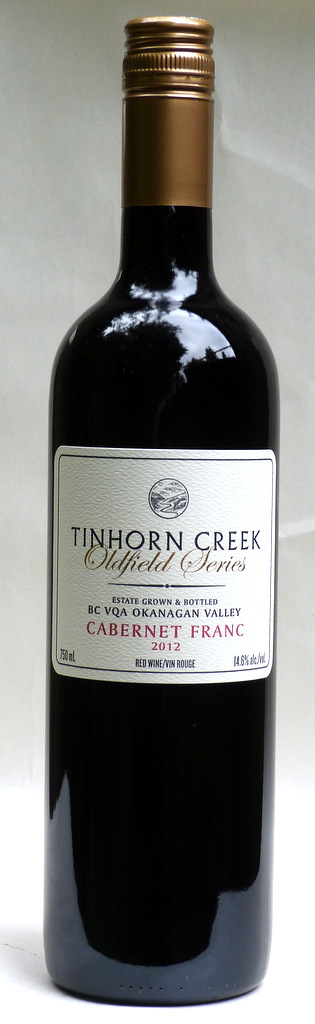
Tinhorn Creek Oldfield Series Cabernet Franc 2012 ($30.99 for 770 cases). Deep purple in colour, the wine has aromas of black cherries and pomegranate. The complex flavours include notes of dried herbs and cedar, blackberry and plum, with smoky notes and dark chocolate. The smooth but concentrated tannin structure will make this a great candidate for cellaring. The winery estimates 10 to 12 years.  93.


Tinhorn Creek Oldfield Series 2Bench Red 2012 ($26.99 for 1,683 cases). This is 41% Cabernet Sauvignon, 28% Merlot, 28% Cabernet Franc and 3% Petit Verdot. This is one of the flagship reds at Tinhorn Creek, an age-worthy wine with great complexity. It begins with aromas of blueberry, cassis and black cherry. Generous in weight and texture, the wine delivers flavours of plum with chocolate and coffee on the lingering finish. To use a baseball analogy, this wine gets on base (it is drinkable now) and then scores a run (it will age 10 to 12 years). 93.

Monday, October 12, 2015

Brooke Blair returns to Australia


Photo: Winemaker Brooke Blair (credit Stuart Bish)

Brooke Blair, the red winemaker at the Jackson-Triggs Okanagan winery since 2004, has returned to her native Australia.

“It's time to get nearer to our family,” she told me last week. “My son is 3 ½ years now, and my husband and I want him to have a closer relationship with everyone there.  And I'm also looking forward to spending more time with them.”

Her husband, Dave Warhurst, was a cellar hand at Culmina Family Estate Winery. “It impacts us, too,” lamented Don Triggs, Culmina’s co-proprietor. He was the chief executive at Vincor International when Brooke was hired in 2004.

Brooke is an accomplished winemaker with an impressive series of rewards from both national and international competitions.

She is going to a job at the Riverland winery of Berri Estates, a major Australian winery. According to Accolade Wines, the group that owns Berri Estates, this is “the largest single winery and distillery complex in the southern hemisphere and is located in South Australia. It produces more Cabernet than the Coonawarra and more Shiraz than the Barossa and McLaren Vale combined, not to mention more Chardonnay than Western Australia combined.”

I dug into my files for more background on Brooke. Here is an excerpt from an interview with her in 2007.

Q. Where and when were you born?

B. A place called Mount Gambier in 1978. [45 minutes south of Coonawarra.] I went to University of Adelaide and studied agriculture science majoring in enology. It was a four-year degree. In my fourth year, I had to do a placement in a winery. I did mine at Hollick Wines in Coonawarra.  At the end of my placement, they asked me to come back and work there once I had completed my final year.  They created an assistant winemaker position for me and I stayed there for three years.

Hollick is a family-owned winery. They crushed around about 500, 800 tons; probably larger now. It was a very hands-on position. I learned a lot while I was there.

While I was there, I also did a vintage in Spain. I was there for three months and worked in two or three different regions.

Through a friend of a friend, I heard about the job here, so I sent my résumé over and got this position. 

Q. Why did you want to come here?

B. I wanted to do at least another vintage overseas. I was thinking of doing either Italy or Canada. When this opportunity came up, I thought why not apply and get a chance to see a bit more of the world. I had heard nothing but good things about Canada. The wine industry was growing, and still is. From an employment perspective, this was a good place to be.

I thought I could bring some knowledge from Australia but also learn some things over here as well, especially Icewine, which we don’t do in Australia.

Q. Was your family in the wine business?

B. My father used to be a viticulturist before I was born. He has always had an appreciation of wine, particularly red wine. I was always exposed to that.

That said, I initially started studying commerce at university, and decided I could not do that for the rest of my life. I wasn’t too sure what I wanted to do but I had a strong science background. I became friends with someone who was studying viticulture. I thought I would be more interested in that and changed to winemaking the following year, and never looked back.

I have always had an interest in travelling. Winemaking seemed like the perfect thing – you can still travel around, plus get experience. You are not set back in your career. You can keep doing all of those things you want to do and gain experience and knowledge at the same time as seeing other countries.

Q. You are the red winemaker here. Did you specialize in that in your studies?

B. No. Coming over here, I didn’t apply for the red winemaker position. It was just decided by Rob Scapin [chief winemaker at Jackson-Triggs] that they were going to split the roles here. Since I came from Coonawarra, which is well known for red varieties, Rob thought it would be a good idea for me to be in charge of the reds.

Q. Have you had any surprises about the Okanagan?

B. I didn’t know a lot about the region before I came. I do remember flying in from Vancouver and being amazed at how beautiful it was. I thought I had hit the jackpot in that respect. Mountains and lakes everywhere. I was so well received that it was not difficult for me to settle in.

I have now stayed for three years, which is an indication of how much I am enjoying it here. I bought a house in Penticton. I became a permanent resident of Canada at the beginning of the year. I plan on staying for a while. It’s a very up and coming region, just getting worldwide recognition now.

Even since I came over here, the bar has been continually raised. The more wineries that produce good wines, everyone has to do the same. In the past three years I have seen the quality levels increase.

It goes without saying that the quality of Okanagan wine has just continued to improve since that interview. Brooke shares in the credit for that. She will be missed but her native land gets a strong talent back.


Friday, October 9, 2015

Blue Mountain takes Gamay seriously


Blue Mountain winemaker Matt Mavety

Conversations with the Mavety family, owners of Blue Mountain Vineyard & Cellars, always run the gamut from entertaining and enlightening to provocative.

Last fall I was interviewing Matt Mavety, the winemaker, for a project I am doing on collectible wines.

Perhaps mischievously, I asked which of Blue Mountain’s wines could be collected by those assembling verticals.

“All of them,” he replied.

“Nobody collects Gamay Noir,” I responded.

“Well,” Matt retorted, “they don’t know what they are missing.”

I was reminded of that chat this summer when the winery sent samples of the current Gamay Noir release (as well as the current Pinot Gris).

I have to admit this is a wine, while delicious now, could be cellared as long as 10 years before getting tired.

It is one of the B.C. Gamays that have made me rethink my casual dismissal of the varietal, an attitude engendered years ago when the market was awash with Beaujolais Nouveau. I never understood the appeal of a wine tasting like grape juice, although I once had it paired with a cassoulet. It is a simple wine for country food.

There are also Gamay Noirs suited for Sunday dinner. Such Gamay Noir has long been the best red from Robin Ridge Winery at Keremeos. It is one of the best reds both at Desert Hills winery and Platinum Bench Estate Winery, neighbours on Black Sage Road.

There are numerous others as well, ranging in style from Beaujolais and Beaujolais Village to one or other of the top-rated dozen Beaujolais Cru wines.

I would rate Blue Mountain’s Gamay with a Beaujolais Cru. I can’t tell you which of the ten Cru because I don’t get to taste them often. From memory, I might compare it to Morgon or Juliénas or Moulin-à-Vent. It might be a thought to pick up a few of these from the Liquor Distribution Branch and organize a comparative tasting. The LDB has a good selection.

Those wines – at least some of them – might cellar a bit longer than the Blue Mountain wine. Blue Mountain suggests its wine will age four to six years, quite adequate for a Gamay. It might very well live a lot longer.

Here are notes on that wine and on the companion wine that arrived for tasting.

Blue Mountain Pinot Gris 2014 ($21). The richness, minerality and texture of this wine reflect the fact that the vines are now 28 years old. When the grapes arrived at the winery, Matt pressed whole clusters to capture the purity of the flavours. Sixty percent was fermented in stainless steel, 40% was fermented in French oak (ranging from new to three years old). This portion also aged sur-lie in oak for six months. That helped build more complexity into the wine. It begins with aromas of citrus, pears and apples and that is echoed in the flavours. The fresh acidity gives the wine a crisp finish. 90.

Blue Mountain Gamay Noir 2014 ($23). The price, by the way, is competitive with most of the Beaujolais Cru wines. Blue Mountain’s vines range in age from seven to 25 years. This wine was totally fermented with wild yeast, in order “to better express the terroir of our estate,” the winery says. The wine was aged nine months on four-year-old French barrels, a technique for enhancing the texture without imparting noticeable oak in a wine meant, above all, to be fruity.

This wine is both fruity and rich. It has earthy aromas and flavours that include black cherry and blackberry. There is a long spicy finish. 91.


Thursday, October 8, 2015

Wines of Conviction from Calona


 Conviction winemaker Sydney Valentino


Calona Vineyards, the oldest B.C. winery name still on a label, is beginning a slow fade to black.

In its place, Andrew Peller Ltd. – which has owned Calona since 2005 – has introduced a new label called Conviction. It has begun to take the place of the Calona Artist series labels, tired after 25 years.

The five Conviction wines were rolled out last month by winemaker Sydney Valentino at a Vancouver tasting of wines in the Peller portfolio. The wines now are also in the Liquor Distribution Branch stores (and likely in VQA and private wine stores).

Each of the Conviction wines has caricature images and sub-titles honouring the pioneers involved in Calona’s early history. For example, the Pinot Noir’s sub-title is The Priest. This memorializes Monsignor W.B. McKenzie who became a parish priest in Kelowna in 1931. His parish would have included the Capozzis, the Ghezzis, the Casorsos and all the other Italians who invested in the winery.

Calona Wines was launched that year as Domestic Wines & By-Products, changing its name a few years later. Its first wines were made with apples and were unstable enough that they re-fermented on store shelves.

But for the Monsignor, that would have been the end of venture. However, the Monsignor arranged for the winery to produce sacramental wines for the Catholic Church in Canada. The cash flow sustained the winery, which was to prosper subsequently by selling other wines to the military depot at Vernon and to other customers.

Calona Wines hit the big time in the 1960s when the three Capozzi brothers (Joe, Tom and Herb) took over management. Sons of Cap Capozzi, one of the winery’s founders, the three had the inspiration to copy the product offers (including bottle shapes) of the Gallo family in California. In 1970, they even asked  Gallo to invest in Calona Wines.

That did not pan out but in 1971, Standard Brands Ltd. of New York and Montreal took over Calona. Since then, Calona has had a succession of owners including a stock promoter who almost ruined the company in the 1990s. Peller has cemented its position among the major B.C. producers.

It was on Standard’s watch that Calona created Schloss Laderheim in 1977, a white wine made with Okanagan Riesling grapes and packaged to masquerade as a German wine at two-thirds the price. Within four years, it had become the largest selling domestic white in Canada, almost 600,000 cases. By that time, it was a blend of local juice and California wine.

The brand’s wings were clipped when the Liquor Control Board of Ontario began marking it up like an import wine. Schloss lost its price advantage.

But it is a durable brand. You can buy a 1 ½ little bottle or a four litre box in almost any B.C. liquor store. Almost certainly, it is a blend of imported wine, as are the handful of brands, like Royal Red, that will carry the Calona name for years to come.

With the emergence of the VQA program in 1990, Calona set out to distinguish its top wines with labels designed by Robb Dunfield, a Vancouver-based artist who, due to an accident, painted by holding the brush in his mouth. The commission from Calona was a godsend for the artist.

“I was definitely struggling,” he told me in an interview in 1995. “They opened a lot of doors for me.”

The first wine with a Dunfield label, ironically, was not a VQA wine but rather a red made hybrid grape called Rougeon. But the label enabled Calona to charge $10 for it. “Calona has never sold a bottle of wine over $10 in its entire history,” said Ian Tostenson, the winery’s president at the time.

The “artist series” wines subsequently produced by Calona featured not just Dunfield but several other artists. The labels were very good but over the years, their impact was eclipsed by the proliferation of new labels from competing wineries. That led to the decision to move most of the artist series wines over to Conviction.

That even includes Sovereign Opal, a Calona exclusive. The white grape, whose aromas and flavours always remind me of Torrontes from Argentina, was developed by the Summerland Research Station. It was released to growers in 1976 and was embraced by the late August Casorso. His family had been among Calona’s founders. A Casorso vineyard in Kelowna is believed to be the only one growing the variety today.

Here are notes on the Conviction wines.

Conviction Pinot Grigio 2014 “The Financier”  ($13.49). This is an unoaked white with 15% Chardonnay in the blend. The wine is juicy and refreshing with aromas and flavours of citrus, pear and apple. 88.

Conviction White 2014 “Movers & Shakers” ($12.99). This is 80% Gewürztraminer and 20% Sovereign Opal. It has spicy aromas, along with aromas and flavours of peach and pear. 88.

Conviction Sovereign Opal 2014 “The Industrialists” ($12.99).
The wine begins with aromas of ginger and citrus. It delivers intense and exotic tropical fruit flavours, with a balance that gives the wine a dry finish. 90.

Conviction Pinot Noir 2014 “The Priest” ($14.79). This is a light and fruit Pinot Noir with aromas and flavours of strawberry and cherry. 88.


Conviction Red 2013 “Dreamers & Schemers” ($13.49). This is 80% Merlot and 20% Cabernet Franc. It is a soft, easy-drinking red with flavours of red and black currant and with pleasantly spicy finish. 88.

Monday, October 5, 2015

Dead End Cellars spawned by Forbidden Fruit


Photo: Steve and Nathan Venables and Kim Brind'Amour

Since opening in 2005, the Similkameen’s Forbidden Fruit Winery has earned a reputation for high quality fruit wines.

However, the winery has quietly diversified into grape wines, first under its own label and now with a companion label just launched: Dead End Cellars.

Owners Steve Venables, Kim Brind’Amour and their son, Nathan, initially added grape wines to their portfolio to satisfy the consumers who had ventured all the way to this secluded winery and found just fruit wines.

“When we first opened, we started getting the Europeans,” Steve recalls. “I remember the big campers pulling in and the Germans walking in. “I like reds!” I thought he has come all the way down here and he is going to be disappointed. Well, I had my cherry port. Other than that, it was sorry, we do fruit wines. And I thought I should have something for everybody.”

The winery started several years ago with its Earth Series wines, with some of the profits going to charitable purposes.

Now the winery has launched an entirely new label, Dead End Cellars, which is destined to evolve into a separate label under Nathan’s direction.

It came about after Forbidden Fruit bought a neighbouring property last fall, south of its orchard and vineyard at a “dead end” against the U.S. border.

Steve, who moved to his Similkameen property in 1977, has been farming this nearly adjacent property since 1979 for the elderly residents.  He had even planted grapes there and had expressed an interest in buying it. Last September, after the death of the last resident, the estate sold it to him.  

The attraction, aside from the one-acre vineyard, is the massive house built there in 1979 on top of an original log cabin. The house fronts onto the Similkameen River. Nathan believes the ground floor (of three floors) will make an excellent tasting room. A red seal carpenter by trade, he has renovated the building.

Three wines have been released so far under the Dead End Cellars label. (I cannot track down the price to go with the reviews.) The wines, like everything from Forbidden Fruit, are organic. Steve and Nathan have sourced some of their organic grapes from organic growers in the Okanagan to supplement their fruit.

They plan to develop more vineyards. “We hope to plant another 2 ½ to 3 acres next spring,” Steve says. “We are looking at some Tannat, probably some Riesling and Pinot Gris; and maybe Merlot.”

They also have eight or nine acres on the Forbidden Fruit farm that is available for vines.

“We are taking a different direction,” Steve says. “It is kind of Nathan’s baby, although we are all partners.”

Here are notes of current releases.


Dead End Cellars Skrewd 2014. This is a blend of Riesling, Sauvignon Blanc and Pinot Gris. It delivers tons of fruity aromas, followed by flavours of grapefruit, apple, peach and nectarine. The wine is so fruity that the finish seems of dry. That’s not sugar, that is fruit. 88.

Dead End Cellars No Return 2012. This is a blend of Merlot, Cabernet Franc and Cabernet Sauvignon. It has aromas and flavours of red and black currants, cherry, vanilla and chocolate, with cherry and raspberry on the finish. The texture is juicy. 90.

Dead End Cellars Game Over 2012. This is a delicious blend of Tannat and Malbec. Dark in colour, it has aromas of plum, blackberry and black currant. On the palate, there is a cascade of red berry flavours with black cherry, blackberry and chocolate on the finish. 91.

Forbidden Fruit Adam’s Apple 2013 ($18.95). This dry apple wine is made from six varieties (not named on the label) which makes for complexity. The  apple aromas and flavours are intense, with a focussed purity. The wine has good weight. The finish is crisp and lingering. 90.

Forbidden Fruit Pearsuasion 2013 ($18.95). This dry pear wine is made from two varieties of Asian pear: Shinsiecki and Kosui. Forbidden Fruit grows these in its organic vineyard. The aromas and flavours are quite exotic, with notes of banana, cantaloupe and, of course, pear. The wine has good weight and the finish is crisply dry. 90.

Forbidden Fruit Plum Noir 2013 ($24). The winery set out to challenge Pinot Noir with a wine from a blend of European and Asian plums. The wine begins with a smoky aroma. On the palate, the plum flavours have an earthy undertone (in Pinot Noir, this would be called forest floor). Oak aging and the natural plum tannins give the wine a moderately firm structure. 88.

Forbidden Fruit Cherysh 2013 ($19.95). This is a rosé wine made with cherries. The fruit defines the aromas and the flavours. The bright acidity gives the wine a tangy and dry finish. 89.

Forbidden Fruit Pomme Desiree 2014 ($($29.95 for 375 ml). This is an iced apple dessert wine that holds its own against any Icewine. The aromas are fresh, with hints of bake apple. On the palate the apple flavours are rich with a lingering caramel note on the finish. The balance is exquisite: the wine has sweet but by no means cloying. 90.

Forbidden Fruit Impearfection 2014 ($21.95 for 375 ml). This Asian Pear dessert wine begins with exotic, spicy aromas, going on to flavours that simply explode on the palate. The wine is a tropical fruit basket of pears and mango, with a long finish of wildflower honey. 92.

Forbidden Fruit Plumiscuous 2014 ($26.95 for 350 ml). In fruit wine terms, this is a mistelle – a wine to 17%. The plum flavours are intense and there is lingering sweetness on the finish. The wine is nicely balanced and can be sipped on its own. I like the recommendation on the back label: make a vodka martini with this. 90.

Forbidden Fruit Sauvidal 2014 Earth Series ($22). This is a blend of Sauvignon Blanc and Vidal. It begins with aromas of lime and pineapple, leading to ripe tropical fruit flavours with a persistent finish. The texture is juicy and the balance leans to dry. 90.


Forbidden Fruit Cabernet Sauvignon 2012 Earth Series ($26). This wine begins with aromas of vanilla, cassis and bell pepper. There are flavours of black currant, blueberries and vanilla. There are long ripe tannins, with the firm backbone one expects in a Cabernet. Decant this wine. 89.

Friday, October 2, 2015

Cassini's jeroboam is a really big wine


Photo: a six-litre jeroboam of Maximus 


The wines of Cassini Cellars, which only opened in 2009, have developed a distinctive house style.

The wines are bold and ripe, usually with alcohol of 14% or better but with such excellent balance that there is no heat on the finish. The reds now all spend close to two years in oak, with the result that the tannins have become silky. The reds are drinkable on release but clearly are age-worthy.

Owner Adrian Cassini has underlined the longevity of this reds by releasing some of the muscular Maximus blend in large formats – 500 magnums, 30 double magnums and 30 jeroboams (with six litres of wine in each). Wines age much more gracefully in larger bottles.

The Jeroboam, which comes with a wooden crate so that it can be handled, will sell for $350. The double magnums are $170 and the magnums, which come in wood boxes, are $99. None are released yet but when they are, most, if not all, will be sold in the Cassini wine shop.

(Jeroboam was a particularly fractious Israeli king about 900 B.C. and hardly an obvious person after whom to name a really big wine bottle.)

All of these are award winning wines. One of the most awarded is the 2012 Cabernet Franc: double gold at the All Canadian Wine Championships, gold at Intervin and a 2015 Lieutenant Governor’s Award of Excellence. Grown on the estate, the variety is getting an ever higher profile at Cassini.

Adrian also ages his reds in barrel for 20 to 24 months which achieves long and polished tannins in the wines. He has now added a new warehouse behind the winery for case storage. The intent is to age the reds at least a year in bottle before releasing them.

There is a cost to tying up capital in wine for three years. If that is reflected in the price of the wines, the payoff should be in quality. I think it is there.

Here are notes on the wines.


Cassini Reserve Chardonnay 2013 ($25 for 320 cases). Lightly gold in hue, the wine begins with assertive aromas of tropical fruit and vanilla. The wine is generous on the palate, with flavours of apples, vanilla and oak. The acidity keeps the wine lively and refreshing. The finish is so persistent that you could time it with a stop watch. 92.

Cassini Roussanne Marsanne 2013 ($25 for 200 cases). This is 60% Roussanne and 40% Marsanne, both white Rhone varieties not yet widely grown in the Okanagan. This is a complex wine, with honeyed aromas of herbs and tropical fruit. On the palate, there are flavours of apricot and orange zest. It is dry with a good spine of minerality. 90.

Cassini Viognier 2014 ($19 for 450 cases). The wine begins with floral aromas recalling lilac blossoms, along with aromas of pear and grapefruit. There are flavours of apple, pineapple and apricot. There is good mid-palate weight with a light elegance and crispness to the refreshing finish. 91.

Cassini Quattro 2012 Collector’s Edition ($28 for 1,800 cases). This is 37% Cabernet Sauvignon, 34% Merlot, 26% Syrah and 3% Cabernet Franc. It begins with aromas of black cherry and chocolate. As the wine opens – decanting is suggested – it reveals a core of sweet berry flavours including black cherry, plum and cassis. There is a touch is espresso on the lingering finish, along with a hint of pepper. 91.

Cassini The Aristocrat 2012 Cabernet Sauvignon ($40 for 180 cases). Dark in color, the wine begins with aromas of vanilla, black cherry and mocha. On the palate there are flavours of black currant, black cherry and Christmas spices. The ripe tannins give this wine a rich and polished texture. The finish is persistent and delicious. An excellent example of well grown Okanagan Cabernet in a good year. The grapes are from an Osoyoos East Bench vineyard. 92-94.

Cassini Cabernet Franc 2012 Collector’s Edition ($32 for 220 cases). Here is a bold and ripe Cabernet Franc with 14.7% alcohol. The aroma is exquisite – blackberries, raspberries and cassis – and those are echoed in the flavours, along with notes of tobacco, leather and pepper. The tannins are supple and ripe, giving the wine a rich texture. There is a hint of cigar box on the long finish. 92.

Cassini Maximus 2012 Collector’s Edition ($34 for 700 cases). The winery also has bottled 500 magnums of this Meritage. The blend is 53% Cabernet Sauvignon, 44% Merlot, 2% Petit Verdot and 1% Cabernet Franc. The wine has aromas of cassis and black cherry. The wine presents a polished texture of silky tannins, with intense flavours of cassis, cherry, blueberry, vanilla and cocoa. 92.

Cassini Nobilus 2011 Grand Reserve ($39 for 110 cases). This is 100% Merlot. It is a concentrated wine with a firm texture; the wine benefits considerably with decanting, which reveals a rich texture. There are aromas of black currant, plum and cedar. On the palate, there are flavours of black currant, plum, black olives and dark coffee, with a slightly earthy finish. A very complex wine. 90-92.

Cassini Cellars The Godfather 2011 ($70 for 150 cases). This is 86% Cabernet Sauvignon, 14% Cabernet Franc. This is a remarkably ripe wine for a cool vintage. The Cabernet Sauvignon expresses a core of sweet fruit including black currant and cherry. The flavours also include dark chocolate and coffee. The texture is firm and the wine should be decanted. Even better, it should be cellared a few more years. This wine will easily live for 15 years.


Wednesday, September 30, 2015

Maverick adds a sparkling wine


Winemaker Bertus Albertyn

The best day for visiting Maverick Estate Winery’s tasting room is Friday.

The reason: that is the only day when Ella, the winery’s excellent new sparkling wine, is open for tasting.

There is an alternative if you arrive any other day. Just buy a bottle and keep it for New Year’s Eve.

The tasting room, by the way, is just beside the highway half way between Oliver and Osoyoos. An elegant and tastefully designed facility, it opened last year, giving much needed access to the first rate wines in the Maverick portfolio.

The winery is operated by winemaker Bertus Albertyn, his physician father-in-law Dr. Schalk De Witt and their spouses. Bertus and Schalk are both from South Africa.

Bertus, born in 1978, earned his enology degree at Stellenbosch University and worked at a large wine cooperative before joining family-owned Avondale as winemaker.  He came to the Okanagan early in 2009 when Elzaan, his wife and Schalk’s daughter, began to practice medicine in Osoyoos. He was Burrowing Owl Winery’s winemaker until mid-2013, when he left to concentrate on Maverick.

Maverick’s 7 ½ acres vineyard had been planted in 2011. The winery also owns 48 acres of raw land near the Osoyoos Larose vineyard. Planting is scheduled to begin next year.

Meanwhile, Bertus and Schalk are getting the brand established. “The most important thing about wine is that you have to sell it,” Bertus says.

Bertus seems to be covering all the bases with a portfolio that begins with sparkling wine and ends with a port-style wine. Bertus says that his model Champagne is Billecart-Salmon, which makes an excellent pink Champagne. This prestigious family-owned Champagne house is a great producer to aspire to.

Here are notes on current releases.

Maverick Ella 2013 Brut Rosé ($35). The winery has produced about 6,000 bottles of this sparkling wine. It is 80% Pinot Noir and 20% Chardonnay. It presents itself beautifully in the glass, with a salmon pink hue and fine, persistent bubbles. On the palate, the wine is toasty with light notes of strawberry. The texture is creamy and the finish is dry. This is a very elegant wine. 92.

Maverick Origin 2014 ($17). This is a blend of Gewürztraminer and Sauvignon Blanc with a dash of Viognier. The wine begins with aromas of spice and citrus leading to intense flavours of spice and grapefruit, with good weight on the mid-palate. The finish is dry and very long. 91.

Maverick Sauvignon Blanc 2014 ($19 for 500 cases). The wine begins with aromas of lime and peach. These are echoed in the tropical fruit flavours. The wine also has an herbal zest on the long finish. 92.

Maverick Pinot Gris 2014 ($19 for 550 cases). This variety, which Bertus regards as a fine stand-in for the Chenin Blanc he once made in South Africa, was fermented with natural yeast; a quarter was fermented in neutral oak barrels and the rest in stainless steel. It begins with a bold aroma of ripe apple, citrus and melon and goes on to deliver flavours of apple, melon and banana. It has good weight and a dry finish. 92.

Maverick Rubeus 2013 ($25 for 500 cases). This wine was formerly called Rubicon. The name was changed in this vintage to avoid a trademark dispute with a South African producer of a red also called Rubicon. The blend here is 35% Syrah, 25% Cabernet Franc, 25% Cabernet Sauvignon and 15% Merlot. After gentle foot stomping, the grapes were co-fermented in 3,400 litre wooden vat, then aged in older oak for 18 months. The result is a generous wine that begins with aromas of blueberry and black cherry. On the palate, there are flavours of black cherry and black currant with hints of tobacco and white pepper. 93.

 Maverick Syrah 2013 ($32 for 200 cases). These grapes were also crushed by foot, fermented in a vat and then aged 18 months in older oak barrels. This is a bold red, with the pepper on the nose and on the finish framing flavours of black cherry, deli meats, black olive and tobacco. 91.