Wednesday, August 19, 2015

Tinhorn Creek's Andrew Windsor shows his stuff


Photo: Tinhorn Creek winemaker Andrew Windsor (courtesy Hawksworth Communications)

In the summer of 2014, Andrew Windsor joined Tinhorn Creek Vineyards as winemaker. He took over from Sandra Oldfield, who had been winemaker since 1994 until her promotion last year to become the winery’s president.

The recent releases from Tinhorn Creek provide a very encouraging glimpse of Andrew’s talents. The three whites from 2014 are impressive. One waits with anticipation for the release of the 2014 reds.

Lest one gets carried away, it is worth noting that Korol Kuklo, who was Sandra’s assistant winemaker, remains in that position. She would have been involved in the wines as well, although the specification sheets for the 2014 wines all credit Andrew as winemaker.

His background was well laid out in the press release the winery issued in April 2014 when his hiring was announced.

“Andrew’s experimental and innovative new ideas fit perfectly with our approach over the last 20 years of continually evolving and moving forward with our winemaking,” says Sandra. “Andrew’s worldly view will ensure a fresh direction as we continue to work dynamically to create our spectacular wines.”

Ontario-born Andrew’s first taste of wine was a friend’s parents’ attempt at homemade wine but it didn’t put him off and he went on to take a course in wine whilst studying Environmental Science at the University of Guelph. In his twenties Andrew met Jamie McFarland of The Ice House Winery, who invited him to assist with his ice wine project in Niagara-on-the-Lake. Andrew had a sharp taste of the winemaking world when he was called to start picking grapes at 3 am in minus 12C weather.

Heading to warmer climes, Andrew gained a Masters of Oenology at the University of Adelaide in Australia in 2006 and then took on an Assistant Winemaking role at Mollydooker Wines in McLaren Vale, where he lived on the beach and cycled to work through vineyards filled with kangaroos.

Working closely with Viticulturist, Andrew Moon and Assistant Winemaker, Korol Kuklo, Andrew will be overseeing the winemaking process from vines to bottle. He brings with him a wealth of experience, having worked in wineries in the Okanagan, Marlborough in New Zealand and the Northern Rhone in France before returning to Canada to work as VQA Winemaker for Andrew Peller Ltd. in Niagara.

“France taught me that wine is not just a science but an art form, a culture and an expression of a place. Wine has the ability to take you to a place in the world without leaving your home,” says Andrew. “I want to make the best wine in Canada and the only place I can do that is the South Okanagan.”

The press release omitted that Andrew already had some winemaking experience in this region. He spent 10 months at EauVivre Winery & Vineyard, starting in July 2010, before taking a job in New Zealand.

For a winemaker in his mid-30s, he has tons of experience. He may be heading into his best, but also his toughest, vintage in 2015. The forest fires that broke out last week in the Oliver area (Tinhorn Creek’s property was spared) have covered the vineyards with smoke. The risk is that the grapes, which are ripening unusually early, will pick up smoke taint.

One only hopes that the smoke is not too thick and not too persistent.

Here are notes on Tinhorn Creek’s current releases.

Tinhorn Creek Oldfield Series 2Bench White 2014  ($19.99 for 1,600 cases). This complex blend is 30% Sémillon, 25% Chardonnay, 23% Sauvignon Blanc, 12% Viognier and 10% Muscat. Portions of the wine were barrel-fermented with wild yeast. The wine appeals immediately with aromas of hazelnut, tangerine and toasted oak. The wine is rich and satisfying on the palate, with flavours of tangerine, guava and ripe apple. The elusive hint of hazelnut returns on a finish that goes on and on. 92.
Tinhorn Creek Chardonnay 2014 ($16.99 for 1,900 cases). This wine appears to be partially barrel-fermented. The oak is so well integrated that it is barely perceptible. The texture is generous and the flavours are mouth-filling. The wine begins with lovely aromas of citrus and apple, leading to tropical fruit flavours and a crisp, refreshing finish. 90.
Tinhorn Creek Gewürztraminer 2014 ($14.99 for 4,800 cases). This is a gold medal winner in national wine awards, deservedly so. It has aromas of spice and lychee. On the palate, there is a medley from fruit flavours, including lychee, peach and grapefruit. The hint of residual sugar, very well balanced with moderate acidity, gives the wine a rich texture. The finish just goes on and on. This is one of Tinhorn Creek’s finest Gewürztraminers. 91.
Tinhorn Creek Merlot 2013 ($17.49 for 9,136 cases). This wine won a bronze medal at the San Francisco International Wine Competition. Frankly, with its 17-year-old vines and good viticulture, Tinhorn Creek could do better. This is an easy-drinking, medium-bodied wine with aromas of cherry and oak, flavours of red fruit and soft, ripe tannins. I liked the wine but would have liked it better if the fruit were more concentrated. 88.
Tinhorn Creek Oldfield Series Syrah 2012 ($30.49 for 180 cases). This gold medal winner is available only to members of Tinhorn Creek’s wine club. What they are getting is a big, solid wine with meaty aromas mingled with red fruit. On the palate, there are flavours of cherry, blackberry and vanilla (thanks to 18 months oak aging). There is an earthy spine of minerality, adding to the concentrated and age-worthy texture. 90.


Saturday, August 15, 2015

Road 13 and other Golden Mile wineries endure terrifying night


Photo: Road 13 winery

Road 13 Vineyards is one of the wineries threatened this week by the  Testalinden Creek forest fire.

For the accounts I have read and heard, the fire – fanned by high winds – went very rapidly from a glow on the mountain side to a terrifying and fast-moving blaze last Friday night.

Road 13 posted a tweet to friends and firefighters who helped protect the winery. “We are very grateful to everyone who helped keep the fire away from us and our neighbours last night,” the winery wrote on Saturday morning.

Church & State Winery, which has a processing facility nearby on Highway 97, recounted the hair-raising night in a series of terrifying tweets.

7.38 pm Friday:  “[The fire is] Right behind the cellar. Pulling out computers and equipment that fits in cars now.”

7.49 pm Friday: “Wind is picking up. Flames building about 300m behind the cellar.”

10.37 pm Friday: “We may have lost the winery.”

11.39 pm Friday: “Positive news - looks like we may have barely avoided burning. Looked like houses nearby went up. Will know more in the morning.”

11.40 pm Friday: “The property may be scorched but looks like the cellar didn't catch. Fingers crossed, anxious for morning. Can't get close yet.”

The news in the morning was that Church & State had survived. While some structures were lost, it sounds like most, if not all, Golden Mile wineries, including Road 13, escaped with a near miss.

The fire is still burning as this is posted and the wind has come back up. The wineries are not out of danger yet.

One certainly hopes for the best. By coincidence, I was monitoring fire news while tasting Road 13’s current releases. These are outstanding wines and most are available only at the winery. It would be tragic if such quality went up in smoke.

It is worth noting that the three whites reviewed here are made entirely with Similkameen grapes. There also is Similkameen fruit in several of the reds. J-M Bouchard, Road 13’s winemaker, has become quite enamoured with the quality of the grapes he gets from the Similkameen.

Road 13 Roussanne 2013 ($24 for 55 cases). This has six per cent Viognier in the blend. It is a big ripe Rhone varietal with 14.6% alcohol. The wine has a lovely golden hue perfectly in harmony with the almost sweet honeyed aromas of ripe apricots. There is intense fruit on the palate – rich flavours of ripe apricot and pear with a squeeze of lime. 91.

Road 13 Marsanne 2013 ($24 for 114 cases). The wine begins with a delicate aroma of fresh melons, flowers and clover honey. On the palate, there are flavours of cantaloupe and pear, with a hint of that honey on the dry finish. A very interesting white. 92.

Road 13 Viognier 2013 ($24 for 142 cases). This wine has classic aromas of white peach and vanilla, with flavours of peach and apricot. The texture is fleshy. There is a bit of warmth (but not unacceptable) from the 13.9% alcohol. That goes with the territory; Viognier needs to be ripe to have optimal flavours. 91.

Road 13  GSM 2013 ($35 for 140 cases). This is 81.4% Grenache, 15.4% Syrah, 2.7% Mourvedre and 0.5% Viognier. The wine was aged 15 months in older French oak. It begins with aromas of pepper and spice with plum and black cherry. Generous on the palate, it delivers flavours of black cherry, plum, vanilla and pepper. The finish is very long. 91.

Road 13 Syrah Malbec 2013 ($26.99 for 393 cases). This is 83% Syrah, 12% Malbec, 4% Viognier and 1% Mourvedre. The wine is quite dark in colour. On the nose, there are aromas of blackberry, vanilla and pepper which are echoed in the flavours, along with notes of mulberry. The texture is concentrated, making for a long finish and for good ageability. 92.


Road 13 Jackpot Petit Verdot 2012 ($75; production 208 six-packs). Typical of this variety, the colour is almost black. An acquaintance of mine recently said, you can safely look at the sun through a glass of Petit Verdot (there is 4% Merlot in this). The dramatic aromas include black currant, mulberry, olive tapenade and graphite. This is an intense wine, rich on the palate with 15% of alcohol (but it is not hot). There are flavours of black currants, black olives, tobacco and chocolate. 94. 

Wednesday, August 12, 2015

Class of 2015: Emandare Vineyard


 Photo: Mike and Robin Nierychlo

Emandare Vineyard
6798 Norcross Road, Duncan BC, V9L 6C3   
T. 778-679-6706
Tasting room open 1 pm to 6 pm Fridays

A recently tasted bottle of 2007 Maréchal Foch from Starling Lane Winery, which was discovered in my cellar during a reorganization, was a reminder of how good that boutique Saanich winery was.
Who expected such longevity from the variety? Yet the fruit was still fresh and the wine had not begin to fade.
The bad news is that Starling Lane closed three years ago.

The good news is that the Cowichan Valley vineyard that grew some of that Maréchal Foch is now owned by Mike and Robin Nierychlo. In May, they opened Emandare Vineyard not far north of Duncan. They have not yet released their Maréchal Foch but the barrel sample of that wine is promising, as is a barrel sample of Pinot Noir.

They have released two excellent whites, one of them from the oldest block (14 years) of Sauvignon Blanc on Vancouver Island.

It causes one to ask why Sauvignon Blanc has not been planted all over the island. As Mike points out, if that variety thrives in the cool climate of the south island in New Zealand, it should do equally well on Vancouver Island. To the best of my knowledge, the only other producer on the island with Sauvignon Blanc is Dosman Vineyards, a neighbour of Emandare. His planting is four years old.

The Nierychlo name should be familiar to those who have followed wines in British Columbia. For several years, Mike posted wine videos on a site that was known as Wine Garage TV … until a California wine retailer with the similar name forced him to change the name.

The site is still there, with almost 200 videos. Look for www.mnonline.ca.

Mike’s wine education was almost entirely gained when he was picking the brains of winemakers and making contacts while producing the videos. He has combined that knowledge with his native shrewdness to develop Emandare, with the help of his wife, Robin. The winery name is the phonetic echo of their initials: M & R.

Both grew up in Langley, Mike, the son of Polish immigrants, in 1983 and Robin, the daughter of Dutch immigrants, in 1984.

“I came from a family of hard workers,” Mike says. “One of my first jobs was at a lumber mill on the green chain. That makes you a man very quickly.”

Soon after marrying Robin in 2004, Mike discovered that he and his brother-in-law shared a passion for wine. That led them to start making wines. They began with a cherry wine before progressing to grape wines. Robin says they never made the same wine twice.

“We never made wine from a kit,” Mike says. “We would go to wineries we loved and we could say, can we buy grapes from you and can we hand-pick some. Oftentimes, they would say sure, because we would only need 1,000 pounds for what we were doing. Then we would ask the winemakers, by the way, how do you make the wine? That was how we started.”

The next step in his wine infatuation was to start making videos.

“Here is how I got involved in wine media,” he recounts. “I was just sitting in the garage one day, where we were making wine, and I was bored. I had a bottle of wine there, so I grabbed my video camera and started talking about this wine. I don’t even remember what the first bottle of wine was. I talked about it and I posted that on the Internet. And for about two years straight, I was posting several videos a week, talking about wine, winemaking, wine tasting, food pairing. And I did piles of interviews.”

Soon, he and Robin began looking for a way into the industry as producers. “We love island wine.” Mike says. “That is part of the reason we wanted to be here.”

Their search settled on Vancouver Island after the couple moved to Victoria where Robin now is a radiation scheduler with the B.C. Cancer Agency. Mike is self-employed, owning a business making counter tops. And both are keeping the day jobs while Emandare gets rolling. “We didn’t walk in here with deep pockets,” Mike says. “We come into this with business knowhow and work ethic. And a loan. You can’t do it without some cash.”

Their property, with about 6 ½ acres of vines, was planted 14 years ago by a grower named Marcel Fleurie. About the time that Starling Lane closed, Marcel – for personal reasons – leased the property to another winery, hung out a for-sale sign and moved away.

It had been on the market for two years before Mike and Robin bought it in September 2013.

The varieties grown here include two acres of Pinot Noir and one acre of Sauvignon Blanc; they plan to double that planting. They are also growing Siegerrebe, Gewürztraminer, Maréchal Foch and a combined acre of two Blattner hybrids, Cabernet Foch and Cabernet Libre.

“The Cabernet Foch is a brilliant blending grape,” Mike says. “I would never make a straight red from it. It makes a really boring straight wine.”

He is not impressed with Cabernet Libre and likely will pull it out after this vintage – although in 2014, it was the backbone of a popular rosé, 55% of a blend with Tempranillo, Malbec and Carmenère. Mike is not sure why the previous owner had planted about 100 vines each of three late ripening varieties more suited to Osoyoos than Vancouver Island. Another rosé is planned from the 2015 vintage.

Although there are no current plans to seek organic certification, Mike and Robin have adopted many organic practices. They turned off the irrigation system completely. “Last year, 2014, was considered a drought year and our plants were healthy and happy,” Mike says. He believes the vines learned to fend for themselves because irrigation was sporadic when the vineyard was operated under lease.

Last fall, they harvested 11 tons of grapes from a vineyard they were still rejuvenating.

“I figure this place, once it is healthy, can do 12 to 15 tons on average,” Mike says. “If I could hit 30,000 pounds of grapes a year, that would be a beautiful number. We did our conservative business plan [for the winery], based on eight tons of grapes from this property.”

Friends helped Mike and Robin build the modest winery. And he dipped into his “Rolodex of contacts” to equip Emandare.

“Every piece of wine equipment we purchased was used,” Mike says. “Because of my relationships from the past, I found used equipment. I got 120 emails when I needed a bottle filler. I called around and found one and traded some wine for it and got it cheap.  That’s how we got all of our equipment.”

Mike adds that “we are doing everything old world and we are doing everything naturally as far as winemaking goes. Not a grain of commercial yeast has entered this building. That’s why we went organic; we don’t choose the kill the yeast in the vineyard.”

In Emandare’s first vintage, 2014, the winery made about 800 cases of wine – two whites, a sold-out rosé and two reds still in barrel. The winery’s tasting room opened in May. Emandare also has been a regular attendee at the Duncan Farmers’ Market  every Saturday. This has proved one of the best outlets for introducing the brand to the market.

Here are notes on the two whites.

Emandare Siegerrebe Gewürztraminer 2014 ($20). This wine begins with aromas of citrus and delivers generous and intense tropical fruit (lemon, guava). Low in alcohol at 10.4%, the wine is refreshing. The blend is 80% Siegerrebe, 20% Gewürztraminer. 89.

Emandare Sauvignon Blanc 2014 ($24). The wine has a fleshy texture because a touch of residual sweetness remains. Herbal on the nose, the wine has flavours of grapefruit, kiwi and honeydew melon. 90.


Wednesday, August 5, 2015

Moon Curser and my neighbours


Photo: Moon Curser's Beata and Chris Tolley

It is axiomatic that wine is best enjoyed in the company of other wine lovers.

Recently, a neighbour provided that opportunity. He asked if I could lead a tasting for his house guests, knowing that I am always reviewing wine samples from British Columbia wineries.

I don’t want to suggest he was being cheap. He was just being realistic. Like many wine reviewers, I appreciate neighbours who pitch in to finish the wines. I cannot drink them all by myself and, these days, most of the wines are too good to dump.

His guests, all of them wine lovers, included a staff member of the Metropolitan Opera and a young couple who live in Santiago in Chile. They were intensely curious about British Columbia wine which they never get to taste.

By good fortune, I had samples from Moon Curser Vineyards, which was opened in 2006 by Beata and Chris Tolley. Having planted varieties different from the Okanagan mainstream, they produce some of the most interesting wines in the Okanagan. The South Americans had some familiarity with Malbec and Carmenère. Many of the other varietals were novel to my tasting companions.

I did not take all of the wines below to the neighbourhood tasting; it would have made for a very long (if pleasant) night. But we shared six. The guests went away with a positive appreciation of British Columbian wines.

The favourite wine of the evening was Moon Curser’s Tempranillo, a red made with a Spanish varietal gaining traction in the Okanagan.

Here are my notes.

Moon Curser Arneis 2014 Contraband Series ($25.90 for 318 cases). Moon Curser is the first Okanagan winery to release Arneis, a white varietal from Piedmont in Northern Italy. Apparently, the name of the grape in the local dialect means “little rascal.” That may have something to do with viticulture but certainly not with the quality of the wines. The wine is crisp and fresh with aromas of pear, honeydew melon and citrus. There is a delicate note of fennel on the dry finish. 91.

Moon Curser Afraid of the Dark 2014 ($21.90 for 620 cases). This is 43% Roussanne, 43% Viognier and 14% Marsanne. It is a rich and satisfying white wine, with aromas and flavours of apricot, nectarine and hazelnut. 90.

Moon Curser Border Vines 2012 ($26.90 for 1,328 cases). This is a blend of 37% Merlot, 22% Cabernet Sauvignon, 16% Petit Verdot, 15% Malbec and 10% Carmenère. The wine is deep purple in colour, with aromas of black currant, mulberry and blueberry. On the palate, there is black currant, blackberry and plum, nicely wrapped up with a peppery finish. The long ripe tannins give this a generous texture and a savoury finish with classic Okanagan sage notes. 92.

Moon Curser Carmenère 2013 ($42.90 for 315 cases). Dark in colour, the medium-bodied wine has aromas and flavours of pepper; it also has flavours of cherry and black currant. The wine benefits from decanting to bring out its generous texture. 90.

Moon Curser Malbec 2012 ($31.90 for 241 cases). This begins with the variety’s classic aromas of cherry, blueberry and violets. On the palate, the wine delivers bright fruit with flavours of boysenberry, blackberry and black cherry and with spice on the finish. 91.

Moon Curser Petit Verdot 2012 ($31.90 for 247 cases). In the glass, this wine is so dark that – as one of our tasters said – you could look at the sun through it. You might want to lay in a bottle for the next eclipse.  It is a muscular wine with bold, ripe tannins and flavours of cola, black cherry and coffee. The wine also has a firm backbone of minerality (a hint of graphite). This wine will age very well. 92.

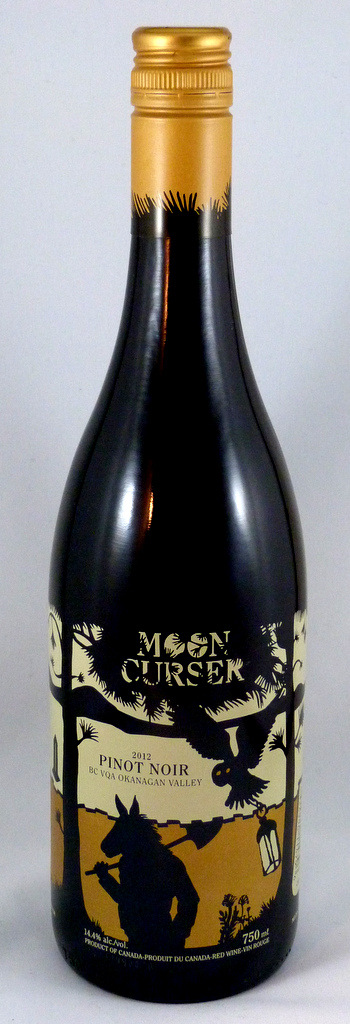
Moon Curser Pinot Noir 2012 ($24.90 for 97 cases). Dark in colour, this wine begins aromas of plums and dark red fruit. There are robust flavours of pepper and plum with an earthy undertone. As Okanagan Pinot Noirs go, this wine is a stylistic outlier that I would pair with game. That is not to criticise the wine: I take my hat off to the winery for daring to be different. 89.

Moon Curser Tempranillo 2013  Contraband Series ($31.90 for 268 cases). This dark red begins with appealing aromas of plums, blackberries and mulberries. Those fruits are echoed in the flavours, along with coffee and dark chocolate. The wine is full-bodied and has a long, spicy finish. 93.

Moon Curser Touriga Nacional 2012 ($49.90 for 48 cases). This is a rare example of an Okanagan wine made with the great Portuguese red. The wine also has a singularly dark colour. The aroma shows plum, black cherry, spice and cedar. Firm in structure, the wine has earthy flavours of plum, black cherry, dark chocolate and coffee. Decant this wine if you drink it now; otherwise, put it in the cellar and forget about it for five years. 92.

Moon Curser Syrah 2012 ($26.90 for 1,299 cases). This wine is rustic in a positive way, with gamy, meaty aromas. On the palate, the flavours include plum, prune, deli meats, with liquorice, minerals and pepper on the finish. 90.

Moon Curser Contraband Syrah 2012 ($31.90 for 444 cases). This is the more concentrated of the winery’s two Syrah wines, in part because some juice is bled off for rosé before fermentation. The wine has the classic black pepper on the nose and palate of south Okanagan Syrah, along with aromas of black cherry. On the palate, it has flavours of black cherry, liquorice, chocolate and leather. The wine benefits from being decanted. 91.


Moon Curser Dead of Night 2012 ($42.90 for 247 cases). The winery’s flagship red, it is a blend of equal parts of Tannat and Syrah. Moon Curser was the first Okanagan winery to produce Tannat, an old French variety now better known as the backbone of Uruguay’s wines. While Moon Curser occasionally releases Tannat on its own, this blend is a match made in Heaven. The wine is rich, almost dense and chewy, with a medley of red fruit on the palate (cherry, plum, blackberry) set against a background of leather and coffee. 94.

Monday, August 3, 2015

Painted Rock's impressive 2014 Chardonnay


Photo: Painted Rock tasting room

At a recent London tasting of British Columbia wines, the eminent British wine writer Jancis Robinson awarded 17 points to the 2013 Painted Rock Chardonnay.

I am assuming she is scoring on a 20 point scale, in which case 17 points is a respectable score.

You could try converting it to the 100 point scale by multiplying by five. In my view, that is never a satisfactory conversion. A score of 85 is an unenthusiastic rating from critics using the 100 point scale.

The explanation is that the 100 point scale effectively is also a 20 point scale, with most scores clustered between 88 and 92. The only judges to award less than 80 points when using that scale tend to be judges from the ranks of amateur winemaking. Those judges usually have a broader range of quality to account for.

There are 75 point commercial wines, of course, but most critics simply ignore them. Commercial wineries are expected to do better than that, and usually do.

Having digressed on wine scoring, I wonder how many points Ms. Robinson would award to the 2014 Chardonnay from Painted Rock. It is a spectacular wine that could inspire a new catch phrase: Nothing but Chardonnay. The wine, bottled six weeks ago, is just being released in the winery’s Okanagan tasting room..

The winery puts considerable effort into making this wine.

“Our 2014 Chardonnay is a blend of three micro-harvests from our single estate Chardonnay block,” the winery explains on its website. “Over seven days we conducted these harvests to capture specific attributes in the fruit. Eighty per cent was aged 5 ½ months French oak, ½ new and ½ second fill barrels. The last harvest of 20% was aged in stainless steel and underwent malolactic fermentation. This process enabled us to embrace the beautiful bright acidity while building mouthfeel, complexity and aromatics with the final pick.”

Here is my note on the wine.


Painted Rock Chardonnay 2014 ($30.35). The wine has glorious aromas and flavours of tropical fruit, including peach, mango and passion fruit. The bright acidity accentuates the refreshing clarity of this fruit-focussed wine. The oak forms a subtle backdrop and supports the lush texture that emerges as the wine warms in the glass. The finish lingers and lingers. 93. 

Thursday, July 30, 2015

JoieFarm puts "the magic" back


Photo: Heidi Noble of JoieFarm Winery


This has been a year of major change at JoieFarm Winery.

Founding partners Michael Dinn and Heidi Noble went their separate ways, with Heidi taking over full ownership of the winery. Michael is now a partner in a Vancouver wine agency.

The most obvious consequence of the ownership change has been the opening of a tasting room and a picnic area.

“I have successfully opened the farm in Naramata back up after 10 years of being closed to the public!” Heidi writes in a covering letter that accompanied the current releases. “We are thrilled to be offering hospitality again and reconnecting directly with our customers. The magic is back on our farm.”

The picnic area is somewhat more elaborate than that term suggests. “Our guests are able to join us on the lawn surrounded by our vineyard to enjoy a casual bite of wood-fired Neapolitan-style pizza, house-made charcuterie boards, and oysters with a glass or civilized bottle of wine,” Heidi writes.

By offering food and hospitality at the winery, Heidi has revived her longstanding interest in food. Born in Toronto in 1974, she began cooking as a teenager. “I had my first kitchen job at 14,” she once told me. “I loved it. So I worked after school and all through the summer while I was in high school.”

A gold medal student at the University of Western Ontario, she earned degrees in both philosophy and literature but turned down an academic scholarship to enrol in the renowned Stratford chef’s school. By the time she was 25, she was running the kitchen for a Vancouver caterer until, after a decade in food service, she switched careers. She completed a sommelier diploma and began working for a wine agency.

When she and Michael opened JoieFarm in 2005, she operated a cooking school for several years, in part because the winery needed the cash flow while getting established.

Over the years, several wineries, like JoieFarm, have succeeded without public tasting rooms. But when a winery reaches the size of JoieFarm, it makes good sense to open an onsite wine shop. That is where the most profitable sales are made. As well, the interaction between the winery owner and the customers reinforces consumer loyalty.

Here are notes on the current JoieFarm releases.

JoieFarm A Noble Blend 2014 ($23.90 for 5,328 cases). This is a blend of six grapes: 38% Gewurztraminer, 30% Riesling, 16% Pinot Auxerrois, 9% Muscat, 8% Pinot Blanc and 1% Schönburger. This aromatic wine shows aromas of spice melon and mango, with flavours of cantaloupe and lychee and a hint of lime on the finish. A touch of residual sugar lifts the aromatics but the final balance is dry. 91.

JoieFarm Riesling 2013 ($22.90 for 1,100 cases). This wine begins its appeal with a light gold hue and herbal aromas with an emerging hint of petrol. Yes, this is a correct development of Riesling wines as they age. On the palate, there are flavours of grapefruit, lime and apple. The wine’s 17 grams of residual sugar create a generous texture. The sugar, however, is balanced superbly with 9.2 grams of acidity. The wine, which has a good spine of minerals, is refreshing and the finish lasts and lasts. 92.

JoieFarm Muscat 2014 ($22.90 for 396 cases). This wine is made with Moscato Giallo grapes from the two-acre block in JoieFarm’s own vineyard. The wine begins with an intensely spicy aroma of nutmeg and cloves. The spice carries through the palate, along with flavours of guava and lime. The wine’s moderate alcohol (11.4%) gives it an appealing delicacy. It is balanced to have a dry and persistent finish. With its ability to refresh the palate, this is a superb aperitif wine. 92.

JoieFarm Pinot Blanc 2014 ($22.90 for 330 cases). This wine, made with grapes from a 27-year-old vineyard, makes a great statement for taking seriously a varietal sometimes overlooked by consumers. This wine, with its aromas and flavours of apple and melon, is generous on the palate. The vibrant acidity gives it a crisp, dry and food-friendly finish. 91.

JoieFarm Plein de Vie Brut 2014 ($N/A). The winery has published neither the specifications not the price of this wine. Reading between the lines in the other winery literature, I think this is a blend of Pinot Meunier and Chardonnay. The wine is only available at the newly opened wine shop. It is an uncomplicated and refreshing sparkling wine with aromas and flavours of cherries. The finish is dry. 88.

JoieFarm Unoaked Chardonnay 2014 ($22.90 for 443 cases). The winery also maintains that its unoaked Chardonnay is inspired by Chablis – even in a year like 2014 when the vintage produced a ripe, muscular wine. It begins with aromas of apricot, peach and ripe pineapple, with a hint of honey. On the palate, the wine is a juicy fruit bomb with a touch of warmth from the 14.2% alcohol. Not a Chablis but a wine to stand up to a charcuterie platter. 89.

JoieFarm Rosé 2014 ($20.90 for 3,145 cases). This is 70% Pinot Noir and 30% Gamay. The destemmed grapes were allowed to soak in their juice for three or four days, extracting a comparatively intense colour for a rosé, along with a bit of tannin for the wine’s backbone. The wine begins with aromas of strawberry, cranberry and cherry. There is a rich medley of berry flavours and a firm, dry finish. 90.

JoieFarm “En Famille” Reserve Chardonnay 2012 ($29.90 for 275 cases). The wine begins with a light golden hue and aromas of honey, quince and a hint of toasty oak. On the palate, there are mouth-filling flavours of butterscotch, marmalade, vanilla and ripe pineapple. This is a ripe and rich Chardonnay. 90.

JoieFarm “En Famille” Reserve Gewürztraminer 2012 ($27.90 for 208 cases). This memorable Gewürztraminer will transport you to Alsace and the Grand Cru wines from the leading producers there. This rich and powerful wine begins with aromas of spice and lychee. The generous tropical fruit flavours give the wine great length while the 14% alcohol enhances the unctuous texture. This is a tour de force. 93.


JoieFarm “En Famille” Reserve Pinot Noir 2012 ($39.90 for 215 cases). The winery’s notes on this wine describe it as the “most masculine style that we have made to date.” It is certainly a bold wine, with aromas of cherries, spice and chocolate that are echoed on the palate, along with savoury “forest floor” notes. Eight months in oak and 18 months of bottle aging have helped the wine develop a velvet texture. 92.  

Sunday, July 26, 2015

Red Rooster hatches a second label


Photo: Red Rooster winemaker Karen Gillis (courtesy Red Rooster)

This summer, Red Rooster Winery has released two new wines under the winery’s new Henhouse label.

Presumably, this might be called a second label unless you think there is something negative about a second label.

In my view, second label wines are not inferior wines. Karen Gillis, Red Rooster’s winemaker, is among the most talented of Okanagan winemakers.

Second label wines are often the creation of the marketing department, either to freshen the winery’s image or to move a little extra wine.

Red Rooster would appear to have both motives in play. The winery’s traditional label bears an elegant outline of a rooster against a crisp white background.

The Henhouse label, on the other hand, has an image of a fox. It strikes just the right note of whimsy to attract a consumer’s eye in a wine shop. The moderate pricing of these well-made wines has additional appeal – although the entire Red Rooster wine portfolio is affordable.

Here are notes on some current releases.

Red Rooster’s Henhouse Sly White 2013 ($13.99). This is a blend of  44% Pinot Blanc, 19% Chardonnay, 17% Pinot Gris, 9% Gewürztraminer, 6% Riesling and 5% Pinot Auxerrois. This is a fruity, off-off-dry wine with aromas of peach and spice. On the palate, there are flavours of apple and melon. The texture is soft and juicy. This is affordable and easy to drink. 88.

Red Rooster’s Henhouse Ruffled Red 2013 ($15.99). This is 54% Cabernet Franc, 46% Merlot. Due to unforeseen circumstances, this wine was opened and then tasted over several days. That can be a tough test for an inexpensive red. This wine passed with flying colours. The brambly aromas opened well with breathing and the flavours of cherry and blackberry were more delicious and complex on the fourth day than on the first. 88

Red Rooster Pinot Gris 2014 ($15.69 plus tax). The wine begins with aromas of melon, apple, pear and citrus, echoed in the flavours. The five grams of residual sugar add texture but the balancing acidity gives the wine a crisp and refreshing finish. 90.

Red Rooster Gewürztraminer 2014 ($16.99). The wine begins with aromas of rose petal, lychee and spice. On the palate, the wine has spicy grapefruit and melon flavours. The wine is crisp and refreshing. 90.

Red Rooster Rosé Reserve 2013 ($21.99 for 480 cases). Lovely bright salmon pink, this wine begins with aromas of strawberry and crème brulé. The palate offers a rich mouthful of cherries and other red berries. The wine is full-bodied for a rosé, with a dry finish. This is a saignée method rosé, incorporating 35% Malbec, 27% Cabernet Franc, 15% Syrah, 8% Mourvedre, 7% Petit Verdot, and 3% each of Pinot Noir and Grenache. This wine demands food. 88.