Writer and wine columnist John Schreiner is Canada's most prolific author of books on wine.
Tuesday, May 9, 2023
CedarCreek's tale of two vintages
Photo: Winemaker Taylor Whelan
The latest releases from CedarCreek Estate Winery offer a glimpse of the two most recent Okanagan vintages, at least from one producer.
CedarCreek is one of the veteran Kelowna area wineries. It opened in 1980 as Uniacke and was renamed after Ross Fitzpatrick, the former senator, bought it in 1986. The winery changed hands again in a friendly transaction in 2014 when Mission Hill proprietor Anthony von Mandl bought it.
His investment enabled CedarCreek to improve its production facility and to build new hospitality facilities. The restaurant at the winery now is one of the best in the Okanagan.
One thing that has not change is the winemaker. Campbell River-born Taylor Whelan had joined as assistant winemaker in 2012 and was promoted to head winemaker several years later. Under his hand, CedarCreek has transitioned its vineyards to organic production.
The two vintages in question are a dramatic contrast.
The winery says this of 2021: “An extremely dry, warm start to the year with a cool and wet spell in early June. Unprecedented mid-summer heat leading to the earliest start of harvest on record and the highest number of growing degree days on record.”
Here is the assessment of 2022: “The year began with a cool and wet spring, with significant precipitation in April/May and the latest budbreak in the last ten years. However, July and August became quite warm, allowing ripening to make up for lost time; and September and October were unseasonably warm, extending our summer season by several weeks. The result was wines low in alcohol but rich in flavour and with very good phenolic ripeness in general.”
In my experience with wines from those vintages, the 2021 wines are surprisingly good (unless there is any smoke taint) while the 2022 are showing themselves to be outstanding. I found no smoke taint in either of the 2021 wines, likely because the grapes were sourced from vineyards where smoke was not a significant issue. As well, Taylor would have handled the fruit carefully (limiting skin contact during fermentation) to mitigate any risk.
Here are notes on these six wines from the winery’s good value estate range.
CedarCreek Estate Sauvignon Blanc 2022 ($N/A). This wine was fermented and aged three months in stainless steel. Zesty and refreshing, the wine has aromas of fresh herbs and gooseberry that are reflected on the palate. The finish is dry. 92.
CedarCreek Estate Riesling 2022 ($N/A). This wine was fermented and aged three months in stainless steel. Moderate in alcohol (12.5%), the wine’s bright acidity of 10.8 grams a litre is well-balanced with 18 grams of residual sugar. The wine begins with citrus aromas mingled with a hint of mango. On the palate, there are flavours of pink grapefruit and nectarine. The balance is exquisite and the finish lingers. 93.
CedarCreek Estate Pinot Gris 2022 ($25). This wine was fermented in stainless steel and an oak foudre; and aged three months on the lees in stainless steel. Another three months of bottle age are recommended to allow the wine to express all of its character. At this early stage in its life, it has aromas and flavours of pear and peach. It is dry, with a lingering finish. 91.
CedarCreek Estate Pinot Noir Rosé 2022 ($26). This dry rosé was fermented in stainless steel and aged four months on the lees. Fashionably pale in colour, the wine is crisp and refreshing. There are aromas and flavours of raspberry and cherry. 90.
CedarCreek Pinot Noir 2021 ($32). This wine was fermented in concrete and in a foudre with indigenous yeast. It was aged 12 months in French oak. The medium-bodied wine has aromas and flavours of dark cherry mingled with toasted oak and hints of forest floor on the finish. 90.
CedarCreek Meritage 2021 ($30). The blend is 55% Merlot, 29% Cabernet Franc, 9% Malbec and 7% Cabernet Sauvignon. The wine was fermented in stainless steel and aged 15 months in French oak. The wine begins with aromas of blackberry, cherry and blueberry. There are layers of dark berries on the palate, with a note of spice on the finish. 91.
Friday, May 5, 2023
Sandhill releases its 2022 rosés
Sandhill winemaker Sydney Valentino
In April, Sandhill Wines promoted Sydney Valentino to lead winemaker at the Kelowna winery, just in time to launch the 2022 rosé wines.
Sandhill, known for single vineyard wines, began making rosé as early as the 2011 vintage, which was about when Sydney began working in what was then the Calona Winery wine shop. About 10 years ago, Howard Soon, the legendary and now retired Sandhill winemaker, moved her into the winery and enabled her to take on ever greater responsibility until she took over the Sandhill portfolio.
Here is the winery’s announcement which includes Sydney’s biography.
“With a Bachelor of Science from the University of British Columbia Okanagan, her WSET level 3 and Winery Assistant Certificate from Okanagan College, Valentino brings over 10 years of experience to her new position. She worked closely with previous Sandhill winemakers Sandy Leier and Howard Soon. Both award-winning winemakers were mentors to Valentino, aiding in her career growth and instilling Sandhill’s winemaking philosophy of producing truly distinct, terroir-driven wines.
“Over the past decade Valentino has held numerous roles on the winemaking team with Andrew Peller Ltd. She started in the tasting room of Calona Winery and later moved on to her role as the non-VQA winemaker, where she oversaw winemaking operations for brands such as Copper Moon and Peller Family Vineyards. From there Valentino led the winemaking team for Wayne Gretzky Okanagan before settling into her current position.
“Originally hailing from Winnipeg, Valentino grew up in Kelowna where she currently resides with her family, making the most of the Okanagan lifestyle in her free time. She is a lover of cooking, reading and soaking up the Okanagan weather with her two kids. Valentino will play a pivotal role in the launch of upcoming new releases at Sandhill, including the 2022 Rosé and will continue to honour Sandhill’s terroir-driven legacy.”
Sandhill has emerged as one of the leading rosé producers in the Okanagan. While the production in 2011 was a mere 396 cases, consumer demand for rosé has enabled Sandhill to increase output steadily. The winery made just over 7,000 cases of Sandhill Rosé in 2021 and has now released 8,100 cases from the 2022 vintage.
In 2022, for the third vintage in a row, Sandhill has also released 175 cases of Small Lot Sangiovese rosé. The quantity is necessarily small because the Sangiovese block in the Sandhill Estate Vineyard is just 3.69 acres in size and most of the fruit is used to make a red table wine.
The two rosé wines are quite different in style. The Sangiovese is a cerebral expression of the terroir of the vineyard, in the tradition of Sandhill. The larger volume rosé, which is made with grapes from Okanagan and Similkameen vineyards, is an exuberant celebration of fruit aromas and flavours. “It needs to be easy-drinking and enjoyable,” Sydney explains.
Here are notes on the wines.
Sandhill Sangiovese Small Lots Rosé 2022 ($30 for 175 cases). The grapes were gently handled: pressed in a basket press with minimal skin contact to achieve a delicate copper hue in the wine. The wine was fermented cool in stainless steel and then went into neutral oak barrels, aging three months on lees. The object was to augment the structure of the wine. The wine begins with a delicate bouquet of cherry and raspberry. There is good weight on the palate, with flavours of red berries mingled with citrus and pear. The wine is dry. This is quite a sophisticated rosé, well-suited to accompany a wide range of foods. 92.
/>
Sandhill Rosé 2022 ($22 for 8,100 cases). The unconventional blend in this wine is 43.7% Merlot, 29% Gamay, 14% Syrah, 10% Petit Verdot and 3.3% Viognier (which was co-fermented with the Syrah). The grapes had minimal skin contact, but enough to give the wine a visually appealing coral hue. The aromas of strawberry, watermelon and rhubarb explode from the glass. On the palate, there are also flavours of watermelon, pink grapefruit and pomegranate. A very slight hint of residual sugar gives this wine a juicy texture; but the balancing acidity supports a refreshing finish that lingers. The wine is quite simply delicious. 92.
Monday, May 1, 2023
Church & State showcases the 2019 vintage.
Church & State winemaker Arnaud Thierry
The 2019 vintage in the Okanagan is considered to have been a cool vintage with a comparatively small crop. But judging from the current Church & States releases, it produced wines with good acidity and concentrated textures and flavours.
“We farm 95 acres of low yield South Okanagan and Vancouver Island vineyards to produce 25,000 cases annually,” the winery says on one of its back labels. “Only the best hand-sorted grapes are worthy.”
The winery was started by Kim Pullen, a former Vancouver Island tax lawyer. In 2017, he sold the business to Sunocean Wineries and Estate, a Vancouver company operated by a very low-profile Chinese businessman.
The primary public face of the winery is Arnaud Thierry, a Champagne-trained winemaker who joined Church & State soon after he and his wife, also a winemaker, came to the Okanagan in 2017.
Arnaud has a sure touch in the cellar, as these excellent, well-priced wines indicate.
Here are notes.
Church & State Chardonnay Coyote Bowl Vineyard 2019 ($31.04 for 600 cases). This wine was aged eight months in French oak. Very lightly gold in colour, the wine begins with honeyed aromas mingle with ripe pear. That is echoed onto the palate, along with notes of butter and nectarine. The very subtle oak manifests as light vanilla on the lingering finish. 90.
Church & State Sauvignon Blanc South Vineyard 2019 ($23 for 750 cases). Fruit for this wine comes from west bench vineyards near Oliver and Osoyoos. The wine was fermented in stainless steel and aged six months (90% in steel, 10% in French oak). The wine begins with aromas of lime and grapefruit mingled with herbs. The aromas are echoed on the palate, along with notes of herbs and tropical fruit. The wine is seriously underpriced for the quality. 92.
Church & State Pinot Gris Coyote Bowl 2019 ($N/A for 750 cases). This wine was aged for six months in stainless steel (80%) and barrel (20%). It begins with herbal aromas. The generous palate is packed with flavours of peach, citrus and apple. 90.
Church & State Viognier Bella Vineyard 2019 ($27.60 for 500 cases). This wine was aged eight months in French oak barrels. It is a rich wine with aromas and flavours of apricot and mango. A spine of minerality gives definition to the texture. 92
Church & State Marsanne Bella Vineyard 2019 ($29.90 for 350 cases). Marsanne is a Rhône varietal not widely planted in the south Okanagan; but it makes an appealing white wine. This wine, which was aged eight months in French oak, has aromas and flavours of orange zest mingled with stone fruits and spice. 92.
Church & State Roussanne Bella Vineyard 2019 ($29.89 for 300 cases). The grapes were whole-bunch pressed and the juice was fermented in barrel for three weeks. The wine was then aged eight months in French oak. The result is a full-flavoured wine presenting in the glass with a light gold hue and aromas of almond and stone fruit. On the palate, there are flavours of apricot mingled with orange zest. 92.
Church & State Cabernet Sauvignon Estate 2019 ($37.37 for 919 cases). This wine was aged 12 months in French oak (22% new). Dark in colour, the wine begins with aromas of cassis, cherry and blueberry, echoed on the palate. The finish has a note of cedar and spice. 90.
Church & State Cabernet Franc Foundation and Coyote Bowl Vineyards 2019 ($37.37 for 1,000 cases). This wine was aged 12 months in French oak (25% new). It begins with classic brambly aromas of blackberry mingled with cherry. The generous texture delivers flavours of dark berries with a touch of pepper. 91.
Church & State Merlot Foundation Vineyard 2019 ($37.37 for 1,000 cases). The fruit for this wine was fermented and macerated in a stainless steel tank for 20 days, followed by aging 12 months in French oak barrels (22% new). The wine begins with aromas of dark fruits (cherry, blueberry). On the palate, there are flavours of black cherry and blueberry jam. Long ripe tannins give the wine a long and appealing finish. 91.
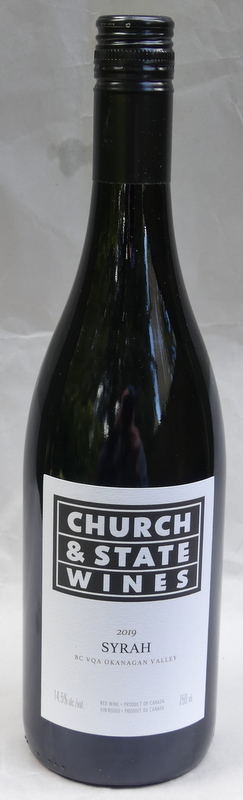
Church & State Syrah Estate 2019 ($37.37 for 660 cases). This wine was aged 12 months in French oak. It begins with aromas of black pepper mingled with dark berries. On the palate, there are intense flavours of fig, plum and deli meats mixed with black pepper, with an earthy note on the long finish. 92.
Church & State Syrah Coyote Bowl 2019 ($64.06 for 356 cases). This is a big wine (15% alcohol) that had its torso sculpted by aging 18 months in French oak (45% new). Aromas of pepper and dark fruit pull the consumer into a dark and concentrated wine where flavours of fig, plum, dark cherry and deli meats mingle with black pepper. The finish is long, with notes of spice. 94.
Church & State Petit Verdot Coyote Bowl 2019 ($N/A) for 200 cases). This wine was aged 18 months in French oak (50% new). The wine presents with a deep, dark colour and aromas of blackberry, plum and leather. Dense and concentrated in texture, the wine has flavours of dark fruits and dark chocolate. The grippy tannins suggest a long-lived wine that should be decanted for current consumption. 93.
Wednesday, April 26, 2023
Blue Mountain releases single vineyard Chardonnays
Photo: Blue Mountain winemaker Matt Mavety
In 2017 Blue Mountain Vineyard & Cellars began making premium Pinot Noirs from selected blocks in its vineyard. After five decades of wine growing, the proprietors of the winery had come to identify exceptional sites within its large vineyard.
Now from the 2020 vintage, Blue Mountain has released two Chardonnays from vineyard blocks also judged to produce exceptional wines.
“With the single vineyard bottlings, we are trying to put in bottle a wine that expresses the site itself, not the hand of the winemaking,” Blue Mountain winemaker Matt Mavety told me in 2019, when the Pinot Noirs were released. “We have been working over the last 10 vintages to remove some of our input or our stamp on the wines, to allow more of the site to show through. Not that at any time we were heavy handed but there was room for refinement.”
I expect those comments would also apply to the two Chardonnay blocks.
Identifying special vineyard blocks reflects the exacting viticulture practised by the Mavety family.
“Over the last 13 years we have made changes in our viticulture and cellar management practices, striving to produce high quality wine that reflect the site in which the grapes are grown,” the winery writes. “2023 marks 52 years of farming on our estate and 32 years of making wine. The strong focus on viticulture across the site allows for an increased representation of individual terroir when the grapes reach the winery. A deliberate refinement of the winemaking process has allowed Blue Mountain to more clearly capture the identity of each of the vineyard blocks.”
Blossom Slope, as one of the Chardonnays is labeled, comes from the vineyard’s Block 17. “A westerly exposure for Block 17 creates a warm site for the 30-year-old vines, the basis for Blossom Slope,” the winery writes.
The other Chardonnay is labelled Alluvium Reflection and comes from Block 32. “Planted in 1990, Block 32 is fondly referred to as ‘The Fan’,” the winery writes. “The vines are westerly facing, catching the later morning and afternoon sun … The surrounding rock mass plays a role in heat retention at night. The mineral deposit and mainly gravel soil add to the strength and ease of Alluvium Reflection.”
Here are notes on these exceptional wines.
Blue Mountain Blossom Slope Chardonnay 2020 ($50). The grapes were fermented with yeasts native to the estate. Fermentation was in new to three-year-old French oak barrels; the wine was also aged in those barrels for 18 months. The wine begins with aromas of citrus which continues to the palate to mingle with notes of spice. Fresh acidity produces a lively and crisp finish. 97.
Blue Mountain Alluvium Reflection Chardonnay 2020 ($50). The grapes were fermented with yeasts native to the estate. Fermentation was in new to three-year-old French oak barrels; the wine was also aged in those barrels for 18 months. Light gold in hue, the wine begins with aromas of citrus mingle with herbal notes. The creamy palate delivers flavours of stone fruits. The finish is quite persistent. There is something cerebral to the personality of this sophisticated wine whose flavours stay on the palate for many minutes. 100.
Friday, April 21, 2023
At Kitsch Wines, small is beautiful
Photo: Winemaker Ruth King (courtesy of Kitsch Winery)
Trent and Ria Kitsch, who opened this Kelowna winery in 2016, have refocussed in the past year to produce wines only from grapes grown in the East Kelowna Slopes sub-appellation.
The winery’s two vineyards are in the East Kelowna Slopes and are planted primarily to Riesling, Pinot Gris and Pinot Noir, varietals well-suited to this cool climate terroir.
Ria explains: “After a couple of low-yield years in the vineyard, along with some adventure/family prioritizing for Trent and me, we decided in 2022 to reduce production and focus only on fruit from our vineyard.”
Graham Pierce, who had previously been the winemaker at Black Hills and Time Winery before coming to Kitsch as general manager, moved last summer to take over the cellar at Ruby Blues Winery on the Naramata Bench.
The 2022 vintage at Kitsch was made by Ruth King, a Boston-born and California-trained winemaker now resident (with her husband and three children) in East Kelowna. “For the last 13 years, she has been in the wine industry in one capacity or another,” Ria writes. Ruth has a winemaker’s certificate from the University of California at Davis as well as a Bachelor of Science degree in horticulture from the California Polytechnic State University in San Luis Obispo.
In the Okanagan, she has been a harvest winemaker for Sandhill Wines; student co-ordinator for Vinica Education Society and a wine researcher and consultant with Terroir Consulting. Currently, she splits her time between making Kitsch wine and managing the Sustainable Winegrowing BC program.
“We are overjoyed to have such a talented woman at the helm of these delicious wines,” Ria writes.
Here are notes on current releases.
Kitsch Pinot Noir Rosé 2022 ($28 for 375 cases). This wine is made with the fruit of an 11-acre 2020 Pinot Noir planting on East Kelowna Road. Five different clones were planted. This wine begins with a delicate light pink hue and delicate aromas and flavours of raspberry and cherry. With seven grams of acidity and almost no residual sugar, the wine has a dry and well-defined finish. 90.
Kitsch Pinot Gris 2022 ($25 for 233 cases). Refreshing and crisp, this wine begins with aromas of pear and citrus. On the palate, the wine delivers flavours of tree fruits with a hint of lime around a backbone of minerality. 90.
Kitsch Riesling 2022 ($29 for 227 cases). This wine will be released in August. This wine begins with aromas of lemon and grapefruit, which is echoed on the palate. The wine is dry with bright acidity mingled with a spine of minerality. This is Riesling should be cellared a few years to bring out all of its complexity. 92
Kitsch 7 Barrel Chardonnay 2020 ($35 for 151 cases). To put it simply, this is a terrific wine. It was fermented with indigenous yeast and was aged six months in French oak. It presents in the glass with a lovely light golden hue. Aromas of butter, vanilla, orange and apple jump from the glass. The palate is richly textured, with flavours of nectarine and orange. The finish will not quit. 94.
Subscribe to:
Posts (Atom)