Writer and wine columnist John Schreiner is Canada's most prolific author of books on wine.
Thursday, June 17, 2021
Lake Breeze's Garron Elmes is now an old-timer
Photo: Lake Breeze's Garron Elmes
Garron Elmes, the president of Lake Breeze Vineyards, is now the longest tenured winemaker at the same winery in the Okanagan.
That is remarkable, not just because winemakers move around a lot but also because the ownership of Lake Breeze has changed several times since Garron arrived to do his first vintage there in 1995. “He is creative and consistent,” Gary Reynolds, a previous owner, once told me.
The winery was opened in 1996 by Paul and Vereena Moser, a Swiss-born couple who bought a Naramata Bench vineyard in 1994 after leaving South Africa, where he had run several manufacturing businesses. To make his wine, he recruited another South African, Garron Elmes. Born in 1972 in Capetown, Garron then was a young graduate from the agricultural college at Stellenbosch.
The Mosers sold the winery in 1998. The new owners tired of the wine business by 2001 and sold Lake Breeze to two business couples from Alberta, all high-powered financial executives. One of those couples, Drew and Barbara MacIntyre, then bought out their partners to become sole owners in 2011.
The MacIntyres not only kept Garron. They promoted him. And they invested to expand the winery and to secure additional vineyards, either by lease or by purchase. Lake Breeze now farms about 60 acres, all of it in the Naramata Bench and much of it contiguous to the winery. The winery also buys fruit from other selected vineyards, including one near Keremeos producing top flight Sauvignon Blanc.
“The philosophy when we started out with Paul Moser was well-priced wines that over-delivered for what you paid for them,” Garron says. “That has always been my philosophy.” Along with assistant winemaker Victor Costa, he has been taken the opportunity to expand the portfolio with premium and ultra-premium wines, without taking away from the quality of the “regular” wines.
In 2016, the winery crowned its portfolio with a $90 Merlot and a $60 Chardonnay under the MacIntyre Heritage Reserve label. At the same time, the winery expanded its Cellar Series of wines, inserting a more affordable premium tier between its regular range, priced between $19 and $24, and the MacIntyre Heritage wines.
“This is our third or fourth vintage making the Cellar Series,” Garron says. “We just wanted to do something, when we had a tier of wines that was small production, that it was what we thought was best of the best. We would put those under the Cellar Series label. All of the wines are named after different winds.”
For example, Alizé, French for trade wine, is 100% Roussanne. This is a varietal rarely seen on its own because it is usually blended with Marsanne and Viognier into what the industry calls a Rhône blend.
“We first made Roussanne in 2016,” Garron says. “I got some fruit and decided to make something different for our wine club. The wine turned out so well that, when that block of fruit became available the next year, we snapped it up. Of all the wines we make right now, this is probably my favorite out of the whites.”
Here are notes on the wines.
Lake Breeze Unoaked Chardonnay 2019 ($19). “I was shooting for a simpler style, a typical Chardonnay with green apple, a bit of pear,” Garron explains. “Nice crisp acidity. It is designed for early drinking. It falls in line with the style of the majority of our whites. Very little manipulation; just looking for pure fruit expression and balance.” This is a very crisp, focussed white which showcases the fruit. 90.
Lake Breeze Pinot Gris 2019 ($22). Lake Breeze also produces one of the best Pinot Blancs in the Okanagan. It is rarely tasted side by side with the Pinot Gris, so as not to confuse consumers. This wine has aromas and flavours of pear, citrus and spice. For a bit of complexity, Garron gave skin contact to less than 10% of the fruit before pressing off the juice and fermenting it in stainless steel. 90.
Lake Breeze Sauvignon Blanc 2019 ($22). To achieve complexity and to add texture, Garron fermented about 20% of the wine on skins with wild yeast. This was blended later with the portion fermented in stainless steel. The wine begins with dramatic aromas of gooseberry and spice; these are echoed on the palate, along with hints of lime and herbs. The finish is crisp and fresh. 91.
Lake Breeze Alizé 2019 ($25). The grape here is Roussanne grown at one of the highest elevation vineyards on the Naramata Bench. This lush wine delivers dramatic aromas of honeysuckle, guava and peach leading to layers of tropical fruit on the palate. 92.
Lake Breeze Aura 2018 ($35). This a Pinot Noir grown on the estate vineyard. The clone is uncertain. Paul Moser referred to it as the Geisenheim clone but Garron has not done the confirming (and expensive) ampelography. In any case, he thinks it makes a good Burgundian-style Pinot Noir with classic forest floor notes supporting the cherry aromas and flavours. 91.
Lake Breeze Mistral 2017 ($35). The grape here is Syrah grown on the Naramata Bench. The floral aromas lead to notes of plum and cherry. On the palate, there are flavours of dark cherry and fig mingled with black pepper. This is a well-structured wine with long ripe tannins and a lingering finish. 92.
Tuesday, June 15, 2021
Fort Berens releases debut Grüner Veltliner
Photo: Rolf de Bruin
The spring wine release from Fort Berens Estate Winery in Lillooet includes the winery’s first Grüner Veltliner.
The major white varietal in Austria, Grüner Veltliner was first planted in the Okanagan about a decade ago by Culmina Estate Winery. That brilliant wine has inspired a number of other producers to plant it, including Summerhill Pyramid Winery, Bordertown Vineyards & Estate Winery and Peak Winery.
The co-founder of Fort Berens, Rolf de Bruin, first planted a trial block of Grüner Veltliner in 2011. He committed fully to the varietal by planting an acre in 2019 in the winery’s new Red Rock Vineyard.
The entire 18-acre Red Rock Vineyard has been planted over two years, beginning in 2018, to double the size of Fort Berens estate vineyards at Lillooet. In addition to Grüner Veltliner, Red Rock also grows six acres of Merlot, five acres of Cabernet Franc, 3 ½ acres of Riesling, and two acres of Cabernet Sauvignon.
The fruit in the winery’s 2020 Grüner Veltliner was purchased from the Okanagan in 2020. “While these grapes are not from our property,” Rolf explains, “we wanted to experiment with this varietal as we look ahead to producing our first estate vintage of Grüner Veltliner in 2021 or 2022.”
Here are notes on that wine and on the other releases.
Fort Berens Dry Riesling 2020 ($21.99 for 332 cases). This wine is made with 82% estate fruit and 18% fruit from The Rise Vineyard near Vernon. The wine begins with aromas of citrus. On the palate, the citrus flavours mingle with mineral notes. The finish is crisp and dry. This is a wine which will benefit from another year in the bottle. 91.
Fort Berens Riesling 2020 ($19.99 for 1,430 cases). The wine begins with aromas of lemon and green apple, echoed on the palate. The residual sugar in this wine, 9.3 grams a litre, is exquisitely balanced with lively acidity, giving the fruit a lively lift on the palate. The refreshing finish persists. 91.
Fort Berens Pinot Gris 2020 ($19.99 for 1,126 cases). Grapes for this wine were sourced from the estate vineyard, from a small vineyard near Lytton and from a vineyard in West Kelowna. Whole clusters were pressed with only free-run juice used. Fermentation was cool, in stainless steel. The wine has aromas of tropical fruits (kiwi, lime), with mouth-filling flavours of lime, grapefruit and pear. The finish is crisp and refreshing. 91.
Fort Berens Grüner Veltliner 2020 ($21.99 for 340 cases). This is the winery’s first release of a wine made with Grüner Veltliner, a leading Austrian white varietal. Fort Berens has an acre in a new vineyard near the winery. This wine, however, is made with grapes the winery purchased from an Okanagan vineyard just to get an early start on making the wine. The aroma delivers an intriguing tropical medley leading to flavours of apple and stone fruit. 90.
Fort Berens Rosé 2020 ($19.99 for 1,179 cases). This wine is made with 80% Pinot Noir grapes, 16% Cabernet Franc and 4% Merlot. The crushed grapes soaked on the skins for 48 hours. The result: a rosé that is beautiful in the glass and packed with aromas and flavours of watermelon, raspberry and strawberry. The finish is dry and refreshing. 92.
Saturday, June 12, 2021
Black Widow Winery expands Naramata Bench holdings
Photo: Shannon, Dick (centre) and James Lancaster
Since opening in 2006, Black Widow Winery has relied on grapes from its seven-acre property on Naramata Road, along with purchased fruit.
Now, the winery has begun to bring on production from a five-acre property, also on the Naramata Bench, that winery owner Dick Lancaster bought five years ago as his daughter, Shannon, and son, James, were joining the business.
“It was originally an orchard in the 1930’s and was turned into pasture for beef cattle about 45 years ago,” Dick says. “One of my sons came up with the clever vineyard name, Beau-Vines, as a play on that. We planted it with Pinot Noir, Gamay, Syrah, Cabernet Sauvignon and Cabernet Franc. We have about three acres of vines, with a higher density planting. We’ve had some soil nutrient deficiencies that have made for a slow start, but we’re releasing our first Pinot Noir since 2011. The 2020 Rosé is largely based on the Syrah and Cabernets from this site. The Pinot has been blended with a small portion of Gamay, and we have 100 cases coming out in July.”
The winery projects it will get a “decent tonnage” this year and a full crop next year from the Beau-Vines Vineyard.
“The idea behind the purchase was not so much to increase production, but allow us to be more self-reliant and to increase the red wine portion of our business, as well as rosé,” Dick says. “We’ve cut back on some of the grapes we purchase. We hope to maintain a 3000-case production average.”
Much of Black Widow’s wine is snapped up by its very loyal wine club, a loyalty that the Lancasters foster with special events at the winery.
For example, the winery is holding what is called an “En Primeur” tasting of yet to be released reserve red wines. The tastings are schedule for June 26 and June 27 at the winery, with limited seating available.
“Our 2019 Merlot, Syrah, Hourglass and Vintage One will be accompanied this year by a 2020 Pinot Noir,” the winery has announced. “All but the Syrah will be available for sampling.” The wines will be bottled and released in July.
Here are notes on currently released Black Widow wines.
Black Widow Pinot Gris 2020 ($25 for 320 cases). The wine presents in the glass with a very slight and appealing blush. It has aromas of citrus and apples, leading to an abundance of fruit flavours including peach, pear and apple. 90.
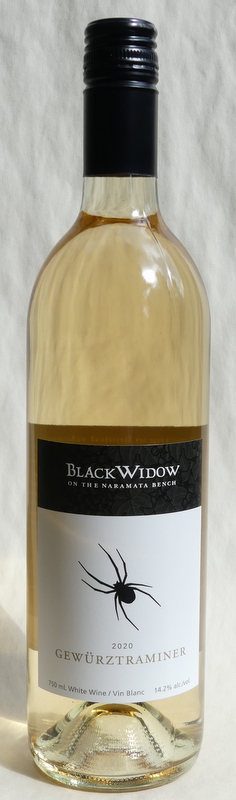
Black Widow Dry Gewürztraminer 2020 ($24 for 115 cases). Think of Alsace when drinking this wine. It begins with aromas of lychee, pineapple and spice, which are echoed on the palate. The rich, almost oily texture recalls the concentration of dry Alsace Gewürztraminer wines. 91.
Black Widow Oasis 2020 ($25 for 330 cases). This is a blend of Gewürztraminer, Pinot Gris and Schönburger. The wine begins with aromas of spice and rose petal. Rich in texture, the wine delivers flavours of apple, papaya and spice, with a crisp, dry finish. 90.
Black Widow Sparkling Web 2020 ($26 for 220 cases). This is a blend of Muscat, Gewürztraminer and Pinot Gris. It is made as a dry frizzante wine, crisp and fruity with floral aromas. It is lively and refreshing. 91.
Black Widow Rosé 2020 ($30 for 190 cases). This wine blends juice of Syrah, Cabernet Sauvignon and Cabernet Franc, with added touches of Merlot and Pinot Noir. The wine presents with an appealing rose petal hue, with aromas and flavours of watermelon, cherry and raspberry. The finish is crisp, dry and refreshing. 91.
Black Widow Phobia 2019 ($34 for 275 cases). This is a blend of 70% Merlot, 30% Syrah aged in barrel for 17 months. It begins with aromas of cherry, blackberry and plum. The juicy and rich palate delivers flavours of blueberry and dark cherry with a hint of pepper. 91.
Black Widow Red Back 2019($38 for 100 cases). This is a blend of Cabernet Sauvignon, Merlot and Syrah, aged 17 months in oak. This is a bold wine that is drinking well but will age very well. Aromas and flavours of black currant and dark cherry are mingled with notes of chocolate, tobacco and oak. 92.
Black Widow Hourglass 2018 Reserve ($50 for 750 ml, $27 for 375 ml). The winery produced just 260 cases and is sold out except for 375 ml. bottles. This is blend of 73% Merlot and 27% Cabernet Sauvignon. The wine was aged in French oak (40% new) for 21 months. It is a polished wine, beginning with aromas of black cherry, cassis, tobacco and chocolate which are echoed on the palate. There are fine silky tannins on a concentrated texture. The finish is long, with a note of spice. 93.
Black Widow Vintage One 2018 ($52 for 750 ml bottle; a limited number of 375 ml bottles available). This is a port-style fortified Merlot barrel-aged for 21 months. Total production is just 75 cases. The wine is dark in colour. The aroma explodes with sweet cherry and black licorice. It delivers delicious flavours of sweet berries mingled with spice and chocolate. It has the appealing freshness of late-bottled vintage port. 92.
Thursday, June 10, 2021
Tightrope gets first certification for sustainable winegrowing
Photo: Lyndsay and Graham O'Rourke
Tightrope Winery & Vineyard on the Naramata Bench marked Earth Day in April with the announcement that it is the first member of Sustainable Winegrowing B.C.
The winery, which opened in 2013, is owned and operated by Graham and Lyndsay O’Rourke. It was their objective from the beginning that the winery and vineyard would be environmentally sustainable.
The seed for Tightrope Winery was planted in the decade that Lyndsay and Graham O’Rourke spent working in bars and restaurants at the Whistler ski resort. The jobs supported their skiing, Graham’s fly-fishing, and their shared meals in fine restaurants. “My wine experience all started with really good wine,” Graham says. “I did not grow up drinking Baby Duck and the box wines.”
Both were born in 1971. Lyndsay, whose geologist father, Grenville Thomas, is a diamond explorer who is in the Canadian Mining Hall of Fame, has a University of Windsor business degree. Graham, the son of an accountant, grew up near Sarnia and learned to fish during summers in a family cottage on the river. His love of the outdoors led to a University of British Columbia degree in wildlife management.
They moved to the Okanagan in 2003. Immediately drawn to the vineyard lifestyle, they both took Okanagan College courses in grape growing and winemaking. To further improve their skills, they went to Lincoln University in New Zealand for honours degrees in those disciplines. The studies paid off quickly. When they returned, Graham joined Mission Hill for six years as a vineyard manager before, with a partner, setting up his own vineyard-consulting firm. Lyndsay became the winemaker for Ruby Blues Winery for several years before devoting herself totally to Tightrope.
In 2007, the couple bought a 10-acre Naramata Bench property with a million-dollar view over the lake. They planted seven acres of grapes—Pinot Gris, Riesling, Viognier, Pinot Noir, and Merlot, with small blocks of Cabernet Franc and Barbera. They made the first 900 cases of Tightrope wines in 2012, using the Ruby Blues winery until they built their own in 2014.
Graham set out to pursue sustainable wine growing not just in the Tightrope vineyard but as a founding director of Sustainable Winegrowing BC. The organization, a project of the BC Wine Grape Council, has developed criteria for practices in the vineyard as well as in the winery.
In its news release, Tightrope says that “the vineyard management plan incorporates practices like lowering water and energy use; and protecting worker health.”
The winery management plan is extensive. Grapes must come from certified vineyards. There must be programs for conserving and recycling water. At least 80% of the energy must come from clean, renewable sources. The waste management program calls for composting the residue from making wine and putting it back on the vineyard. There must be a program for reducing greenhouse gas emissions. There must be programs pf social equity in the operation.
“We are committed,” the O’Rourkes write, “to making the highest quality wine in a manner that best supports people and the planet. Sustainability is a path, not a destination.”
Here are notes of four current releases.
/>
Tightrope Pinot Gris 2020 ($21.50 for 675 cases). The wine begins with aromas of apple, peach and pineapple, which are echoed on the palate along with hints of lime. The finish is crisp and tangy. This is a delightfully refreshing wine. 90.
Tightrope Riesling 2019 ($22 for 325 cases). On the nose, the wine has begun to show the classic hint of petrol mingled with orange peel and lime. It is dry and full on the palate, with flavours of nectarine and mandarin orange. The backbone of minerality adds to the lingering finish. 91.
Tightrope Sauvignon Blanc Sémillon 2020 ($22 for 450 cases). This is 77.5% Sauvignon Blanc and 22.5% Sémillon. The fruit was fermented cool for 28 days, preserving the zesty fruit. The wine begins with aromas of gooseberry and fresh grass. These are echoed on the palate along with flavours of lime and green apple. The wine shows the intensity of aroma and flavour seems to typify the 2020 vintage. 92.
Tightrope Rosé 2020 ($22 for 565 cases). This is 75% Pinot Noir, 20% Syrah and 5% Barbera. The grapes were crushed and left to cold-soak on the skins for one or two days. The juice was fermented cool in stainless steel for 30 days. 90.
Wednesday, June 9, 2021
1 Mill Road Pinot Noir 2019
Good news and bad news about the second release of a Pinot Noir from 1 Mill Road Vineyard, the Naramata boutique launched by David and Cynthia Enns.
The 2019 Home Block Pinot Noir is, in my judgement, even better than the 2018 vintage. The bad news is that the production, at 219 cases, is half the volume produced in 2018, due to some bud damage in the cold 2018-2019 winter. Most of the 2019 release was sold out in the first week of June.
The quality of the wine, however, suggests that fans of Pinot Noir need to get on 1 Mill Road’s mailing list for the next vintage.
David and Cynthia are the former owners of Laughing Stock Vineyards, which they launched in 2003 and sold to Arterra Wines Canada in 2017. Laughing Stock’s production had grown to 12,500 cases a year.
“After almost two decades of making wine in the Okanagan Valley, this time we are going deep with one varietal from one place, the Naramata Bench,” the couple explain their apparent decision to step off the fast lane to focus just on Pinot Noir.
1 Mill Road, the name of the winery, is taken from the address of the property, located at the northern edge of the village of Naramata. David and Cynthia bought the five-acre property in 2012, planted vines in 2013, and moved there in 2016, after having a house built.
“We went looking for a property, mainly to move away from the winery property because we were trying to get some balance in life,” Cynthia says.
1 Mill Road’s vineyard, which is on a bench about 50 feet above Okanagan Lake, was a former organic pear orchard that was semi-abandoned when they bought it. They planted a little more than 1 ½ acres of Pinot Noir vines, all clone 115.
“When we sold Laughing Stock, we knew we wanted to keep working with this little vineyard,” says Cynthia, who is the grape grower. “We stare at that vineyard from our dining room table. It is very immediate, more so than at Laughing Stock, the way we experience the vineyard. It is small enough that I have been able to tackle the farming without too much difficulty.”
Here is a note on the wine.
1 Mill Road Pinot Noir 2019 Home Block ($50). The fruit – 20% whole clusters – was fermented in large French oak tanks and was aged in these tanks and in neutral oak barrels. This elegant wine begins with aromas of cherry and spice. The palate is sensuous, with flavours of cherry and blackberry mingled with vanilla and mocha. The finish is persistent. 94.
Subscribe to:
Posts (Atom)