Wednesday, May 23, 2012

River Stone Estate Winery’s releases for 2012


Wine tourists can’t miss River Stone Estate Winery because it is in a red and yellow house at the top of a vineyard just off Tuc-el-Nuit Road at Oliver. You just can’t get to it from that road: access is via Buchanan Road which more or less borders the south end of the vineyard.

Winery access could be arranged from Tuc-el-Nuit Road, but only at the sacrifice of precious vines in a vineyard just seven acres in size. That is not going to happen. The best and highest use of this site is growing grapes.

Ted Kane, the co-owner of this two-year-old winery, bought the property in 2001 after it had been fallow for 30 years. Eager to get into the wine business, Ted had worried that the best sites in the Okanagan would be snapped up before he could move from Edmonton, where he was a respiratory therapist.

As it happened, he found an excellent site for grapes, a sun-bathed slope with an excellent southern exposure. The local terroir was already proven by the vineyard next door, which is Roland Kruger’s Mistral Vineyard. The Kruger family’s Wild Goose Vineyards produces award-winning Pinot Gris and Pinot Blanc from that vineyard.

Ted and his wife, Lorraine (now a doctor in Osoyoos), began planting the vineyard in 2002 and included a small block of Pinot Gris and a smaller block of Gewürztraminer. However, the additional heat units collected by slope of the vineyard led to planting primarily four Bordeaux red varieties – Merlot, Cabernet Sauvignon, Cabernet Franc and Malbec.

The size of each block was determined by the percentage of each variety that Ted wanted for the flagship red that he had in mind. That wine is called Corner Stone. The first release, from the excellent 2009 vintage, is among the wines currently available from River Stone. Judging from the taste of the wine, Ted’s planting decisions (made with advice from a viticultural professional) are working out well.

The debut releases from this winery, some of which I tasted last year, were very good. The same can be said for the newest releases. Here are my notes.

River Stone Pinot Gris 2011 ($19.90 for a production of 284 cases). This is a crisply dry white with citrus aromas and with flavours of apple, pear and green melon. The lively acidity of the vintage gives the wine a tangy finish. 88.

River Stone Malbec Rosé 2011 ($19.90 for 138 cases). The success of the winery’s 2010 rosé ensured that River Stone would keep this in the portfolio. Rosé wines from the Malbec grape are relatively rare. This is a big, juicy rosé with aromas and flavours of plum and black cherry. It has the weight of a light red, with a lingering and refreshing fruit on the dry finish. 89.

River Stone Merlot 2010 ($19.90 for 133 cases). The largest block in the River Stone vineyard is Merlot because, as the winery says, “it thrives in the South Okanagan climate.” Merlot certainly gets ripe on this site: this wine has 15% alcohol and a sweet, fruity aroma that almost suggests port. On the palate, this big wine has flavours of plum, blackberry, blueberry and fig, with a touch of vanilla and chocolate on the finish. 88, with the potential to grow to 90 with a couple of years in the cellar.

River Stone Cabernet Franc 2010 ($25.90 for 120 cases). This variety also does well in the South Okanagan and has begun to capture a consumer following. River Stone’s wine has the classic brambleberry and peppery aromas of the variety, with flavours of blackberry, raspberry and mocha. Initially, the wine has a youthful firmness suggesting it either should be decanted or, as the winery says, cellared for five to seven years. I sampled it over four days and it improved each day. 89-90.

River Stone Corner Stone 2009 ($28.50 for 349 cases). This is the blend of the four red varietals, with Merlot as the backbone. Aged 14 months in French oak, the wine is built for reasonably long aging (five to seven years) but is showing well now. There are aromas and flavours of vanilla, plum and black currant, opening up to show dark chocolate on the finish. 89-91.

Currently, the winery also offers, in small volume, a 2010 Cabernet Sauvignon and a 2011 Gewürztraminer from its own vineyard. It also sells a wine called Splash, a fruity Pinot Gris made with purchased grapes.

Tuesday, May 22, 2012

Should a wine review be pointless?


The gap of more than two weeks before postings is explained by the photograph above: I was in Russia.

This small but striking church is the Church of Prince Dimitri on Blood in a city called Uglich, about two hours northwest of Moscow. Built in 1692, it commemorates the death of the young Prince Dimitri, the son and only heir of Czar Ivan the Terrible. His death, which ended a dynasty and led to the rise of the Romanov Dynasty in 1613, was said to have happened accidentally when the boy was playing with a knife. The more likely explanation is that he was assassinated.

The church, at the edge of a river, is among the sights that attract tourists to cruise between St. Petersburg and Moscow.  These are not wine cruises, even if our ship served remarkably good Spanish wines at lunch and dinner and offered a vodka tasting (six anaesthetizing samples) one evening.

However, there was enough leisure to reflect on wine, notably on the spring newsletter from Le Vieux Pin winery which arrived on my Ipad during the cruise.

The winery offered a thought about rating wines which struck me as curious. I have reviewed the winery’s releases twice this year in this blog, generally scoring the impressive wines at 90 points or better. The newsletter reprinted some of the reviews, describing them as “flattering” while omitting my point scores.

Here is the reason:

“ … We debate frequently and passionately whether to include scores for our wines in our newsletter and website content,” Le Vieux Pin writes. “As you know, up until now we have included the scores that are awarded to our wines by critics. We firmly believe that reducing a wine to a single number is an affront to the depth, complexity, passion and soul of a wine. … We may in future include numerical scores in our reviews, but for this newsletter we are going to avoid the practice.”

I agree that reducing a wine to a number would be “an affront.” That is the reason why the number of every wine I review is preceded with text that describes the wine and puts it in context. The numerical rating just sums up a judgment on the quality of the wine. Most wine reviewers operate like that.

A more interesting debate might question the rating scales that are in use. Thanks to Robert Parker and The Wine Spectator, most reviewers have come to use the so-called 100 point scale to rate wines.

In my view, it is far less precise than the 20 point scale developed decades ago by the University of California and still used in some wine competitions. The scoring sheet breaks a wine into categories – a point or two for appearance, four or five points for aroma, and so on. It forces the critic to pay attention to key individual properties of a wine. The sum of these is the final score of the wine. An 18 point wine is generally the equivalent of a 90 point wine.

But tell me: would you buy a wine if the shelf talker said that John Schreiner had awarded it 18 points? Or three stars out of five, or six out of seven, or whatever other rating system exists. Not likely, because the North American consumer reacts almost exclusively to the 100 point scale.

Of course, the 100 point scale is a bit of a sham. You can pass a school exam with 50 or 51 points. Wine, on the other hand, needs to score at least 75 to pass, if not 80. I can’t recall seeing a review of a wine that scored only 80. I think we all would consider that such a score signifies a drinkable wine but nothing more.

So the 100 point scale really is just another 20 point scale, but one that does not separate individual properties of a wine. The scores reflect the benchmarks of quality that experienced reviewers recognize (most of the time).

In the past year, I have raised my scoring threshold to rate more wines 90 and above and fewer in the mid-80s. That compensates for the perceived shortcomings of the 100 point scale. Why not score a good wine 92 to 94, even higher, if I judge the quality to be there?

And when I “reduce” a wine to 95 points, be assured that the text will support my reason for that score.

Would I score a wine 100? Yes. Last year, I tasted an Austrian dessert wine that was so perfectly balanced, with such clean, elegant flavours, that I could not find any reason to deduct anything from a perfect score.

Whenever I open a wine to rate it, I start from an optimistic position. I have judged with people who approach every wine, looking for its faults. I approach every wine, looking for its qualities.

And when I find them, I will describe them and score them.


Sunday, May 6, 2012

Quails' Gate spring releases include medal winners


Photo: winemaker Grant Stanley


In the recent Pacific Rim Wine Competition at Orange County in California, Quails’ Gate Estate Winery came away with two gold medals and flour silvers.

This is one of the earliest international wine competitions in the season. Quails’ Gate will go on to compete in many more this year and, as usual, will bring home a host of awards.

The Pacific Rim awards: gold for both the 2010 Chardonnay and the 2010 Pinot Noir in the “under $25” category. Silver for the 2010 Pinot Noir (under $25); for 2010 Stewart Family Reserve Chardonnay; for the Dry Riesling 2011; and for the Optima 2010 dessert wine.

Quails’ Gate is one of those Okanagan producers so reliable that you don’t need my scores before you buy the wines. But here they are anyway.

Quails’ Gate Chasselas Pinot Blanc Pinot Gris 2011 ($18.99 for a production of 10,237 cases). This wine is a blend of 40% Chasselas and 30% each of the other varietals. The winery has the oldest planting of Chasselas – a Swiss white variety – in the Okanagan. A few vintages ago, winemaker Grant Stanley began blending it with Pinot Blanc and Pinot Gris, partly to make a more interesting white and partly to reduce the size of the portfolio. As the production indicates, the wine is hugely popular. This one brand is bigger than most wineries in B.C.

The wine begins with an appealing aroma of tropical fruits and flowers, leading on to tangy flavours of pink grapefruit and lime. There is a slight touch of residual sugar balancing the acidity and adding weight on the palate. This is a delicious summertime white wine. 90.

Quails’ Gate Gewürztraminer 2011 ($16.99 for a production of 4,627 cases). This is an attractively understated Gewurz, with delicate aromas of rose petals, spice and citrus; and with flavours of grapefruit and lychee. The wine has just enough residual sugar (10 grams) to plump up the fruitiness without taking away from crisp finish. 89.

Quails’ Gate Chenin Blanc 2011 ($18.99 for 3,843 cases). Quails’ Gate is believed to be the largest producer of Chenin Blanc in British Columbia. Only a hand full of wineries has this varietal, alas, for it is a great wine with shellfish and other seafood. It is a tangy, racy wine with dramatic aromas of lime and lemon and flavours of lime, grapefruit and tart apples. The minerals and the fresh acidity give the wine good structure and weight. While this is drinking well already, it will age superbly, developing a richness of flavour and texture in four or five years. 91.

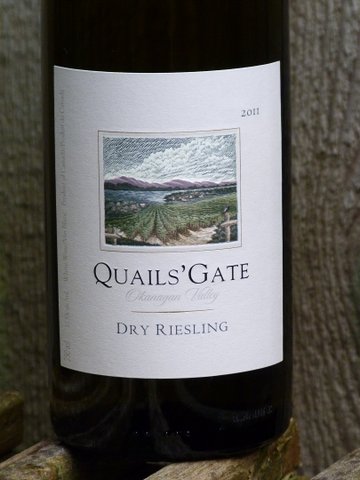
Quails’ Gate Dry Riesling 2011 ($16.99 for 4,404 cases). This bone-dry Riesling, very good now, will age over the next decade to great elegance. It begins with lime and green apple aromas which also are expressed in the flavours of lemon, lime and minerals. The bright acidity makes the wine savoury and mouth-watering, with a tangy finish. 90.

Quails’ Gate Rosé 2011 ($14.95 for 4,245 cases). This is blend of 85% Gamay Noir, 10% Pinot Noir and 5% Pinot Gris. The red grapes were crushed, with the skins left in contact with the juice overnight to extract colour and flavour. Then the juice was racked and fermented cool, like a white wine. The wine begins with aromas of strawberry and cranberry. On the palate, it has flavours of strawberry, rhubarb and pink grapefruit, with a tangy, refreshing finish. 90

Quails’ Gate Pinot Noir 2010 ($25 for 9,000 cases). Fairly dark in colour, the wine begins with aromas of sour cherry and spice. There are flavours of cherry and chocolate. The winery’s notes speak of a silky texture but I think the texture is still firm and a little closed – nothing that time won’t resolve. The wine has only been in the bottle since December and will benefit with another six to 12 months of bottle age. This won gold in the “under $25” category. 88.


Thursday, May 3, 2012

Township 7 goes to the Stampede

Photo: Township 7's Mike and Lori Raffan


Township 7 Vineyards & Winery has pulled off a coup by being selected to produce the official wines for Calgary Stampede’s centenary this summer.

The Stampede got samples from a number of wineries and, after tasting them, settled on a Chardonnay and a Merlot from Township 7.

The Centennial Chardonnay is $21.99 and the Centennial Merlot is $26.99 in British Columbia, where the wines are available at Township 7’s wineries in Penticton and in Langley. The wines, selling for a couple of dollars less in Alberta, are available in several leading Alberta private wine stores. They will also be sold on the grounds at Stampede Park in Calgary during the Stampede, which takes place during the first two weeks of July.

Calgary is familiar stomping ground for Township 7 proprietor Mike Raffan. A Vancouver native, he lived in Calgary from 1998 until he bought Township 7 in 2006. In Calgary, he was a partner in the launch of several restaurants, including three Milestones restaurants.

Mike says that he has “great memories of all the fun Stampede activities and of the exceptional Calgarian spirit.”

Township 7 is getting into that spirit in a big way. During the Stampede, it will host a number of food and wine seminars in Calgary.

As well, it plans Stampede parties at its two wineries. There will be a “Western Roundup Anniversary” at the Penticton winery on July 7 and 8, complete with barrel tastings with winemaker Brad Cooper. There will be country music and barbecue food paired with the Centennial wines.

On the following weekend, there will be a comparable party at Township 7’s Langley winery, this time including a $20-a-ticket country and western concert on the evening of July 14. The winery is encouraging guests to break out their western attire and get into the spirit with Township 7.

Meanwhile, Township 7 has just released two excellent reserve wines. Both are in limited quantities and should sell out quickly.

Township 7 Reserve Chardonnay 2008 ($24.99 for 228 cases). The grapes in this wine are a blend of Similkameen and Black Sage Road fruit from two excellent vineyards. Winemaker Brad Cooper, something of a Chardonnay specialist, aged the wine 18 months in French oak.It is a big, rich Chardonnay, with aromas of tangerine and buttery oak. On the palate there is great spoonful of tropical flavours - tangerine, guava -supported by, but not overwhelmed by the oak. 90

 Township 7 Reserve 7, 2008 ($34.99 for 217 cases.) This is a blend of 75% Merlot, 17% Cabernet Sauvignon and 8% Cabernet Franc, aged 25 months on French and American oak. It is a big, ripe wine, beginning with a dramatic aroma of black currant and vanilla. On the palate, there are flavours of black currant, plum, chocolate and vanilla. The texture is rich and concentrated and the finish is very long and satisfying. 91.

Tuesday, May 1, 2012

Twenty three camels remembered in wine

Photo: Rolf de Bruin and Heleen Pannekoek


In 1862, a resident of Lillooet named John Callbreath had the bright idea to import 23 camels as pack animals for the Cariboo gold rush.

It proved to be a fiasco, as the CBC’s Mark Forsythe and Greg Dickson wrote in their book, The Trail of 1858. “The trail mules and horses were terrified of the Arabian interlopers, and stampedes often ensued with supplies flying everywhere; some animals fell over the cliffs to their deaths. It got so bad the government outlawed camels on the Cariboo Trail.”

This history has now found its way onto an excellent white blend called 23 Camels, made by Fort Berens Estate Winery, the first and, so far, only winery in Lillooet. 

During the gold rush, Lillooet was briefly the largest city north of San Francisco. When Dutch immigrants Rolf de Bruin and Heleen Pannekoek established their 20-acre vineyard and winery there in 2009, they dipped into local history. First, they named the winery for a Hudson’s Bay post that was set up at Lillooet, but never completed. And they were attracted to the unlikely story of the 23 camels for a wine they are making exclusively for restaurants.

John Callbreath was “a pioneer,” Rolf and Heleen write on the wine’s back label. A century and a half later, they are the new pioneers in Lillooet by opening up what their consultant, Harry McWatters, calls Canada’s newest wine region.

Fort Berens has just released its first two estate-grown wines, a rosé and a Riesling. The latter wine has just won a gold medal and “best in class” at the recent Pacific Rim International Wine Competition in California. What a way to introduce a new region!

Rolf and Heleen were in high-powered consulting and banking careers in Holland when they decided in 2005 that they want a change of lifestyle and career by entering the wine business. Fluent in English, they began looking at vineyard property in the Okanagan. In took them three years to get their immigration papers sorted out and by that time, vineyard prices were sky high.

 One of the viticulturists they spoke with directed them to Harry McWatters, the founder of Sumac Ridge and now an independent consultant. It turned out that Harry had recently been in Lillooet to look at grape growing trials then being sponsored by the province. He thought there was excellent potential – and vineyard land was very reasonable in price.
Photo: Harry McWatters

Following his advice, Rolf and Heleen leased property there and planted 36,000 vines in the spring of 2009. The varieties chosen are Riesling, Pinot Gris, Chardonnay, Pinot Noir, Cabernet Franc and Merlot. All are doing well although there is still a question mark about Merlot, a vine susceptible to winter kill.

Growing conditions in the Lillooet and Lytton areas are somewhat like those of the south Okanagan – hot sun-soaked days and cool nights. The average frost-free days at Lillooet total about 183 days. There is some concern that winters might be colder than in the Okanagan, killing vines. However, Harry notes that the hard cold comes later in the season in Lillooet, meaning that the vines have had time to go into protective hibernation.

A handful of other vineyards have now been planted in the area. “I would love to see more wineries come to the area,” says Heleen. Not that Lillooet is especially isolated: it is a little more than an hour from Whistler (via the picturesque Duffy Lake Road) and three hours from downtown Vancouver.

With Rolf and Heleen needing to make a living, they began selling Fort Berens wine since the fall of 2009 with wines made from Okanagan grapes. The strategy has paid off. The winery, now making about 2,200 cases a year, has its wines in all of the VQA stores and in many restaurants.

Okanagan winemaker Tim DiBello (formerly with CedarCreek) supervised their initial vintages. Last fall Bill Pierson, who was Tom’s assistant at CedarCreek, became the fulltime winemaker for Fort Berens.

In 2011, when Fort Berens got its first harvest from the Lillooet vineyard, the estate-grown fruit provided 40% of the production. Rolf expects that, by 2013, the vineyard will provide 80% of the grapes they need. They will buy grapes from other vineyards in the area, if those grapes are available, showcasing this emerging wine region. 

But they may never quite wean themselves from some Okanagan fruit. The winery needs Cabernet Sauvignon for its Meritage blend and that is a long-season variety unlikely to succeed in Lillooet.

Here are notes on the current releases.

Fort Berens Riesling 2011 ($17.99 for a production of 175 cases). The wine begins with honeyed floral aromas. On the palate, there are flavours of lime and grapefruit, with just a touch of sweetness to give additional lift to the fruit flavours. The wine is drinking well now (see the gold medal) but there will be further development here with more bottle age. 91.

Fort Berens Pinot Gris 2011 ($17.99 for a production of 275 cases). This wine, made with 35% estate grapes and 65% Okanagan grapes, won a bronze medal at the Pacific Rim competition. The wine is crisp and refreshing, with aromas and flavours of citrus, apples and pears. 88.

Fort Berens White Gold 2010 ($24.99 for 98 cases). This is a Chardonnay; White Gold signifies an upper tier of quality. Half of this wine spent six months in new French oak while the remainder was in stainless steel. About half of the wine also went through malolactic fermentation. All of this detailed fussing paid off. The wine retains lovely aromas and flavours of citrus supported subtly by hints of oak and by buttery flavours and texture. 90.

Fort Berens Pinot Noir Rosé 2001 ($17.99 for 90 cases). This is 100% from Lillooet grapes, the first small harvest (1.6 tons) of Pinot Noir. The juice spent 48 hours on the skins to extract a vibrant colour and lots of flavour. The wine begins with aromas of strawberries and cherries. On the palate, there are flavours of sour cherries, raspberries and cranberries. There is a hint of spice on the crisp, dry finish. 88.

Fort Berens 23 Camels 2011 ($N.A.). This is a delicious blend of Pinot Gris, Chardonnay and Riesling, finished in the apple-fresh style that screams wine by the glass … the perfect restaurant wine. It is crisp but also fruity, with floral and herbal aromas and with flavours of citrus, melon and apple. 90.


Sunday, April 29, 2012

Marimar Torres shows her wines in Vancouver

Photo: Marimar Torres


A member of Spain’s best-known wine family, Marimar Torres moved to San Francisco in 1975 to promote Torres wines in the United States.

In 1986, backed by the family, she planted Pinot Noir and Chardonnay vines in the Sonoma Valley. Marimar Estate Vineyards and Winery released its first wines in 1991 and has gone on to become one of Sonoma’s leading boutique producers.

Last week, she was in British Columbia to get more of her wines into this market. She already has a peripheral connection to British Columbia: her winemaker is Napa consultant Bill Dyer, who made the first seven vintages at Burrowing Owl Estate Winery and subsequently consulted on several vintages for Church & State Wines.

The Torres family’s history in wine began in 1870 when Jaime Torres returned to Spain with a Cuban fortune and teamed up with a brother to launch the business. Jaime is remembered today for building the world’s largest wine vat (600,000 litres). It was destroyed when the winery was bombed during the Spanish Civil War.

The winery was rebuilt in 1940 by the leader of the family’s next generation, Miguel Torres, to whom the honorific “Don” was applied through much of his life, perhaps because he was hard-driving and somewhat imperious. He was still influencing the business when he died in 1991 at age 81, having been succeeded by his son, Miguel A. Torres, Marimar’s brother.

Miguel A., who was born in 1941, studied enology in France. When he joined the family business in 1962, he persuaded his father to plant Cabernet Sauvignon, along with other French vinifera. The winery’s reputation moved to a higher level in 1979 when a Cabernet Sauvignon from Torres won top honours in the so-called wine Olympics in Paris.

According to a recent article in the Irish Times, Miguel A. was “frustrated by the length of time it took his own father … to hand over the reins.” So he laid down a policy that managing directors should retire at 70.  He has not retired yet himself. But when he does, there are two family members being groomed. His daughter, Meriea, is the winery’s technical director, and his son, Miguel Torres Jr., is running the major winery that the family established in Chile in 1979.

By basing herself in California, Marimar (who was once married to wine critic Robert Finnegan) has carved out a respected and independent place in wine while acknowledging the family heritage and its Catalan roots.

The first vineyard planted in Sonoma, 60 acres in size, is called the Don Miguel Vineyard. A more recently planted 12-acre vineyard is called Doña Margarita, for her late mother. Both have adopted organic viticulture in 2003 and are moving toward biodynamic methods.

The winery, which opened to the public in 1993 and has a capacity of 15,000 cases, is designed like a Catalan farm house.

And in the family tradition, Marimar, who was born in 1945, is being joined in the California winery by daughter Cristina, an economics major at Princeton University.

This is also a literate family. Marimar has written two cookbooks: The Catalan Country Kitchen and The Spanish Table: The Cuisines and Wines of Spain.  Her brother, Miguel A., has written a number of highly-regarded books on Spanish wine.

While the Torres wineries in Spain and in Chile have developed large portfolios of varietals and blends, Marimar Estate is tightly focussed just on Chardonnay and Pinot Noir. That reflects the varieties best suited to the two cool vineyards, which are six and 10 miles from the Pacific Ocean.

The cool growing conditions show through in the vivid and fresh fruit flavours of the wines.

Here are notes on the wines that can be found in various private wine stores in Vancouver (such as Legacy, Kitsilano Wine Cellars and Dundarave Wine Cellars). The prices shown here are suggested retail prices in California. Expect the Canadian prices to be somewhat higher.

Marimar Estate “Acero” 2009 Chardonnay (US$29). This is an exceptional unoaked Chardonnay, vibrant with aromas of lime and tangerine and with flavours of tropical fruits, including tangerines. Acero is Spanish for steel, the wine having been fermented and aged in stainless steel. 90.

Marimar Estate “La Masía” 2009 Chardonnay (US$35). La Masía is Catalan for farm house. This is a barrel-fermented Chardonnay, with notes of honey and tropical fruit on the nose and with flavours grapefruit, stone fruit, apples, hazelnut and spice – a very complex and satisfying wine. 92.

Marimar Estate “Dobles Lías” 2008 Chardonnay (US$45). The name means double lees – the wine had extended lees contact in the barrel, resulting in a toasty and rich texture. The flavours recall honey and marmalade with subtle oak notes. 90.

Marimar Estate “La Masia” 2007 Pinot Noir (US$39). This is a bright, charming Pinot Noir, loaded, as the winery’s own notes say, “with black cherry flavours.” I also found raspberry and mocha. 90.

Marimar Estate “Mas Cavalls” 2007 Pinot Noir (US$44). Mas Cavalls is Catalan for horse farm because the winery also has an equestrian centre near the vineyard. This is a stunning Pinot Noir, with rich layers of flavour – black cherry, wild strawberry, spice, even earth notes. It is what the critics would call “barnyard” and that is positive. 92.

Marimar Estate “Cristina” 2007 Pinot Noir (US$49). This wine is a special selection of 20 barrels that the winery believes shows the best of the terroir of the Don Miguel Vineyard. It is rich on the palate, with black cherry, plums and blackberry flavours. The texture is classically seductive. 93.


Saturday, April 28, 2012

Tinhorn Creek's compost pile and other good deeds


  Photo: Tinhorn Creek's Sandra Oldfield


On your next visit to Tinhorn Creek Estate Winery, walk to the northern border of its Golden Mile vineyard and look over the edge. You will see the winery’s compost field.

While this is not the most photogenic feature at the winery, it is a key part to Tinhorn Creek’s focus on sustainable winegrowing.

During the past six years, the winery’s sustainability initiatives have been gathering momentum, part of its policy to reduce its carbon footprint. Some examples:

* In 2004 the winery began releasing beetles to control a particular weed (the beetles eat the stems), replacing herbicides.  Also in 2004, the winery became involved in a major project to restore the antelope brush habitat in the south Okanagan.

* A trial program with snake fences, begun at Tinhorn Creek, is now widely used in the south Okanagan to safeguard people from snakes – and to protect the endangered snakes from people. These are low fences, low enough to step over, that prevent snakes from slithering into the vineyards. There is one, for example, at the top end of the winery vineyard, ensuring that snakes stay in the grassland on the hillside.

* The winery is believed to be the first in the Okanagan to convert to biodiesel for its farm machinery.


Photo: Tinhorn Creek's compost field

* The winery – like a growing number of its peers -- has been ramping up a program to compost every residual, from spent grape skins and seeds to food wastes from its restaurant. The compost then is put back onto its 130 acres of vineyard, much of it on sandy soil on Black Sage Road that benefits from the addition of the compost.

“We have a never-ending supply of land that can accept the waste that we generate from the process of making our product,” says Sandra Oldfield, the winery’s president and winemaker. “It means we don’t have to ship our waste out.”

It is not always the easiest way to deal with waste. For example, it would be cheaper to take restaurant waste to the local landfill. Tinhorn Creek has developed a method of fermenting these wastes before mixing them into the compost. That eliminates the odours that could attract bears and also annoy winery visitors.

* The winery has numerous programs to conserve water in its processing and in its vineyards, water being a precious commodity in the dry Okanagan. Currently, the winery is well into a four-year $1 million conversion of its overhead irrigation system to drip irrigation. Drip is so much more efficient that it can reduce the amount of water put onto the vineyard by as much as 75%.

“There are huge cost savings in putting in the drip system from an operational point of view and an environmental point of view,” says Andrew Moon, the winery’s viticulturist. “Grape vines don’t like having water thrown on top of them. They start getting diseases. Converting to drip cuts down the opportunity of those diseases getting into the vines. We don’t have to spray as much.”

* The winery has an extensive health and safety program developed over the last two years by a committee of the employees. The employees actually identified 900 workplace hazards – everything from dealing with confined spaces to avoiding repetitive strains. This initiative has changed the entire culture at the winery, and for the better.

“Employees are where it is at,” Sandra says. “Wine is just a by-product.”

That is just for starters. The winery uses energy efficient light bulbs, paperless faxes, and recycled packaging products whenever possible. This is a winery that is truly serious about have a light footprint on the environment.

Tinhorn Creek is certainly not alone among Okanagan wineries in working to be green, but it seems to be in a leading position.

A bean counter might ask whether wine consumers will reward Tinhorn Creek’s laudable efforts by buying its wines. I don’t think Tinhorn Creek is engaged in good works in the expectation of gaining more sales; the management here is not  cynical. However, the rising green sensibility in society in general is certain to translate into better sales for those wineries making an effort at being good citizens.

Here are notes on current Tinhorn Creek releases. With the exception of the rosé and the new white blend, most of the Oldfield Series wines were released last fall and may have been reviewed here. I have another opportunity to taste them this spring, however. Oldfield Series is the winery’s designation for its reserve tier.

Tinhorn Creek Pinot Gris 2011 ($17.99). In this vintage, the winemaker tweaked its most popular white by letting 30% ferment in small stainless steel barrels and putting it through malolactic fermentation. When assembled with the other 70%, this portion softened the acidity and broadened the palate. The wine is still a bowl full of fruit brimming with pears and apples. 90.

Tinhorn Creek Gewürztraminer 2011 ($17.99 for a production of 3,640 cases). This is one of the winery’s drier Gewürztraminers, showing classic spicy aromas and flavours of grapefruit. This is a very good wine with seafood. 88.

Oldfield Series 2Bench Rosé 2011 ($22.99). The third vintage of Tinhorn Creek’s rosé, it is made in greater volume that in previous years because the vintage gave the winery more Cabernet Franc best suited for rosé. This wine is crisp and dry, with aromas and flavours of raspberry. It is a light, refreshing wine looking for a picnic. 88.

Oldfield Series 2Bench White 2011 ($22.99 for a production of 1,091 cases). This wine, which will be released June 1, is complex blend of 52% Chardonnay, 31% Sauvignon Blanc, 11% Viognier and 3% each of Sémillon and Muscat. It begins with attractive citrus, herbal, grassy and tropical fruit aromas; it delivers lovely fruit flavours and has a refreshing, zesty finish. 90-92.

Oldfield Series Merlot 2008 ($27.99 for a production of 1,200 cases). This elegant Merlot begins with aromas of red berries and vanilla. It delivers flavours of blackberry, plum, chocolate and vanilla. 90.

Oldfield Series Syrah 2008 ($34.99 for a production of 528 cases). This wine begins with aromas of pepper, meat and plum and delivers flavours of plum, fig, game meats and pepper, all with a polished texture. 90.

Oldfield Series 2Bench Red 2008 ($34.99 for a production of 731 cases).  This is 40% each of Cabernet Sauvignon and Merlot and 20%, Cabernet Franc, aged almost 20 months in French oak barrels (a mix of new and used). This is still a wine for cellaring, with its backbone of grippy, earthy tannins supporting flavours of black currant and chocolate. 90.