Saturday, December 17, 2011

Young & Wyse Collection releases 2010 reds

 
Posted by Picasa


Photo: Stephen Wyse

The two red wines just released by Young & Wyse Collection proprietor Stephen Wyse are among the first 2010 reds in the market. They are a sign of good things to come from that vintage.

Much like 2011, the 2010 vintage started late, suffered cool growing conditions for much of the spring and summer and then was saved by a long, warm and dry autumn. To quote this winery: “An October heat wave rounded the vintage out beautifully and brought everything together for a fantastic harvest.”

Those growers that reduced the crop load early, so that the remaining grapes ripened, made surprisingly good wines. Judging from the taste of the Merlot and the Cabernet Sauvignon from Young & Wyse, there was impeccable viticulture in the winery’s 10-acre Osoyoos vineyard and in that of its growers.

This boutique winery, a stone’s throw from the Osoyoos border crossing, was opened two years ago by Michelle Young and her partner, Stephen Wyse.

His surname is familiar in British Columbia wine circles. Jim Wyse, his father, started the Burrowing Owl Winery; Stephen’s brother, Chris, and his sister, Kerri, now handle much of the management at Burrowing Owl.

Stephen, who once trained as an airline pilot, got into wine as part of the construction crew that built Burrowing Owl. Then he spent a number of years in the cellar there, including three as winemaker, before he and Michelle decided to strike out on their own.

Very quickly, they have reached a production of about 4,000 cases a year, supported by contracts with several Osoyoos growers and by rising production from their young vines. The Young & Wyse vineyard grows Gewürztraminer, Pinot Gris, Viognier, Cabernet Sauvignon and Zinfandel, with just a little Malbec. (Frost damage a few years ago decimated Stephen’s Malbec, sadly.)

The winery has the volume to make its wines available widely in VQA and other wines stores, as well as in restaurants, and at reasonable price points.

Here are notes on the two current releases.

Young & Wyse Collection Merlot 2010 ($19.90 for a production of 1,400 cases). The wine still has the firmness one expects of a young wine; decant it if you don’t have the patience to cellar it. The wine begins with spice and berry aromas (raspberry, blueberry, cherry). On the palate, the wine has good concentration with flavours of plum and black currant, with a long finish. 89.

Young & Wyse Collection Cabernet Sauvignon 2010 ($26.90 for a production of 1,848 cases). This is a late-ripening variety but the grapes were fully ripe when picked at the very end of October and into the first few days of November, yielding a wine with 13.3% alcohol. The aromas begin with an intriguing note of spearmint (to the expected in an Okanagan Cabernet), along with nutmeg and red fruit. On the palate, there are flavours of black currant, blueberry and blackberry. The texture is concentrated with ripe tannins. Even though the wine is drinking well, it will definitely reward anyone who cellars it for about five years. 90

Thursday, December 1, 2011

Remembering Dave Dhillon of Chandra Estate Winery

 
Posted by Picasa


Photo: Devindar (Dave) Dhillon

The British Columbia wine industry has lost a remarkable gentleman with the passing of Devindar (Dave) Dhillon, the founder of Chandra Estate Winery in Oliver.

Dave, who opened the winery in 2oo8, died of cancer on November 26.

He had one of the more improbable backgrounds among the many who have started wineries in the Okanagan: he had a 30-year career in the Canadian penal system and had risen to senior posts before retiring. He bought a vineyard and started a winery when he grew bored of retirement.

Most of us who met this elegant and sweet-tempered man had difficulty imagining that he was once a prison warden. He got into that career by chance, as he told me in a charming interview in 2006.

He was born in India in 1939 and migrated to North America, via Kenya, to teach. After substitute teaching in California, he lined up a teaching job in British Columbia – but the immigration paperwork took so long that the job was gone by the time he arrived.

Here, in his words, is what happened next.

“This is a true story. The British Columbia Penitentiary in New Westminster, an old traditional place, advertised at time for security officers and correctional officers. I thought that is a big thing, officer. From my background in India, officer means something. So I applied without understanding what that really meant.

“And the fellow called – who became a very good friend of mine – and said, ‘Do you understand what you are applying for?’ I said, ‘To be honest, no. I’m looking for a job.’ He said: ‘Your qualifications look really interesting. Why don’t you come over and we’ll explain what this job is.’

“So I went there and he explained it to me. That was not my suit. [But] I said I need a job, so I want to do it. In the next three, four days, a vacancy came up in counselling. He said, ‘How about that?’ I asked him, ‘More money or less’, because you need money when you come to a new land. He said: ‘I think it is more money and it is in your area of training.’

“So we were preparing for that when a job came up in Prince Alberta as a teacher in corrections. He said, ‘Hey, you have a teaching degree. Would you like to do that?’

“He said [it paid] a lot more money! I said I like it.

“He said it is very cold in Prince Alberta. When I want there, it was 51 below, with the wind chill. It was February 14, the day I started. 1966. … I became school principal in the Penitentiary after three years.”


He earned additional degrees, did postgraduate work in counselling at the University of Saskatchewan, and moved up in the corrections service, ultimately to regional director general for the Prairies. He eased into his retirement in 1996 with two years running the Ferndale minimum security institution in the Fraser Valley.

He tired of travelling and of consulting by 2005 and decided to buy a vineyard. “The whole field of the wine industry is very challenging,” he told me. “That’s the kind of thing I like. I thought it can’t be any more complex than inmate behaviour.”

Because the vineyard and winery were organic, he wanted to call it Ecovitis until his family – he has two daughters and a son – said that sounded like dishwater detergent. With his good nature, Dave shrugged off the critique and agreed with the family’s name – Chandra, a Hindi word for moon. Many of Chandra’s wines had names alluding to the moon.

His mentor in viticulture and winemaking has been Karnail Singh Sidhu, the owner of Kalala Organic Estate Winery in West Kelowna. Karnail helped manage the vineyard and winery after Dave became ill.

The Dhillon family has not yet made a decision on the future of Chandra.

Wednesday, November 30, 2011

BC Red Icons: the fourth annual tasting


Painted Rock Estate Winery, which John and Trish Skinner opened only two years ago, is on a roll.

In the recent Canadian Wine Awards, Painted Rock was first among British Columbia wineries for the Winery of the Year award and third overall, just pipped by two Ontario wineries.

Painted Rock entered 13 wines in competition and came away with three gold medals, four silvers and six bronzes. One of the three golds was the winery’s 2009 Red Icon, which finished second as the top British Columbia red after Church & State’s Coyote Bowl Syrah 2009.

And at Sip Wines fourth annual tasting of B.C. Iconic Reds, Painted Rock Red Icon 2009 was scored in first place among the 19 great Okanagan and Similkameen blends.

Sip Wines is a VQA wine store in Richmond. The first three tastings of “iconic reds” were held in the store. This year, the demand of Sip’s customers was so great that the tasting was moved to a room at the Richmond Country Club big enough to handle a sit-down tasting for more than 100.

This is a very professionally-run tasting. To begin with, the wines were all decanted several hours before the tasting. These were all young wines made, in general, to be cellared for 10 or so years, in the tradition of great Bordeaux reds. Decanting the wines and letting them breathe accelerates their development and enables us to enjoy them sooner.

The wines were served blind, one at a time, and in good stemware. No one, other than Sip proprietor Simon Wosk – who did not have a vote - had any idea what the order was until all the wines had been tasted and all the ballots were tallied.

Guests at the event were able to order their favourite wines. When a winery agrees to enter its wine, Simon makes every effort to get an allocation set aside for attendees at the tasting. For the most part, these wines are produced in small volumes, with sales limited to the winery and to very few wine stores.

There was one wine here that I had never even heard of. I suspect most of the attendees have not tasted most of these wines because they are so hard to get.

For collectors of fine British Columbia wine, this tasting should be one of the highlights of the year. None of these wines disappoint. Only three of the wines has less than 90 points on my score card (one 88 and two 89s). The others ranged from 90 to 95: impressive winemaking!

Here are my notes on the 19 wines in the order that they were ranked by the attendees.

Painted Rock Red Icon 2009 ($55). This is a big, unfiltered red, a blend of Merlot (30%), Cabernet Franc (29%), Cabernet Sauvignon (25%), Petit Verdot (15%) and Syrah (1%). This is the third vintage of Red Icon and the first with no Malbec in the blend. It begins with aromas of spice, blackberry, black currant and dark cherry. It shows a rich texture with flavours of berries, plums, dark chocolate and vanilla. This is a wine, while still youthful and in need or cellaring, which has both power and elegance.


Church & State Quintessential 2008 ($50). This is a blend of five Bordeaux varietals (the percentage of each is not available). Each varietal was aged separately in French oak for 12 months and then, after the wine was blended, it spent another 12 months in French oak. The wine soaked up the wood very well; it does not intrude on the vibrant aromas and flavours of red fruit (raspberry, cherry), with hints of mocha and red liquorice. The fine-grained tannins give the wine a supple, accessible texture.


Laughing Stock Portfolio 2008 ($40). The wine is 53% Merlot, 24% Cabernet Sauvignon, 12% Cabernet Franc, 9% Malbec and 2% Petit Verdot. This is a big, satisfying wine with 14.6% alcohol. It shows spicy red berries and vanilla on the nose, flavours of plum and black cherries and ripe tannins that make the wine rich on the palate.


Mission Hill Oculus 2007 ($70). This is 50% Merlot, 24% Cabernet Sauvignon, 21% Cabernet Franc, 5% Petit Verdot. It is a big wine with muscular, but ripe, tannins, a structure to enable to wine to age 10 or 15 years. The wine offers layer upon layer of flavour. The initial aromas were primarily oak and dark chocolate; plum and cherry aromas developed with time. On the palate, the flavour layers revealed plum, currants, figs, chocolate, with a hint of spice on the finish.


Poplar Grove Legacy 2007 ($50). This is 71% Merlot, 17% Cabernet Franc and 12% Cabernet Sauvignon. Here is a wine that spent two years in barrel and another two in bottle before release. Even with all that barrel and bottle age, it retains vibrant flavours of currants and blackberries, aromas of plum and vanilla. The fine-grained tannins contribute to a full texture.


CedarCreek “Colbert Edition” Platinum Reserve Meritage 2006 ($45 for a production of 144 cases). This is a blend of 40% Merlot, 31% Cabernet Sauvignon, 18% Malbec, 9% Cabernet Franc, 2% Petit Verdot. There are aromas of cassis, spice, vanilla leading to plum flavours with a hint of eucalyptus. The texture is still firm enough to suggest aging this wine a few more years.

Why Colbert Edition? A few years ago, CedarCreek managed to buy 40 very expensive barrels made from a 350-year-old oak in the French forest of Bertrange. The story has it that the trees were planted under the directions of Jean-Baptiste Colbert, the finance minister to Louis XIV. Four of those barrels were used to age this wine for 19 months.


Lake Breeze Tempest 2008 ($35). This is 50% Merlot and 25% each of Cabernet Sauvignon and Cabernet Franc. The wine begins with an attractive perfume of blueberries and cassis. Rich on the palate, it tastes of plum and black currant and red liquorice. The wine is elegant and balanced.


Hester Creek The Judge 2007 ($50 for a production of 220 cases). This is a blend of Merlot, Cabernet Franc and Cabernet Sauvignon with about two years of barrel age and more than a year of bottle aging before release. It is a big wine with firm tannins, with mint, vanilla and black currants on the nose and with a complex flavour profile – currants, black pepper, figs, with a hint of liquorice on the finish. The 2008 vintage of The Judge has just been released through the winery’s website.


Nk’Mip MəR’R’IYM 2009 ($50). This wine is a blend of 45% Merlot, 42% Cabernet Sauvignon Blanc, 5% Cabernet Franc, 5% Malbec and 2% Petit Verdot. In keeping with the winery’s name – which means marriage – this struck me as quite a pretty wine with sweet aromas of cherry and blueberries and with flavours of cherry and blackberry.


Mission Hill Compendium 2008 ($40). This is 43% Cabernet Sauvignon, 28% Merlot, 26% Cabernet Franc and 3% Petit Verdot. This is a richly satisfying wine, beginning with appealing aromas of black cherries, vanilla and spice. On the palate, there are flavours of black currants and plums with notes of sage and tobacco.


Fairview Cellars Bear’s Meritage 2008 ($35 but sold out). The blend is not available on the label but the minty note on the nose suggests this might be built around Cabernet Sauvignon. On the palate, the fruit flavours are vibrant, with notes of black currant and liquorice. There is also a taste of black chocolate in this interesting wine.

The following two wines were tied.


Black Hills Nota Bene 2009 ($53). This is 48% Cabernet Sauvignon, 41% Merlot, 11% Cabernet Franc, a fairly classic blend. Those who collect this wine will find this ripe, rich vintage reflects the house style that has been consistent throughout its history. There is vanilla, eucalyptus and dark fruits on the nose, with flavours of plum, black cherry and chocolate. The ripe tannins give the wine an immediate accessibility but it certainly will cellar well over the next five years.


Osoyoos Larose Le Grand Vin 2007 ($45). This is 70% Merlot, 21% Cabernet Sauvignon, 4% Cabernet Franc, 3% Petit Verdot and 2% Malbec. I tasted this wine recently in a more leisurely setting at home and I reproduce those notes. This is a dark, concentrated wine with aromas of red fruit and cedar and with a complex palate of black currants, plums, coffee, chocolate, liquorice and cedar. On first opening, the tannins were firm and even a bit bitter on the finish, which is quite normal for a young red made in the Bordeaux style. Half a bottle was reserved for re-tasting on the second day, by which time the wine had rounded out to a rich palate with Christmas pudding flavours. If you must open the wine now, please decant it an hour or two ahead of time. If you can, put it away until at least 2015.


Clos du Soleil Signature 2009 ($39.90 for a production of 275 cases). This is a blend of 41% Merlot, 28% Cabernet Franc, 20% Cabernet Sauvignon, 7% Petit Verdot and 4% Malbec. It presents a delicious array of red fruit flavours – currants, black cherries – with the added complexity of chocolate, fig and tobacco notes. The 18 months spent in French oak added a touch of cedar and vanilla.


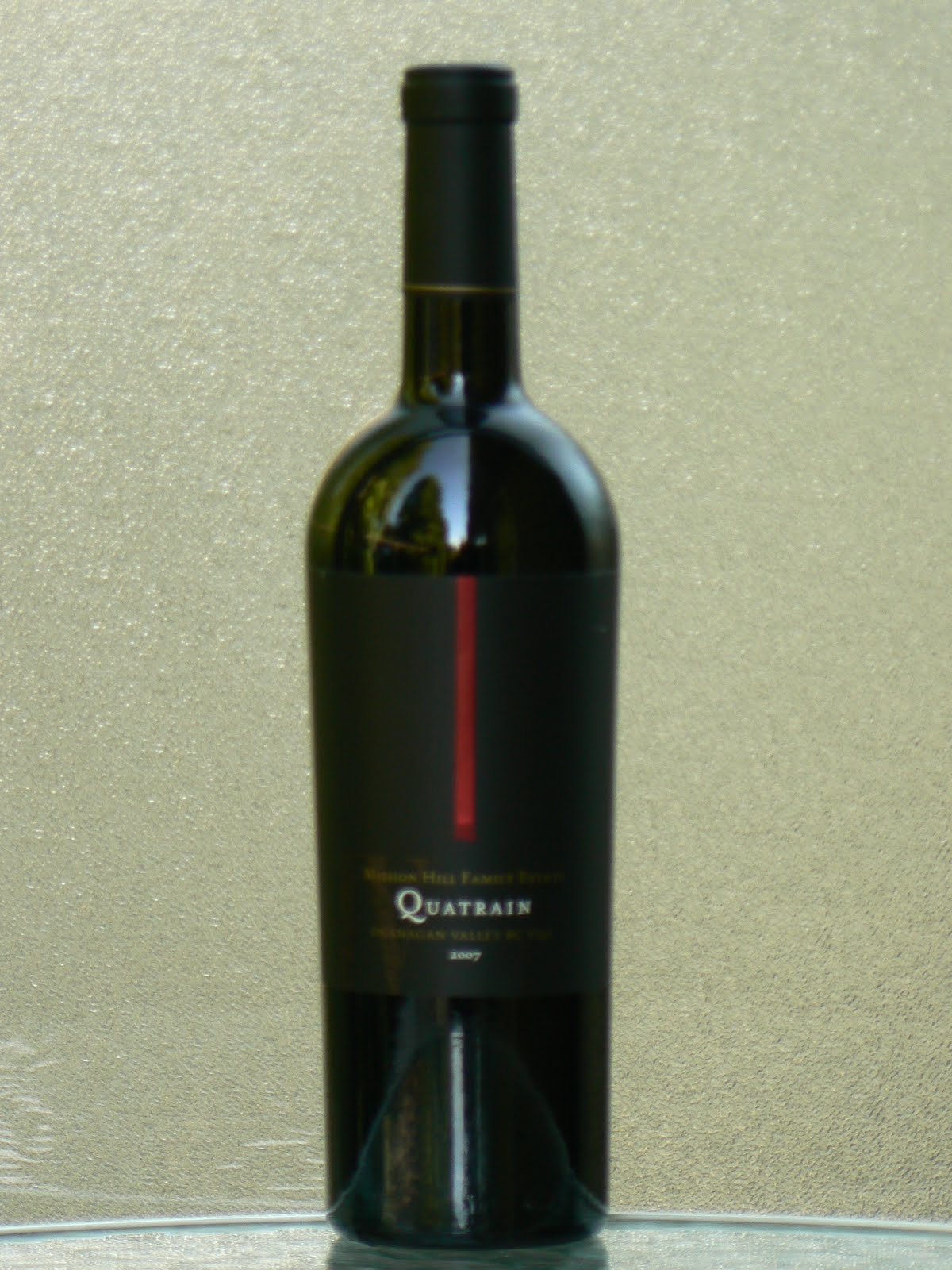
Mission Hill Quatrain 2008 ($45). This wine is either sold out or not released yet because it is not on the winery website. This is a blend of 34% Merlot, 29% Syrah, 22% Cabernet Franc and 15% Cabernet Sauvignon. The two Cabernets in this interesting blend seem to give the wine aromas of mint and cassis while the other two give the blend a lovely core of fruit – plum, black cherry, black currant. There is also a note of mocha. The wine still has a firm structure.


LaStella Fortissimo 2009 ($35). This is 67% Merlot, 24% Cabernet Sauvignon, 12% Cabernet Franc and 8% Sangiovese. This wine has appealing aromas of black fruit and vanilla and these carry through on the flavours. The wine is still firm and a long way from peaking – but it will with patient cellaring.


Herder Josephine 2008 ($50 with a production of 3,180 bottles). This is a blend of 81% Merlot, 15% Cabernet Sauvignon and 6% Cabernet Franc. Stated alcohol is 14.8%, again not an issue, given the fullness of the fruit and texture. The wine begins with dramatic aromas of spicy blackberries and blueberries. On the palate, there are flavours of blackberry and black currant, with the cedar notes often found in a Bordeaux-style red that has been aged in good oak.


Clos du Soleil Eclipse 2009 ($Not released yet). The winery made just four barrels, about 100 cases, of this blend of 50% Merlot, 25% each of Cabernet Sauvignon and Cabernet Franc. The wine is quite Bordeaux in style, with concentrated textures, aromas of spice and mint and flavours of currant and blackberry.

Osoyoos Larose Le Grand Vin 2008 ($100 for the magnum). This is a blend of 60% Merlot, 25% Cabernet Sauvignon, 7% Cabernet Franc, 5% Malbec and 3% Petit Verdot. Don’t be alarmed that this wine was at the end of the ratings. The wine is too young to reveal its potential, especially when served from a magnum. But this magnum will be spectacular in 2020. I thought it already better than this last place finish suggested, with a powerful aroma of dark fruit and plum jam. On the palate, there are notes of currants, dark chocolate, pepper and minerals. The texture is nicely concentrated.

As it happens, Laughing Stock has just released the 2009 vintage, suggesting the 2008 could be hard to find. The wine was not in the Sip tasting but here are my notes on it.

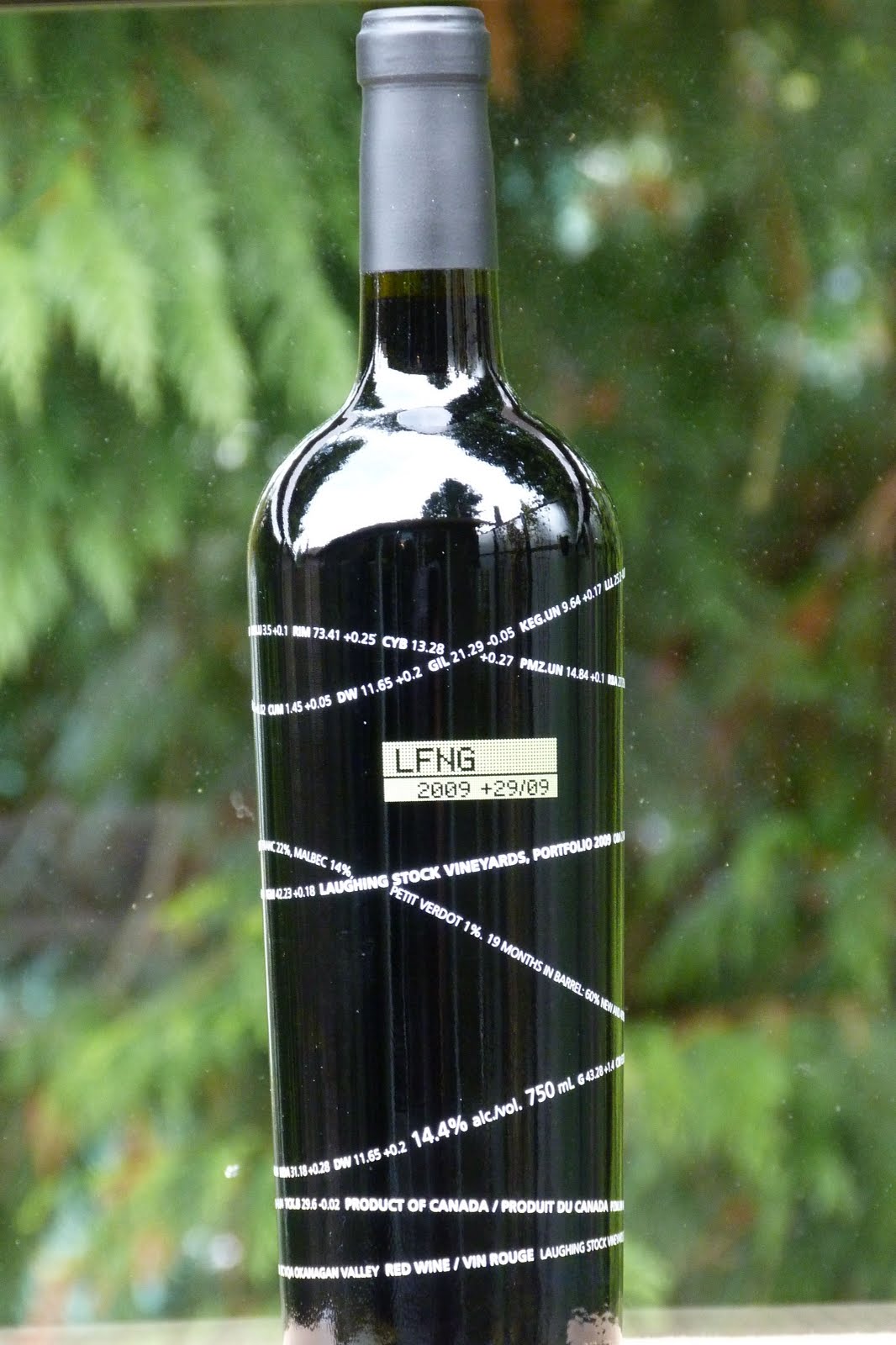
Laughing Stock Portfolio 2009 ($42 for a production of 1,990 cases). This is 36% Merlot, 27% Cabernet Sauvignon, 22% Cabernet Franc, 14% Malbec and 1% Petit Verdot, with an alcohol of 14.4%. In the style one has come to expect of Portfolio, this is a big ripe wine with aromas of red fruit, mocha and the oak that comes from its 19 months of barrel aging. Generous in texture, it has layers of flavour – plum, black currant, black liquorice – with ripe but firm tannins. This wine will cellar well. 92.

Saturday, November 26, 2011

Black Hills founders launch Terravista


Figaro is available at Marquis Wine Cellars in Vancouver

The couple that brought you the Black Hills winery and Nota Bene are back in the wine business.

Senka and Bob Tennant have just released the first wine, a white called Figaro, from Terravista Vineyards, their new winery high on the Naramata Bench.

The Tennants, along with Susan and Peter McCarrell, opened Black Hills in 2001 and sold it in 2007 when the McCarrells retired.

After taking a few years off, the Tennants returned to wine growing in 2009 when they began to plant a 1.6-hectare (four-acre) and to develop a winery with an unusual focus for the Okanagan. Terravista Vineyards has only Albariño and Verdejo, two Spanish white varieties never grown before in the Okanagan – and probably not in Canada. The couple travelled in Spain during the 2008 vintage there, picking the brains of growers and winemakers.

They also buy white Rhône varieties and are launching the winery with two blended whites.

“If you are doing this again, you might as well go for it,” Senka says of the decision to plant the Spanish varieties. “I felt we couldn’t plant Merlot clone 181.” She is referring to the most widely planted varietal in the Okanagan. “That would have been rather redundant.”

It was not easy to get even the small quantities of vines they needed. The University of California had just released disease-free stock; nurseries were scrambling to build up stocks of vines to meet the strong demand for these somewhat exotic varieties. The Tennants received just enough vines in 2009 to plant a quarter of the vineyard and some of those vines were killed in a freeze that fall. It was not until 2011, with their new winery under construction, that they got enough vines to finish planting Terravista.

 
Posted by Picasa


Photo: Senka and Bob Tennant

The 600-square-metre (2,000 square-foot) winery, set into a hillside and partly below ground, is designed exclusively for producing only small volumes of white wine, with production capped at less than 2,000 cases a year.

“It was nice getting back to the grassroots,” Senka says. “Black Hills got so big. This is great because Bob and I do everything ourselves.”

The winery and vineyard are uphill from the Kettle Valley Trail and offer dramatic views of the Naramata Bench. However, there is no wine shop, nor are there plans to open one. The fans of Senka Tennant’s winemaking will just have to pick up the telephone (778-476-6011) and order.

“Our intent is to sell our wine through our agents to restaurants and stores, and to people who are interested in ordering from us,” Bob says.

The first release is 220 cases of Figaro 2010 ($24 a bottle), made with grapes purchased from neighbouring vineyards and also from a grower in Osoyoos. This is blend of Roussanne, Viognier and Marsanne.

The white blend from their Spanish varietals, due for release next year, will be called Fandango.

Both wines are made in a crisp, dry style, suiting the varieties and also suiting the palates of the owners.

“You may as well make what you like,” Bob reasons. “Can you imagine making a wine and saying it is not really what I like but the public likes it?”

Here is a tasting note on Figaro 2010. The wine begins with appealing aromas of melons, apples and apricots. It delivers a complex array of flavours - apples, citrus, honeydew and apricot - with a fine spine of minerality and with satisfying weight on the palate. The finish is crisp and dry. 90.

Friday, November 25, 2011

Intersection Winery releases its first wines

 
Posted by Picasa


Photo: Bruce Schmidt

Vancouver businessman and angel investor Bruce Schmidt has just opened the Okanagan’s newest winery, Intersection Wines, by hand-selling its two first releases to restaurants and wine enthusiasts.

Bruce is hardly a stranger to the British Columbia wine industry. He was the national marketing manager at Calona Wines in the early 1980s when Schloss Laderheim became the best-selling domestic white wine in Canada.

In the early 1990s, he ran a company that helped raise financing for the start of Blue Mountain Vineyards & Cellars. He remained a Blue Mountain shareholder for 18 years and regards that winery as an example of how to do things correctly in the wine business.

In his non-wine life, he has run start-up life sciences companies. He is currently chief executive of Carrus Capital and plans to continue in that business as well as run the winery. “I have way too much fun in science to give it up at this point,” he says. “Also, the winery can tolerate that now. We don’t have such a large production now.” Intersection opened with about 1,000 cases of wine and is targeting 2,500 cases when its vineyard is in full production.

Bruce, who has a silent partner in the winery, began looking for Okanagan vineyard property in 2002, buying a former orchard, with a packing house, at the intersection of Highway 97 and Road 8 in 2007. The location inspired the winery’s name, along with the bright X on the labels and the website, which is www.xwine.ca (still under development).

The property now has 20,000 closely-packed vines on four hectares (10 acres). Half of the vines are red varieties (Merlot, Cabernet Franc) and the other half are whites (Sauvignon Blanc, Viognier, Marsanne, Riesling).

The wines are made by Summerland wine consultant Philip Soo. The wines released so far are good and quite fairly priced for their quality.

“At this point the wines are only available directly from the winery,” Bruce says. “As I am back and forth from Vancouver on a regular basis, I can easily arrange to get people some wine. Once we have a bit more inventory, we will certainly seek some private store listings.” The current telephone number for ordering wine is 604.760.0160.

Here are notes on the wines.

Intersection 2010 Mile’s Edge White ($20). This is a blend of Sauvignon Blanc and Viognier (the blends may change from vintage to vintage). Fermented in stainless steel, the wine begins with appealing floral and fruity aromas (apricots, pineapples). On the palate, there are flavours of green apple, melon and citrus, with the defining mineral spine that Viognier brings to the party. The finish is crisp and refreshing. 90.

Intersection 2009 Unfiltered Merlot ($25). Bruce believes that his vineyard delivers quite unique terroir notes in the Merlot. This elegant wine’s appeal begins with its lovely dark hue and its smoky aroma, mingled with aromas of blueberry, black currant and black cherry. These are echoed on the palate, which is bold and concentrated. This wine deserves to be cellared for a few more years to reach its full potential. 90-92.

Thursday, November 24, 2011

Cassini Cellars - current releases


Photo: Adrian Cassini


Since opening in 2009, Cassini Cellars has been releasing solid and interesting wines.

There is, it seems to me, a house style. The white wines deliver lovely and focused fruit flavours while the reds are generous in flavour and texture. In short, satisfying wines.

The winery was established on a vineyard south of Oliver by Adrian Cassini, an immigrant from Romania with a healthy streak of entrepreneurship and a love of wines.

As a winemaker, he retained Philip Soo, the Summerland-based consultant with a stable of good wineries in his professional portfolio (Noble Ridge, Dirty Laundry, Gold Hill, to name just a few). It is difficult to understand how he juggles his clients but the fact is that all are making good wine.

The reviews that follow are from wines that Cassini released this year. Alas, by the time I got around to reviewing them all, some were sold out at the winery. But it is probable that even those wines might still be on the shelf in a private wine store or two; or on a restaurant list.

Here are my notes.


Cassini Chardonnay 2010 ($19 for a production of 400 cases). This wine, I am informed, sold out quickly. This is a textbook unoaked Chardonnay. I know that I have disparaged unoaked Chardonnay occasionally as cocktail wines … but this is a very good wine. It begins with aromas of pear, citrus apples and pineapple, all of which are duplicated on the palate. The finish is crisp and fresh. 90.


Cassini Chardonnay Reserve 2009 ($29). This is the wine for those who love Chardonnays that have had the full treatment. I might have liked a hair less oak but my neighbour, with whom I shared the bottle, raved about it. Gold in colour, the wine has aromas and flavours of coconut, butterscotch, vanilla, tangerine and ripe pear. The wine is rich on the palate and has a long finish. 88.


Cassini Sauvignon Blanc 2010 ($19 for a production of 181 cases). Think of Graves, not New Zealand. The wine has aromas of pear, herbs and citrus that carry through to the palate. The finish is crisp and dry, with mineral notes. 88.


Cassini Mama Mia Pinot Gris 2010 ($19 for a production of 620 cases). It is good that production is substantial because this is a crowd-pleaser with just over 15 grams of residual sugar but a fairly moderate acidity. As a result, the wine is juicy with flavours of pears and ripe apples and a lingering sweetness on the finish. 88.


Cassini Viognier 2010 ($19 for a production of 425 cases). With an alcohol of 12.6%, this is probably the lightest wine from Cassini in the vintage. It has pleasant fruit aromas and flavours of apricot, pineapple, pear and lemon. The wine is crisp and tangy with skein of minerality. 88.


Cassini Nobilus 2008 Merlot Collector’s Series ($39 for a production of 290 cases). This big red (14.9% alcohol) announces itself with a dramatic aroma of black currants, lingonberry, black cherry and raspberry jam. The richly textured palate presents flavours of blackberry, dark chocolate, figs, spice and cedar. A generous and satisfying Merlot, it has the structure and concentration to justify cellaring it a few more years. 91.


Cassini Red Carpet Pinot Noir 2010 ($20 for a production of 1,049 cases). This easy-drinking wine has to be one of the best value Pinot Noirs in the Okanagan. It is made from grapes grown near Osoyoos, which is generally not regarded as ground zero for Pinot Noir. Yet the grapes were obviously well grown. This is a nice ripe, medium-bodied wine with 14% alcohol (which is unobtrusive). It has aromas and flavours of cherries and spice cake, with a hint of chocolate. 90.


Cassini Pinot Noir Reserve 2009 ($29 for a production of 115 cases). In his notes on the wine, Adrian Cassini pays credit to the grower, a friend called Lino Barbbieri, who grows low-tonnage Pinot Noir in a small vineyard north of Oliver. “Rich soil, perfect sun exposure, cool nights and the meticulous Lino makes the perfect formula for the moodiest grape on Earth,” Adrian writes. The result is a very good Pinot Noir with vibrant flavours of raspberry and cherry and a bright, silky palate. 90-91.


Cassini Maximus 2009 Collector’s Series ($34). Another big ripe 14.9%-alcohol wine, this is a blend of 48% Cabernet Sauvignon, 39% Merlot, 12% Cabernet Franc and 1% Malbec. This begins with aromas of currants and blackberry. It has complex layers of flavour – black currants, plum, spice, sage – with long ripe tannins and a concentrated texture. I would not hesitate to lay this down at least until 2015. 90-92.


Cassini Syrah Collector’s Series 2009 ($34). A robust Syrah in the Cassini style, the wine has meaty and dark fruit aromas with flavours of black cherry, plum, fig, liquorice and pepper and an almost earthy finish. 90.

Cassini Malbec 2009 Collector’s Series ($29 for a production of 85 cases). Full-bodied, even chewy in texture, this is a wine with aromas and flavours of blackberry, cherry, peppery spice and vanilla. 90.


Cassini Cabernet Franc 2009 Collector’s Series ($NA). This is a big rustic wine that needed plenty of time to open its aromas and its spicy, herbal flavours. 88.

Tom DiBello becomes a Canadian

 
Posted by Picasa


Photo: Tom DiBello

Now it is confirmed: winemaker Tom DiBello is a keeper.

Early in November, Tom and Tari, his wife, became Canadian citizens, erasing any concern that Tom would eventually resume his winemaking career in the United States where he grew up.

Tom is still close enough to his citizenship exam to delight in stumping native Canadians with some of the questions.

Example: Who was Louis-Hippolyte Lafontaine? Answer: in 1842, he was the first Canadian to become prime minister of the United Province of Canada and the first head of a responsible government in Canada.

I had to admit to Tom that I didn’t know that.

As if to celebrate becoming a citizen, his DiBello Wines has just released two more wines. This spring, he released the first wine on his own label, 87 cases of $33 Viognier. It has now flowered wonderfully in the bottle to become a luscious white with layers of tropical flavours.

It has now been joined with a Chardonnay and a Merlot; and a Syrah will be along as soon as it has had a bit more bottle age.

Tom was born in 1957 in New York, Tom grew up in California’s Newport Beach, acquiring a lifelong love of surfing. After vacillating between medicine and business, he qualified as a winemaker at the University of California. His first job in 1983 was at Napa’s respected Stag’s Leap Wine Cellars, where he became director of cellar operations.

“Warren Winiarski is a tough taskmaster,” DiBello said of the owner of Stag’s Leap. “He’s a demanding perfectionist.” Some of that may have rubbed off on Tom, even though he hides it behind a laid-back personality.

He left Stag’s Leap for Australia in 1987 where he had the pick among several choice winemaker jobs. He went to Cape Mentelle, a highly-regarded producer at Margaret River in Western Australia. “It’s right on the beach,” DiBello explained the choice. “Margaret River has one of the best surfing beaches in the world and that’s what I looked on from my house there.”

He came back to California a year later (for economic and romantic reasons) and spent two years as a wine salesman. In 1989 he joined a small new winery at Temecula in southern California, Clos de Muriel, which won medals for its wines but was under-financed and closed after the 1992 vintage.

He went from there to do a vintage in Virginia and then spent four years with a winery in Arizona. In 1996 he joined Claar Cellars, a new Washington State winery. He made two vintages there and another two at a winery called Washington Hills before being recruited by CedarCreek. He came to the Okanagan in the summer of 2000 and stayed at CedarCreek for a decade before leaving to consult.

He is currently associated publicly with Alto Wine Group in Okanagan Falls and with Perseus Winery in Penticton. He also has a list of clients with lower profiles.

And he has his own label, DiBello Wines. (Actually, the labels are designed by Tari, a good artist.) Here, he produces small lots of interesting wines for sale to key restaurant clients and wine enthusiasts. The DiBello website also lists a wine store in Vancouver and another in the Okanagan that carry the wines.

Here are my notes on the current releases.

DiBello Chardonnay 2010 ($27.90 for a production of 110 cases). This is lovely crisp Chardonnay. The subtle use of oak supports but does not mask the fresh, tangy flavours of citrus and peach. There is a touch of butteriness, just enough to flesh out the palate. 90.

DiBello Merlot 2010 ($29.90 for a production of 110 cases). The grapes for this wine come from an Osoyoos vineyard from which Tom has secured Merlot since 2000. He believes it is a special site and the flavours of the wine confirm that. It has a lovely aroma and flavour of black currants, with long ripe tannins but also with that fine backbone that gives Okanagan Merlot the structure to age. This is an elegant wine. 91.

DiBello Syrah 2010 ($29.90 for a production of 140 cases). Not yet released but very promising, this robust wine is also made with Osoyoos grapes. It has a touch of pepper on the aroma and on the palate, along with flavours of dark fruits and black chocolate. 90-92.